STORY
My Husband Boarded a Plane—Then Our Son Exposed His Plan

“We already opened it,” Detective Ruiz said.
I sat on the edge of a chair in the hotel lobby, one arm around Ben while the detective spoke through my phone. Around us, people rolled suitcases toward the elevators and a television murmured over the breakfast counter. Ordinary life kept moving five feet away from the moment mine split in two.
Ruiz read from the first page.
It was an insurance schedule.
Two policies.
One on me.
One on Ben.
For a second, the words did not mean anything. They were just sounds. Then the numbers followed, and my stomach turned.
The policies had been increased less than four months earlier.
Graham had handled our finances for years. He paid the premiums, renewed the car insurance, dealt with tax forms, and told me I worried too much about paperwork. Whenever I asked to sit down and go through everything together, he would kiss my temple and say, “I’ve got it.”
Now I understood what “I’ve got it” could hide.
“There’s more,” Ruiz said.
Paper shifted on his end.
“There’s a typed timeline for today. It lists your expected return from the airport. Eleven forty-five to noon. There’s also a furnace service note and a beneficiary form.”
I looked at Ben.
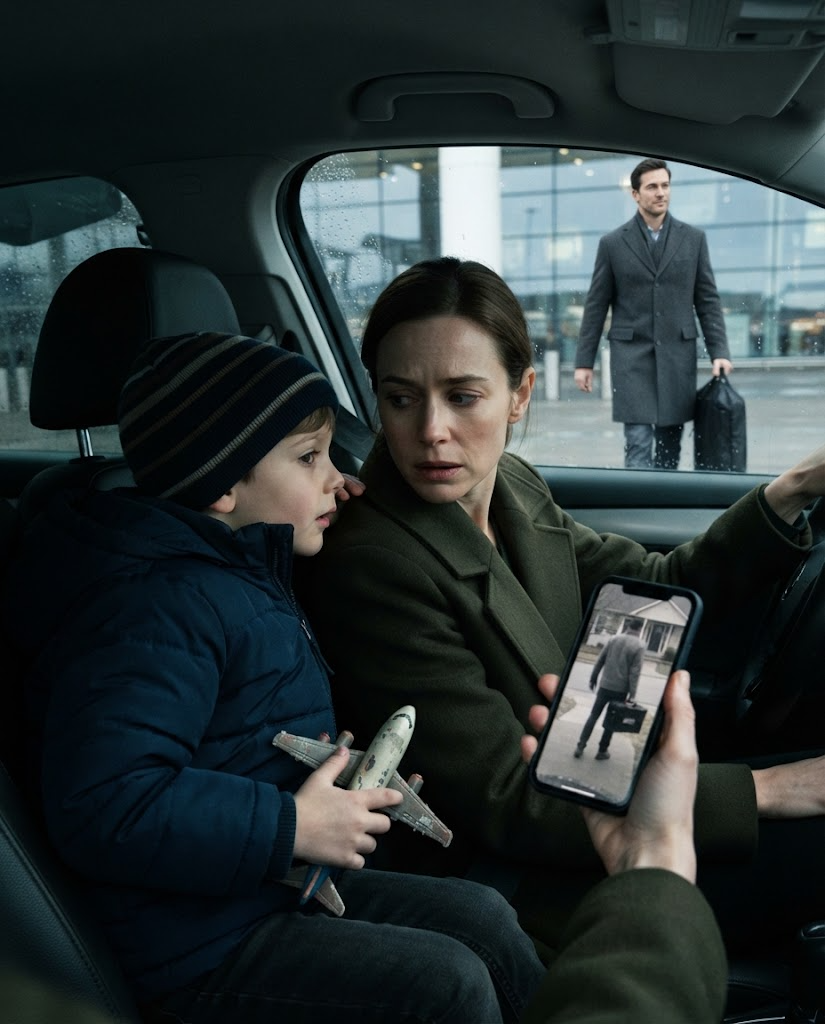
He was sitting beside me with his plastic airplane in his lap, staring at the carpet.
“What beneficiary form?”
“Your husband is listed as sole beneficiary on both policies.”
My mouth went dry.
Ruiz continued carefully. Nolan Price had claimed he was inside the house to perform a repair Graham asked him to handle while we were gone. But officers had found two safety detectors disabled. Nolan’s tools were beside the utility room. Nothing about the scene looked like a normal service call.
The detective did not speculate beyond that.
He did not have to.
I already knew the sentence Ben had heard.
They’ll be back by noon. Then it’s easy.
Once they’re out of the picture, everything we planned will move forward.
My phone vibrated in my hand.
Graham: Whatever they found, you’re misunderstanding it.
I stared at the message.
He was supposed to be in the air.
I read it aloud to Ruiz.
There was silence on the line, then the rapid sound of a keyboard.
“Stay where you are,” he said.
A minute later, he came back.
“Mrs. Carter, your husband’s flight departed without him. Airport staff confirmed he boarded, then got off before the gate closed.”
I felt something colder than fear move through me.
The polished goodbye at Departures.
The garment bag.
The public wave.
He had wanted to be seen boarding.
But he had never intended to leave.
The hotel elevator chimed.
“Sarah.”
My entire body locked.
I knew that voice before I turned around.
Graham stood ten feet away.
He was still wearing the charcoal coat he had worn at the airport. The garment bag hung from one hand. His face was composed, almost gentle, but his eyes moved too quickly—first to me, then to Ben, then to the phone pressed against my ear.
His smile vanished.
“How did you find us?” I asked.
He took one step forward.
Ben climbed off the chair and pressed himself against my side.
Graham noticed.
His expression tightened.
“Why are you scaring him?” he said.
The question was so perfectly Graham that for half a second I almost fell back into the old rhythm. He would do something sharp, then speak softly enough to make me defend my reaction instead of examining his action.
I did not answer.
Ruiz was still on the phone.
I lowered it just enough to say, “He’s here.”
“Do not leave the lobby,” Ruiz said immediately. “We’re sending officers to you now.”
Graham heard him.
His face changed.
Not much.
Just enough.
“Who is that?”
I looked at the man I had shared a bed with for eleven years.
“The police.”
A family waiting near the front desk went quiet.
The clerk behind the counter lifted her head.
Graham forced a laugh.
“Sarah, this is ridiculous. Ben heard half a conversation and you turned it into some criminal fantasy.”
He moved closer.
I moved Ben behind me.
“Stop there.”
His eyes flashed.
Then the softness returned.
“Come on. We’re going home.”
“No.”
The word landed harder than I expected.
Graham glanced toward the hotel doors, then back at me.
“You are making this much worse than it needs to be.”
That sentence did something inside me.
Not because it was a threat.
Because I had read nearly the same words in his text ten minutes earlier.
Do not make this difficult.
I lifted the phone.
“Say that again.”
His gaze dropped to the screen.
He realized Ruiz was listening.
“Sarah,” he said, quieter now, “Nolan was doing me a favor. There was a problem with the furnace. That’s it.”
I said nothing.
He kept talking.
People who believe they are smarter than everyone else hate silence. They rush to fill it.
“I was trying to handle it before you got back.”
My heart beat once, hard.
Before you got back.
Ruiz heard it too.
“What problem?” I asked.
Graham’s jaw flexed.
“The furnace.”
“What problem with the furnace?”
“I don’t know. That’s why Nolan was there.”
“Then why were the detectors disabled?”
His eyes snapped to mine.
That was the first moment I saw real panic.
He had not known the police had found them.
Behind the front desk, the clerk quietly picked up a phone.
Graham noticed that too.
He lowered his voice.
“Give me your phone.”
“No.”
“Sarah.”
“No.”
He reached toward me.
The hotel’s security guard stepped between us.
“Sir, don’t.”
Graham stopped instantly.
The charming public face came back on like a light.
“Of course,” he said. “There’s been a misunderstanding.”
The security guard did not move.
Neither did I.
Two police officers entered less than three minutes later.
Graham did not run. He was too controlled for that. He tried to explain. He said his son was confused. He said his wife was frightened. He said Nolan had been hired for a repair. He said the insurance policies were routine financial planning.
Then one of the officers asked why he had gotten off the plane after boarding it.
For the first time, Graham had no immediate answer.
They escorted him out of the lobby.
Ben watched through the glass doors until the patrol car pulled away.
Then he whispered, “Is Dad mad at me?”
I knelt in front of him so fast my knees hit the carpet.
“No.”
He looked unconvinced.
I took his small face in my hands.
“You told me something scary because you thought I needed to know. That was brave. The grown-ups will handle the rest.”
He nodded, but six-year-olds do not stop loving a parent just because the adults around them discover terrible things.
That became one of the hardest parts.
The police moved us to a different location and asked me not to share it. I turned off location sharing on my phone, changed every password I could remember, and called my sister, Emily.
I had not told her much about my marriage.
That was another thing Graham had been good at. Nothing was bad enough, by itself, to sound alarming. He criticized friends until I saw them less. He managed the accounts because numbers “stressed me out.” He made decisions quickly and called it efficiency. He apologized beautifully when I was angry and then behaved exactly the same way a month later.
When Emily arrived, she hugged me so hard I almost lost my balance.
Then she crouched in front of Ben and asked whether he wanted pancakes.
No questions.
No horror on her face.
Just pancakes.
I loved her for that.
Over the next forty-eight hours, the case stopped looking like a misunderstanding.
It began to look like a plan.
Nolan Price’s phone contained messages with Graham going back weeks. Some were vague, but others were not.
Make sure the house looks normal.
No cameras inside.
They’ll be back before lunch.
I need this finished today.
Police also recovered deleted messages after obtaining the necessary authorization. Those messages referred to the insurance policies, Graham’s travel schedule, and a payment Nolan would receive afterward.
The payment was not from some mysterious criminal account.
It was from our savings.
Money I had helped earn.
Money Graham had moved in small amounts into an account I did not know existed.
Investigators also learned that the furnace service note in the folder had never come from our heating company. The company had no appointment scheduled and had not sent Nolan.
The note was fabricated.
What Nolan had intended to do inside the utility room was explained to me only in broad terms, and that was enough. He had been preparing a dangerous condition that could later be blamed on equipment failure. The disabled detectors were part of it.
If Ben had not overheard the call, we would have driven home around noon.
Exactly when the typed timeline expected us.
Nolan lasted one night before he asked for a lawyer and began cooperating.
Graham lasted longer.
He denied everything.
He said Nolan had misunderstood instructions.
He said the folder was private estate planning.
He said the insurance increases were prudent because Ben was getting older.
He said his decision to leave the flight was caused by sudden stomach pain.
He said his text—Do not make this difficult—referred to my refusal to answer his calls.
Every explanation sounded possible when isolated.
Together, they collapsed.
The side-gate camera became more important than I ever expected.
It showed Nolan arriving with Graham’s spare key.
It showed his vehicle parked out of sight behind the garage.
It showed him leaving the house briefly to take a phone call less than a minute after Graham called me asking how far we were from home.
Phone records placed Graham’s call to Nolan in that same window.
Mrs. Alvarez gave a statement confirming what she had seen from her upstairs window.
Airport records showed Graham boarding his flight and then leaving the aircraft before departure.
The hotel cameras showed him arriving less than an hour later.
And my phone contained his messages.
Why aren’t you home?
Sarah, answer me.
Do not make this difficult.
What had once looked like ordinary sentences became a timeline of their own.
The prosecutors did not need Ben to carry the case on his shoulders.
That mattered to me more than almost anything.
A child specialist spoke with him once in a controlled setting. After that, the adults worked from the physical evidence, the digital records, the folder, Nolan’s statements, and Graham’s own words.
I did not want my son spending years believing he was responsible for what happened to his father.
Graham was responsible for that.
No one else.
The first time I saw him after the hotel was in a courtroom during a hearing.
He wore a navy suit.
Of course he did.
His hair was neat. His posture was perfect. He looked like a man arriving to give a presentation.
When I entered, his eyes found mine immediately.
For eleven years, that look had been enough to change my behavior. I would sit straighter. Speak softer. Reconsider whatever boundary I had drawn.
This time I sat beside the prosecutor and opened a small notebook.
Graham looked away first.
His attorney argued that the case depended too heavily on interpretation. There had been no completed harm. Sarah Carter had not returned to the house. Nolan had not finished whatever work he was doing. A frightened child had overheard ambiguous language.
Then the prosecutor placed a printed copy of a recovered message on the table.
It was from Graham to Nolan.
She did not dramatize it.
She simply read it.
They need to come back like normal. I’ll call when she’s close.
The courtroom went silent.
I heard Graham inhale.
The prosecutor read another.
After today, the policies solve everything.
That was the first time the truth was spoken publicly in a room where Graham could not edit it.
He turned toward Nolan, who sat with his own attorney across the aisle.
Nolan stared at the floor.
The judge ordered Graham to remain in custody pending further proceedings.
Outside the courtroom, a reporter tried to ask me how I felt.
I said nothing.
The story was not about winning a dramatic exchange on courthouse steps.
It was about getting Ben home safely.
Except we did not go back to our old house.
Not at first.
Police finished processing it, and I returned only once with Emily to collect clothes, school things, family photographs, and Ben’s blue blanket.
The house looked exactly the same.
That was the strangest part.
The cereal bowl from breakfast still sat in the sink.
Graham’s coffee mug was beside it.
Ben’s robot was on the kitchen cabinet where he had gone to retrieve it that morning.
I stood there staring at that little plastic robot and realized how narrow the distance had been between an ordinary day and catastrophe.
Ben had wanted a toy.
He had walked down the hall.
He had heard a voice.
He had listened.
At six years old, he had noticed what I had spent years explaining away.
Months passed.
Nolan eventually accepted a plea agreement and testified about the plan. He admitted Graham had recruited him, promised him money, and assured him the scene would look accidental. Nolan tried to minimize his own role, but the physical evidence made that difficult.
Graham chose to go to trial.
His defense attacked Nolan’s credibility and argued that messages had been taken out of context.
Then the prosecution played the timeline.
Airport footage.
The security video.
Phone records.
The false service note.
The insurance documents.
The messages.
Mrs. Alvarez’s testimony.
The location data showing Graham leaving the airport and traveling toward the hotel after realizing I had not gone home.
Finally, they introduced the folder found on his desk.
On the last page was a handwritten checklist.
Most of it was mundane enough to sound almost harmless.
Flight.
Call N.
Confirm return.
Policies.
But one line had been crossed out so heavily it was almost unreadable.
Investigators recovered the indentation from the paper beneath it.
Make sure Ben is with her.
When the prosecutor displayed those words, I did not look at Graham.
I looked at my hands.
They were steady.
The jury returned guilty verdicts on the most serious charges after deliberating for less than a day.
The sentencing came later.
I did not ask for revenge.
I read a short statement about trust.
I said the cruelest part was not that Graham had hidden a plan from me. It was that he had built it inside our ordinary life. He used school schedules, airport routines, household repairs, and the financial responsibilities of marriage as camouflage.
Then I spoke about Ben.
“He is six,” I said. “He should never have had to understand that a parent’s words could mean danger. He should never have believed that telling me the truth might destroy his family. The person who created that danger is responsible for what followed.”
Graham stared straight ahead.
For once, he had no line prepared.
The court imposed a long prison sentence.
Nolan received a lesser sentence under his agreement, though not freedom.
The insurance policies were canceled. The hidden account was identified during the financial investigation. Through my attorney, I separated every remaining legal and financial tie I could.
But paperwork was the easy part.
The harder part was rebuilding Ben’s idea of safety.
For months, he asked me whether doors were locked.
He asked whether the furnace was okay.
He asked whether every unfamiliar car outside belonged to a bad person.
I found a child therapist who never forced him to talk about Graham before he was ready.
Some days Ben talked.
Some days he built airports out of blocks.
Some days he said nothing at all.
I learned not to turn every silence into a question.
One afternoon, nearly a year later, he brought home a drawing from school.
It showed two stick figures standing beside a crooked blue house.
Me and him.
Above us, he had drawn an enormous yellow sun.
“Is that our new house?” I asked.
He nodded.
Then he pointed to the front door he had drawn in bright green.
“That door locks,” he said.
I smiled.
“Yes, it does.”
He thought for a moment.
“But we can still open it for people we trust.”
That was the first time I understood what healing might actually look like.
Not forgetting.
Not pretending the bad thing had never happened.
Just learning that a locked door and an open door could both belong to you.
I still have the screenshot from the side camera.
I do not look at it often.
I also kept Ben’s little plastic airplane.
The nose is scratched now. One wing is bent from being dropped so many times. To anyone else, it is a cheap airport toy.
To me, it marks the exact day my son trusted his fear more than the performance of the adult everyone else believed.
And the exact day I finally did the same.
Graham had thought silence made me weak.
He mistook restraint for obedience.
He thought a child would be too young to understand danger, and a wife would be too conditioned to leave the route he had chosen for her.
He was wrong on all three counts.
Ben spoke.
I listened.
And we never went home at noon.

More From This Author