STORY
She Begged Me Not to Cut His Cast—Then I Found His Note
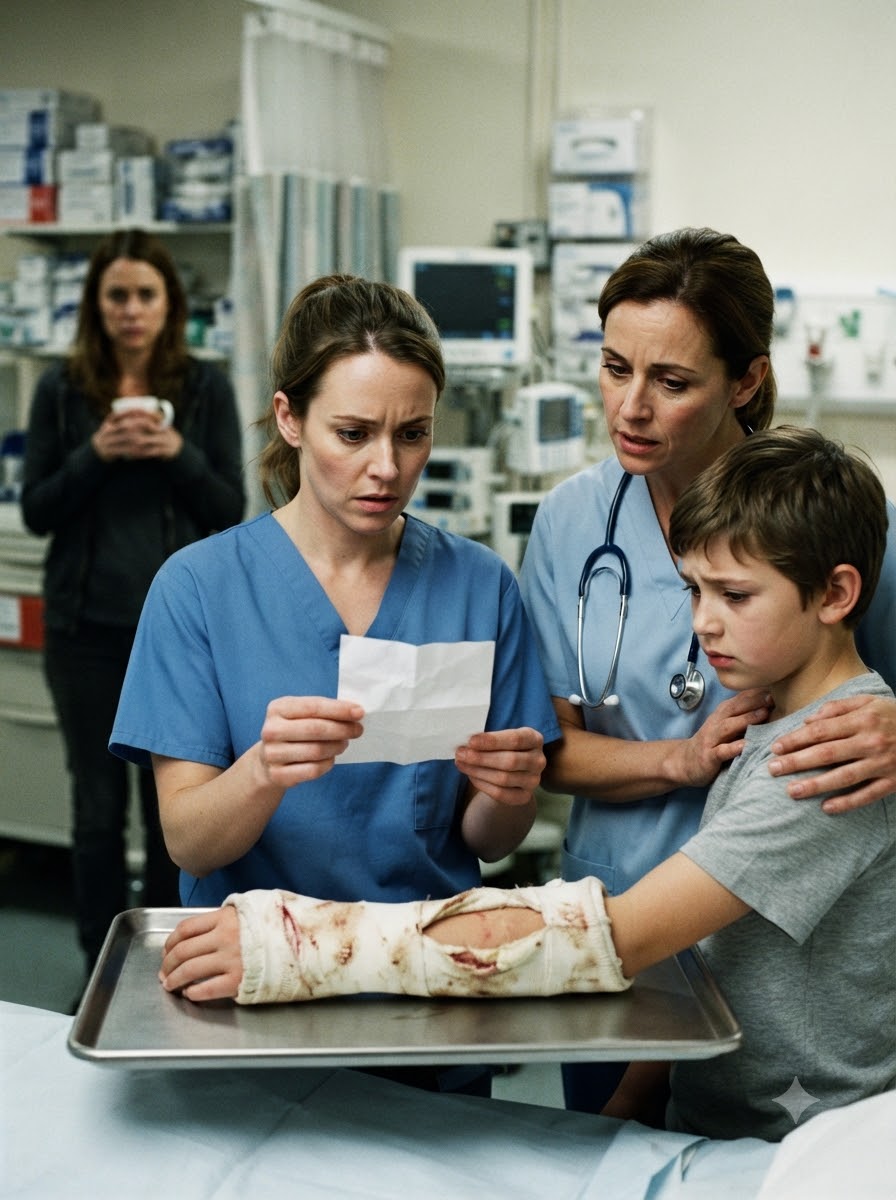
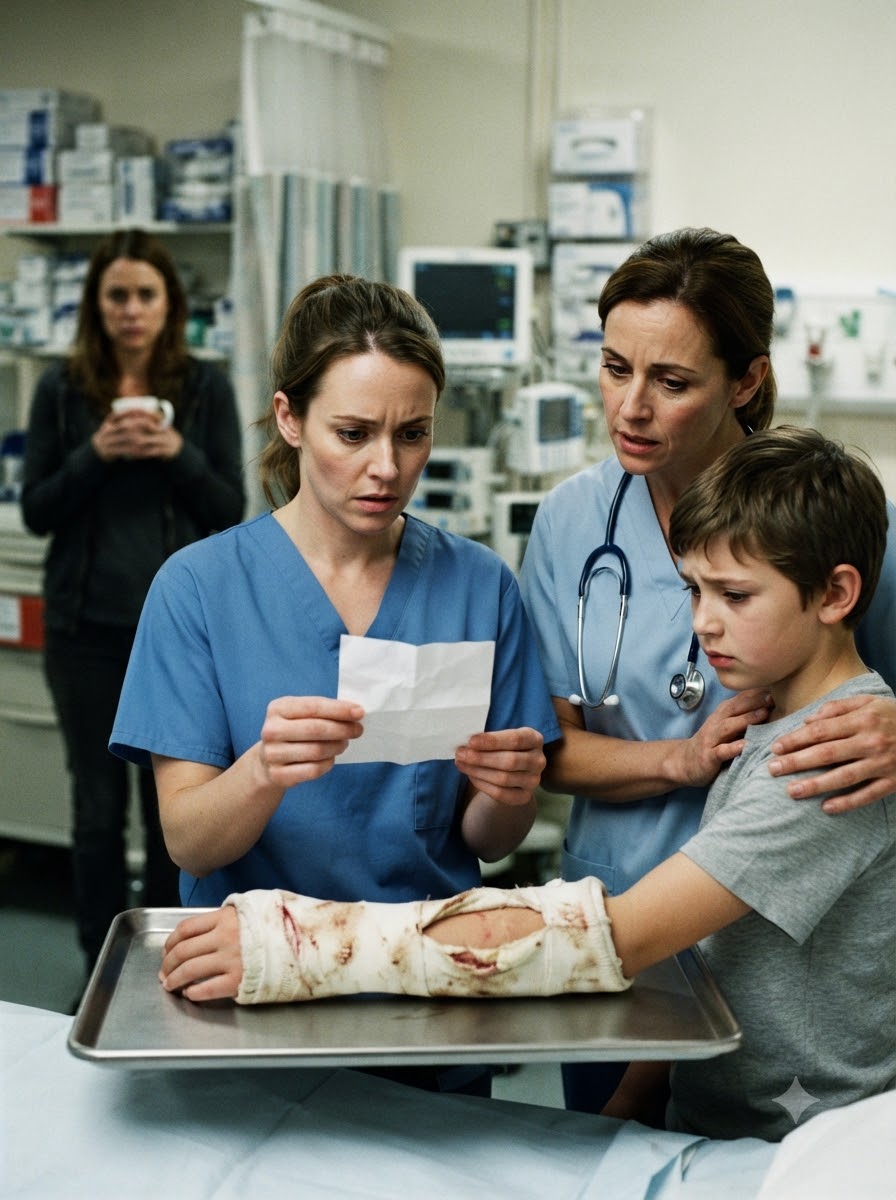
Martha Harris tried to stop me from cutting open her son’s cast. While two nurses worked to raise his blood pressure, she stepped between me and the bed and said she would take him home.
The boy was eight years old. His fingertips were blue.
“You can call a lawyer,” I told her. “You cannot take him out of this room.”
For one second, her composure slipped. Her eyes went to the filthy cast, then to the boy’s face. I thought she was finally frightened for him.
Then she said, “He’s always making a scene when he’s sick.”
The boy did not move. He lay beneath a warmed blanket, staring at a stain on the ceiling as if he had learned that looking at people only made things worse.
His chart identified him as Owen Harris. His mother’s name was Martha. His temperature was over 103, his pulse was racing, and his blood pressure was dangerously low. The cast on his right arm reached from his knuckles past his elbow. Its edges were dark with grime. A sour, rotten smell came from underneath it.
I was an emergency physician at St. Jude’s Medical Center. I had smelled infected wounds before. I had never seen a parent more concerned about a cast being opened than about the child inside it.
Marcus, one of our transport aides, had brought Owen in from the ambulance entrance. He stood near the door now, waiting to help transfer him if we needed imaging. Clara, my nurse, was hanging fluids and antibiotics.
“How long has he had the cast?” I asked Martha.
“A month. His regular doctor wants it on for two more weeks.”
“Which doctor?”
“I can get you the name.”
“Did you see that doctor when his fingers changed color?”
Martha looked at Owen’s hand. “They get cold.”
The fingertips were swollen and dusky. When I pressed one, the color returned far too slowly.
“He may lose circulation to this hand,” I said. “And the infection could kill him. We’re removing the cast.”
“He has a virus. Give him something for the fever.”
I had already asked for an orthopedic surgeon and a critical care bed. I asked Clara for the cast saw.
Martha caught the bed rail. “You don’t have my permission.”
“Owen needs emergency treatment.”
“I said no.”
A security officer appeared in the doorway after Clara quietly pressed the call button. Martha began speaking loudly about lawsuits and consent. Then she saw the saw in Clara’s hand.
All the anger went out of her face.
“Please,” she said. “Don’t open it.”
I looked at her, waiting for an explanation. She gave none.
I moved to Owen’s bedside and told him what I was going to do. A cast saw vibrates rather than spins, but the noise frightens children, especially children who are already hurt.
“It’ll be loud,” I said. “I’ll go slowly. If anything hurts, tell me.”
His lips parted. No sound came out.
Clara held his other hand. I began cutting along the outside of the cast, then the inside. Each pass released more of the smell. The fiberglass was far thicker than it should have been, with uneven ridges that caught the blade.
Martha backed toward the door. Security asked her to stay where she was.
Under the outer layer, I found more fiberglass. Then padding, hardened with old moisture. Near Owen’s wrist, the saw struck something that did not give.
I stopped. The orthopedic surgeon, Dr. Rao, arrived as I eased the split cast apart with spreaders.
A length of rusted chain lay against Owen’s skin. One end disappeared under the upper edge of the cast. A small padlock had been pressed against the inside of his wrist, where it had worn a deep, infected wound.
For a moment, no one spoke.
Then Dr. Rao said, very evenly, “We need a sterile tray.”
Clara brought one. As we lifted away the remaining padding, a tiny plastic bag slid free. It had been folded flat and sealed shut with tape. Inside was a square of paper.
Martha lunged.
Marcus stepped into her path. The security officer caught her arm before she reached the bed.
“That’s mine,” she said.
I placed the bag on the tray. “It was inside his cast.”
“He took it from me.”
“Then you can tell the police what it is.”
Martha’s gaze fixed on Owen. For the first time since his arrival, he looked back at her. The fear on his face was unmistakable.
I opened the bag with gloved hands. The paper inside was covered in cramped block letters, written in dark blue ink.
My name is Owen Vale.
Martha is my aunt.
My mom is alive. She is locked in the blue room.
Please tell her I tried.
I read it twice. So did Clara.
Martha gave a short laugh. “He’s confused. His mother died.”
Owen made a noise then, small enough that I almost missed it.
I leaned close. “What did you say?”
“She didn’t.”
His voice scraped at the words. Then his eyes closed.
I gave the note to Clara to preserve with the bag and told security to call the police. I told Marcus to make sure no one from Martha’s family was brought to Owen’s bedside. Then I turned back to my patient.
The chain could wait. Owen could not.
Dr. Rao and I freed the rest of the cast. The chain had been built into it: a loop at Owen’s wrist, with several links emerging near his upper arm. A long-sleeved shirt could hide the exposed links. The skin beneath was raw and swollen. The padlock had rubbed one spot until the infection reached deep into the tissue.
We took photographs before removing anything further. Owen needed surgery to clean the wound, but first we had to stabilize him.
As Clara started another medication, Martha called across the room, “Ask him where he got that note. He lies when he wants attention.”
I turned to her. “Your nephew is in septic shock.”
She went still.
I had not meant to tell her we believed the note. But I was done calling her his mother.
Two officers arrived within minutes. I heard Martha tell them she had adopted Owen after her sister’s death. She said the note was a story he made up. She said the chain was part of a game and must have slipped into the cast when he broke his arm.
One officer looked through the glass at Owen’s wrist. “A padlock slipped in there too?”
Martha asked for a lawyer.
At noon, Owen was in surgery. By then, the police had begun the first part of their investigation, and hospital social worker Denise Bell had joined us. She found no adoption record in the documents Martha had provided. The emergency contact was a disconnected number. The doctor Martha had named had not treated Owen.
Denise found an older hospital record under Owen Vale. Three years earlier, he had come in for stitches after falling off a bicycle. His mother, Nadia Vale, had signed the consent form. Her address matched the one Martha had given the ambulance crew that morning.
The police sent officers there.

More From This Author