STORY
She Bought Her Mother’s Farm for Seven Dollars—Then Found the Hidden Letters
The night I turned eighteen, my foster father put my clothes in a trash bag and told me my mother had never wanted me.
He said it while standing beneath the kitchen light, one hand on the door and the other holding the silver ring I had inherited from her.
“You’ve got nowhere else to go,” Martin Vale said. “So don’t make this harder than it needs to be.”
I looked at the ring in his palm.
“That belongs to me.”
“It belonged to your mother,” he said. “And she left you behind.”
He tossed it onto the table.
The ring struck the wood and spun in a bright circle before falling flat.
I did not cry. Crying had never changed anyone’s mind in Martin’s house. It only made him impatient.
I picked up the ring, put it on my thumb, and took the trash bag.
My entire life fit inside it.
Three shirts.
Two pairs of jeans.
A paperback with a cracked spine.
A photograph of my mother I had stolen from the back of a filing cabinet.
And a cardboard box the state had given me that afternoon when my placement officially ended.
Martin had told me I should be grateful he had kept me at all.
Then he had locked the door behind me.
I slept that night in the bus station with my backpack under my head and the cardboard box pressed against my chest.
Inside it were the last pieces of my mother.
A birth certificate.
A silver bracelet.
A few legal papers with most of the words blacked out by age and water damage.
And a Polaroid of a young woman standing in front of a white farmhouse beneath an enormous Montana sky.
She had one hand raised against the sun.
She was smiling.
On the back, someone had written four words.
Mama’s place. Brierwood, Montana.
I had no idea what Brierwood was.
I only knew that my mother had been dead for eleven years, and nobody had ever told me she had owned a place.
For the next two years, I chased those four words.
I washed dishes in restaurants where the managers paid me in cash and leftovers. I cleaned motel rooms until my fingers cracked. I slept in shelters, laundromats, and once beneath a church stairwell during a snowstorm.
Whenever I found a library computer, I searched.
Brierwood.
Holloway.
Emiline Holloway.
The results were usually useless.
Old cemetery records. A newspaper mention about a grain fire. A land map that led nowhere.
Then, one afternoon in Billings, with three dollars and forty cents in my pocket, I found a county property archive.
Emiline Holloway.
Eighty acres.
One farmhouse.
One barn.
Delinquent taxes.
County auction.
Minimum bid: five dollars.
I stared at the screen until the letters blurred.
The librarian leaned toward me.
“Are you all right?”
“No,” I said.
Then I touched the photograph tucked beside the keyboard.
“But I think I found where I’m from.”
Brierwood looked like a town that had forgotten how to expect visitors.
There was one main street, a feed store with faded lettering, a diner with six booths, a hardware shop, and a white church whose steeple leaned slightly east.
The county auction was held in a room that smelled of floor polish and wet coats.
Six people sat in folding chairs.
They looked at the property sheet for Emiline Holloway and saw a collapsed roof, unpaid taxes, dead pasture, and an old barn that leaned so far it appeared to be apologizing for its existence.
I saw the farmhouse from the Polaroid.
The clerk read the parcel description in a bored voice.
“Holloway property. Eighty acres. House, barn, outbuildings. As is. Minimum bid, five dollars.”
No one moved.
The clerk looked around.
“Five dollars?”
My hand rose.
“Seven.”
Every face turned toward me.
The man in the front row looked at my coat, my split backpack strap, and my mud-stained boots.
He gave a quiet laugh.
The clerk blinked.
“Seven dollars. Do I hear eight?”
Silence.
The gavel dropped.
“Sold.”
The clerk handed me a receipt, a ring of rusted keys, and a folder.
“You have ninety days to clear the back taxes,” he said. “If you don’t, the county takes the parcel back.”
“How much?”
He glanced at the folder.
“Three thousand eight hundred and twelve dollars.”
I had twelve dollars.
By sunset, I was standing at the edge of eighty acres that felt both foreign and painfully familiar.
The farmhouse was white beneath the dirt, its porch sagging and its windows clouded. The barn leaned into the wind. Tall weeds covered the fields.
I unlocked the front door.
It opened with a long, tired groan.
The house smelled of damp wood, dust, and old paper. The kitchen sink had pulled away from the wall. A bedroom ceiling had collapsed. Mice had nested in the pantry.
But the living room had high windows and a stone fireplace.
And on the hallway wall were photographs.
A man beside a tractor.
A woman holding a baby.
Two children running through grass.
Then I saw her.
My mother.
Not the woman in my memories, which were little more than flashes of perfume and dark hair.
This woman was young. Sunlit. Alive.
I touched the glass covering her face.
“She was here,” I whispered.
For the first time in my life, the word mother did not feel like an accusation.
I slept in an abandoned pickup behind the barn.
Before dawn, I remembered the letter from the state box.
It had been folded beneath my birth certificate, written in a slanted hand I recognized from the back of the Polaroid.
My grandmother’s handwriting.
Most of the letter was damaged. It mentioned waiting, regret, and my mother leaving in tears.
But one sentence was clear.
If you ever come home, look under the barn. Your grandfather’s hiding place is still there. Everything you need to start over is there.
I spent two hours searching.
I moved rotten hay, broken boards, rusted feed cans, and enough mouse droppings to make my stomach turn.
At last, my fingers caught an iron ring buried under straw.
The hatch resisted.
I pulled until my shoulders burned.
The boards lifted.
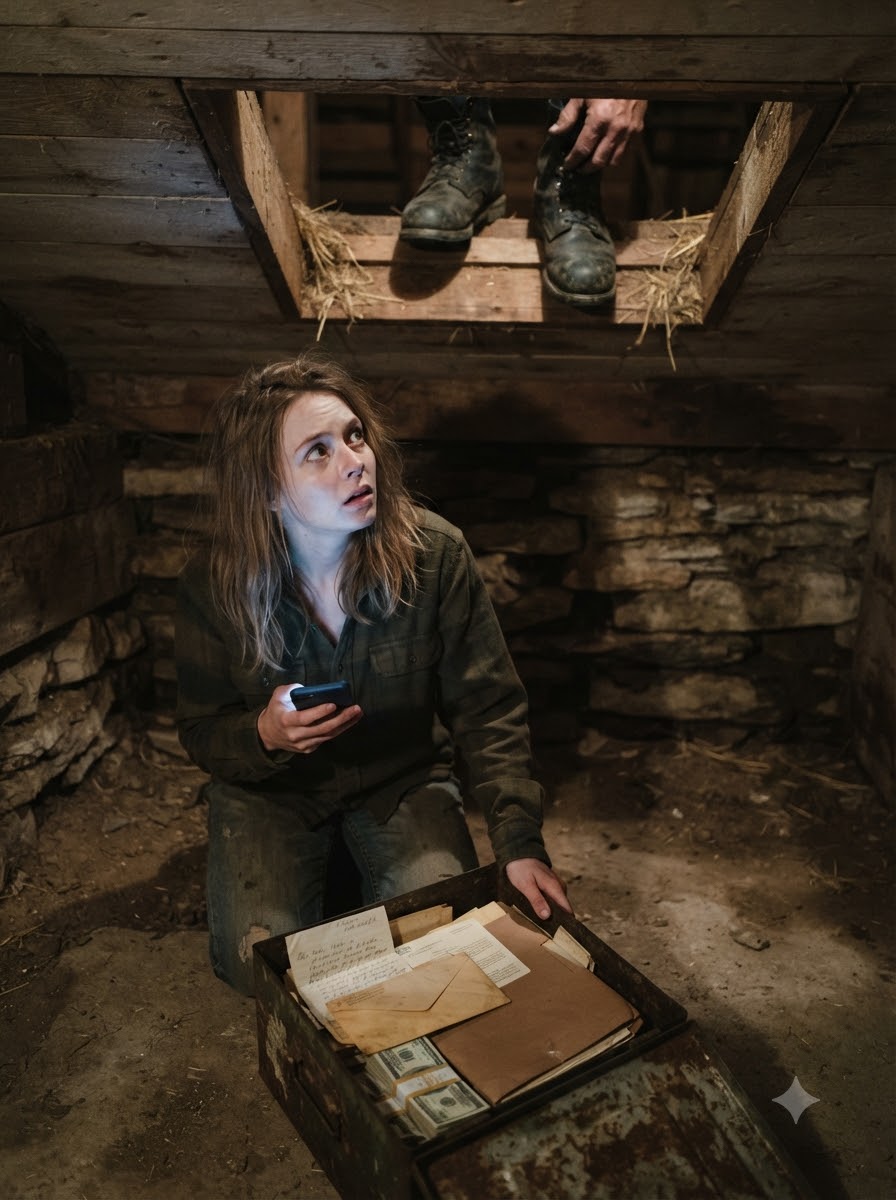
A narrow staircase descended into darkness.
The room beneath the barn was dry and cold. Shelves lined the walls. There were jars of seed, old tools, quilts, lanterns, and a metal box with HOLLOWAY scratched across the lid.
Inside, beneath a wrapped bundle of money, were letters.
Dozens of them.
The first was a birthday card.
Happy fifth birthday, my dearest Ren.
The next was for my sixth birthday.
Then my seventh.
Eighth.
Ninth.
Every year I had believed my mother had forgotten me, someone had written my name.
At the bottom was an envelope sealed with tape.
Across it, my grandmother had written:
Ren, before you trust anyone in Brierwood, read this first. The man who took your mother from this house is still here.
I sat on the basement stairs until my legs went numb.
Then I opened it.
My grandmother, Emiline, had written the letter two months before she died.
She said my mother, Clara, had not abandoned me.

More From This Author