STORY
At Grandma’s Funeral, Her Lawyer Led Me to My Supposedly Dead Mother
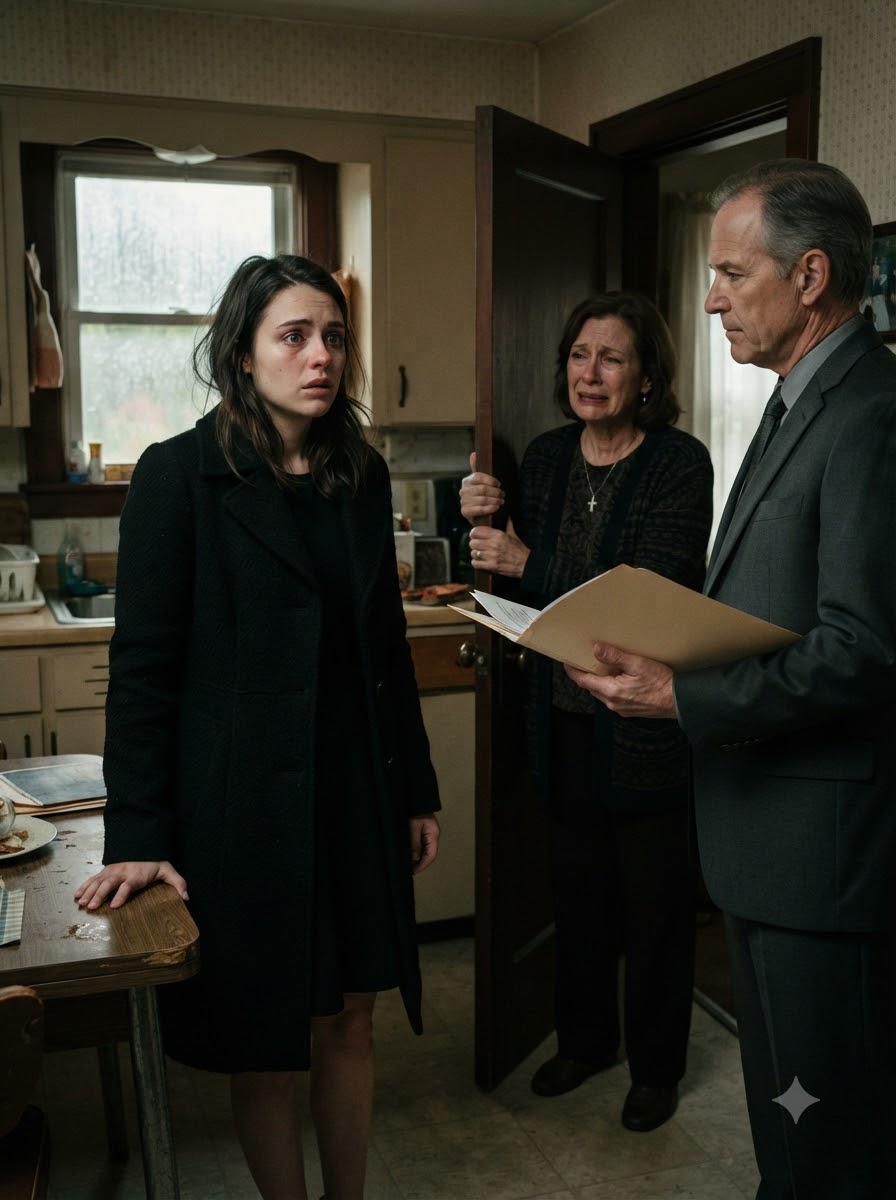
The first betrayal happened beside my grandmother’s grave.
The second was waiting behind a locked door.
Rain moved across the cemetery in thin silver sheets, turning the headstones dark. My grandmother, Evelyn Sullivan, had been lowered into the ground less than ten minutes earlier. The pastor was still speaking about peace when Henry Caldwell, her attorney, came to stand beside me.
He did not look at me.
“Payton,” he murmured, “you need to leave with me.”
I stared at him. “What?”
“Not here. Not in front of your father.”
My father, Daniel, stood several feet away with his arm around Laura’s waist. Laura was his second wife, though she had been in our family so long that most people stopped using the word stepmother. My younger brother, Ethan, stood beside them with his hands shoved into his coat pockets.
Henry’s voice dropped lower.
“Your grandmother did not die naturally.”
The wind pressed cold water against my face.
“What are you saying?”
“I’m saying her death was arranged to look like heart failure. I have evidence. And you must not tell Daniel, Laura, or Ethan that you’ve spoken to me.”
My stomach tightened. “Why would Ethan—?”
“I said not yet.” His eyes finally met mine. “There are things you don’t know about your family. You may be in danger too.”
Then he walked away.
He left me standing beside the grave while my father placed a white rose on the coffin. Daniel looked devastated. His shoulders shook. Laura held his arm and wore the kind of grief that never disturbed her makeup.
When she turned toward me, she smiled.
It was a small, comforting smile.
But her eyes were measuring me.
I had felt something was wrong since the morning my grandmother died.
Evelyn Sullivan had been seventy-eight, sharp-tongued, independent, and impossible to hurry. She had once sent a plumber away because he arrived six minutes early. She kept emergency cash in three different places and wrote down every medication she took, including aspirin.
Yet in the weeks before her death, she had become frightened.
She stopped answering the door without checking who was outside. She began sleeping with a chair wedged beneath the bedroom knob. When I asked if something was wrong, she kissed my cheek and told me I was imagining things.
A week before she died, we stood in her kitchen while rain tapped the glass over her rosemary plant.
“If anything happens to me,” she said, “don’t let them rush you.”
“Who?”
She had looked toward the hallway.
Then she whispered, “Trust the person who brings you the blue folder.”
I had laughed because I thought she was being cryptic for the sake of it.
Now, the memory sat inside me like a live wire.
After the burial, my father touched my shoulder.
“Come to the house later,” he said. “Henry is going to explain the will. There are some things we need to settle quickly.”
Laura nodded. “It’s better if we handle the estate before lawyers and strangers make everything worse.”
“Strangers?” I asked.
Her expression flickered. “You know what I mean.”
I looked down at the mud on my shoes. “No. I don’t.”
For one second, Laura’s polite face disappeared. What replaced it was hard and impatient.
Then she smiled again.
Henry passed behind me as the mourners began walking toward their cars. Something slipped into my palm. His business card. On the back was an address and a time.
Four-thirty.
I waited until my father’s car disappeared from the cemetery road. Then I drove to the address.
It was a narrow brick townhouse near Lake Union, with all the blinds drawn and a porch light glowing despite the afternoon. Henry’s car sat at the curb. Beside it was an old blue station wagon with plates from Oregon.
When Henry opened the door, he looked past me first.
“Where is your phone?”
“In my pocket.”
“Turn it off.”
“Why?”
“Because if you’re being watched, someone may be tracking it.”
My hands began to shake.
He led me inside and placed my phone in a metal box on a table. The house smelled of tea, dust, and disinfectant. A blanket lay folded on the couch. There were prescription bottles on a side table.
Then a floorboard creaked.
I turned.
A woman stood in the kitchen doorway.
She was thinner than I remembered. Her dark hair was streaked with gray, and one hand gripped the doorframe as if standing required effort. A silver cross hung at her throat.
I knew that cross.
I had seen it in the only photograph my father kept of my mother.
My breath stopped.
“Mom?”
The woman covered her mouth.
Her name was Claire Sullivan.
For twenty-two years, I had believed she was dead.
My father had told us she died in a car accident when I was four. He said the crash happened on a mountain road outside Spokane. Her body had been too badly damaged for an open casket. He had handled the funeral. He had protected us from the details.
I had grown up with a framed photograph of Claire on the mantel. In it, she was laughing beside a lake, wearing the silver cross.
I had asked questions as a child. Daniel always gave the same answer.
“She loved you. She didn’t leave because she wanted to.”
Now she crossed the room and touched my face.
“I’m sorry,” she said.
I pulled away. “You’re alive.”
“Yes.”
“You let me believe you were dead.”
“I didn’t.”
I looked at Henry.
He closed the door and locked it.
“Claire has been alive for twenty-two years,” he said. “But until last week, she had no safe way to reach you.”
My mind refused to hold the sentence.
“Why?”
Claire sat down. She looked exhausted, but not weak. Her eyes were the same pale green as mine.
“Your father tried to kill me,” she said.
The room seemed to contract around us.
I laughed once, sharply. “No.”
“I know what you’ve been told.”
“He said you died in a crash.”
“There was a crash. But I was not in it.”
Henry opened a blue folder and placed it on the table.
“Your grandmother kept this hidden in a bank deposit box,” he said. “The box was scheduled to open automatically if Evelyn missed two monthly appointments. After her death, I received instructions to retrieve it.”
Inside were documents, photographs, handwritten notes, and a small flash drive.
The first document was a police report from 2002.
A car registered to Claire Sullivan had gone over a ravine outside Spokane. The driver was unidentified because the vehicle had burned. Dental records had not confirmed the body. The report stated that Claire was presumed dead.
Presumed.
Not confirmed.
I turned the page.
A handwritten note from Evelyn was clipped to the report.
Daniel told everyone she was inside the car. She was not. I know because I saw her run from the road.
My hands went cold.
“Why didn’t she tell me?” I asked.
Claire stared at the table. “Because Daniel told her he would kill you if she contacted us.”
“He was four years old,” Henry said quietly. “Ethan had not been born yet.”

More From This Author