STORY
Every Time His Husband Said “I’m Fine,” He Heard Permission—Until the Night He Told the Truth
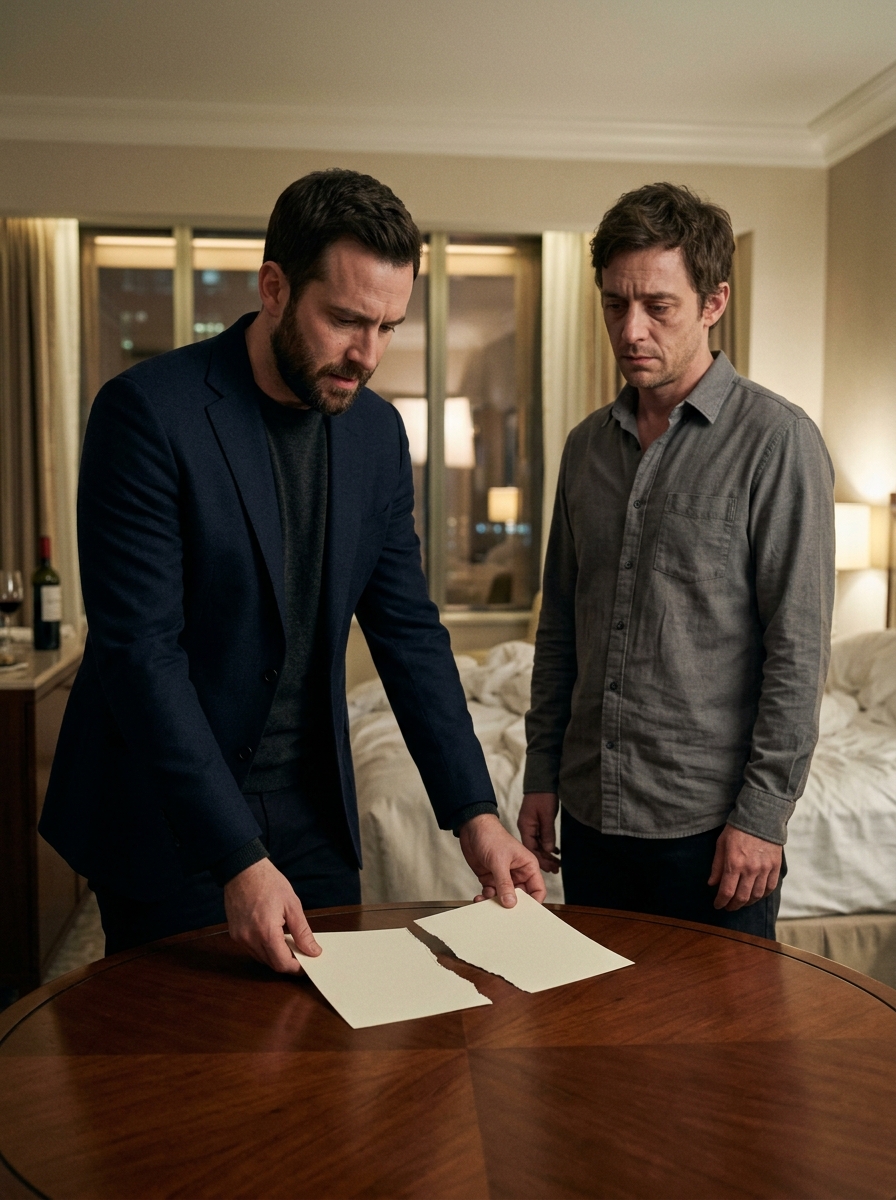
“You wanted a perfect yes,” he said. “When you didn’t get one, you built a shrine to its absence.”
I had no defense against the image because I recognized it. I had made his uncertainty sacred. I had treated every quiet moment as proof that I was right to be afraid. I had stopped initiating, but I had never stopped asking the question in my head.
Am I being tolerated?
Gideon went to the bedroom and packed a small bag.
“Where are you going?”
“To Asha’s.”
“You don’t have to leave.”
“I know.”
That hurt more than if he had said he needed to.
After he left, I sat on the floor beside the dead lamp. I did not call him. I did not send an apology. I wrote a message to Mara and deleted it, then wrote another.
I think I have made his fear the only thing that matters because it allows me to avoid admitting that I am afraid too.
She replied the next morning.
Good. Bring that sentence.
***
At the next session, Gideon sat farther from me than usual.
Mara read my message from her phone.
“You’re right,” she said. “But what are you afraid of?”
“That if I stop monitoring him, I’ll miss the moment he needs me to stop.”
“That is one fear. What is the other?”
I looked at Gideon.
“That he will say yes because he wants to keep me.”
Gideon’s eyes filled, but he did not look away.
Mara turned to him. “What are you afraid of?”
“That if I stop managing Samir’s feelings, he’ll discover there’s not enough desire underneath.”
The room went quiet.
I wanted to tell him there was enough. I wanted to promise that I would never leave, never feel frustrated, never want more than he could give. Mara raised her hand before I spoke.
“Do not answer with reassurance,” she said.
I closed my mouth.
Gideon drew a breath. “I don’t know if I can give him the kind of desire he wants all the time.”
“I don’t know if I can live without more physical intimacy forever,” I said.
Gideon looked at me then.
The truth was frightening, but it was clean. No one had been rescued by a promise that could not be kept.
Mara nodded. “That is the conversation. Not whether one of you can become less complicated. Whether you can make decisions with the information you actually have.”
We talked for nearly two hours.
Gideon said he wanted to continue the marriage, but he would not promise a frequency or a version of himself that never became anxious. I said I wanted to continue, but I would not pretend that sex was irrelevant to me.
We agreed to revisit the question in ninety days. Not as a deadline for Gideon to heal. Not as a test he could fail. It was simply a point at which we would ask whether honesty had made the relationship more livable.
We also agreed that either of us could initiate affection, but the invitation had to include room for change. No one would begin with an unspoken destination. No one would use a pause as an insult. If one of us became uncertain, we would say so before continuing.
It sounded simple.
Nothing important is simple when you have spent years avoiding the truth.
Gideon came home that evening. He put his bag in the closet without unpacking it.
“I’m still angry,” he said.
“I know.”
“I still love you.”
“I know.”
“I don’t want those to cancel each other out.”
“They don’t.”
He nodded. Then he sat on the couch, leaving space beside him.
I sat down, but I did not reach for him.
After a minute, he said, “You can put your hand there.”
He indicated the cushion between us.
I placed my hand on the couch.
He laughed despite himself. “That was not what I meant.”
“Sorry.”
“Samir.”
“I’m trying.”
“I know.”
He took my hand and placed it in his. We stayed that way until the room grew dark.
***
The first time Gideon remained present through closeness, nothing dramatic happened.
There was no breakthrough, no sudden certainty, no moment in which the past released him and walked out the door.
It was a rainy Sunday. We had spent the afternoon cleaning the apartment, which meant we had mostly moved books from one surface to another. Gideon put a record on, one we had bought in Chicago during our second year together. The music was soft enough that we could hear the rain tapping the windows.
He stood in the middle of the living room.
“Can we dance?” he asked.
I felt the old impulse to ask what he meant by dance, how long he wanted to dance, whether he was sure.
Instead, I said, “Yes.”
He came close. I put my hands where he directed them. We moved badly and slowly. After a minute, Gideon rested his forehead against mine.
“I want to kiss you,” he said.
“Okay.”
“And I might change my mind.”
“Okay.”
“You keep saying okay like you’re waiting for a bus.”
“I’m trying not to make your wanting carry my whole emotional life.”
That startled a laugh out of him.
We kissed.
This time, when his breathing changed, I did not interpret it. I felt the panic rise in me, but I did not convert it into a question.
Gideon pulled back.
“I’m getting hazy,” he said.
I stepped away immediately.
His expression tightened. “Not like that.”
“I thought you wanted me to stop.”
“I do. I want to pause. I’m still here.”
The words were new. So was the distinction.
I nodded. “What would help?”
“Sit with me. Don’t look at me like I’ve broken something.”
I sat beside him on the floor.
For several minutes, we listened to the record. Gideon named five things he could see in the room, four he could hear, and three he could feel. He had learned the exercise from his individual therapist. He was embarrassed by it, and I did not tell him there was nothing to be embarrassed about.
When he finished, he said, “I’m back.”
“Do you want to stop completely?”
He considered. “Yes.”
The answer hurt.
I let it hurt without making him responsible for the pain.
He watched my face. “Are you angry?”
“No.”
“Disappointed?”
“Yes.”
He looked down.
“But not at you,” I added. “I’m disappointed that my fear still gets so loud. That’s mine to manage.”
He reached for my hand. “Thank you for not pretending you don’t care.”
That was the first time I understood that honesty did not have to be sharp. It could be gentle without becoming false.
We did not go further that night. We ordered noodles and watched an old comedy. Gideon fell asleep with his head against my shoulder. When he woke, he apologized for taking up space.
I told him, “You’re allowed to take up space even when nothing happens.”
He closed his eyes again.
***
Three weeks later, Gideon initiated.
He did it in the kitchen while I was washing a plate. He came up behind me, then stopped before touching me.

More From This Author