STORY
Grandma’s Will Exposed Who Stole My College Fund—and Framed Me
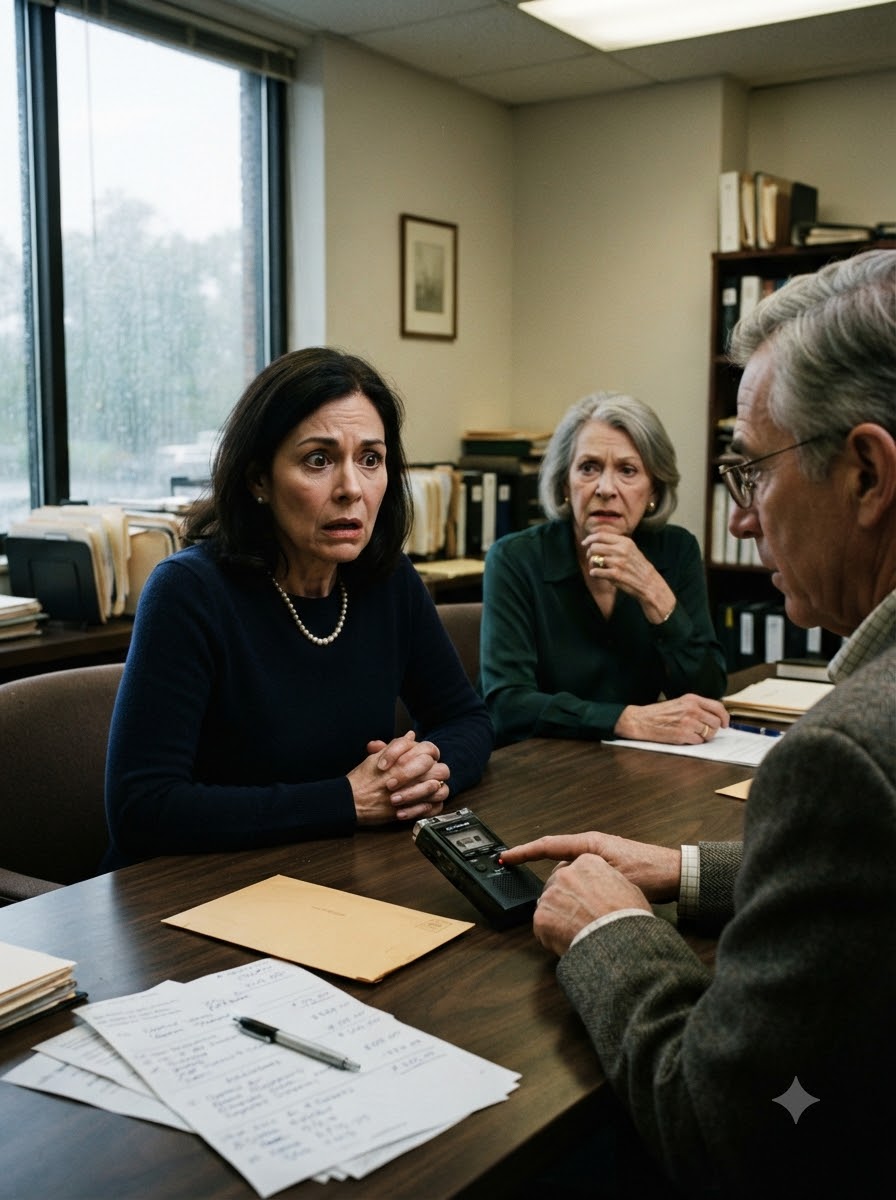
My mother told me to wait outside the conference room in the same gentle voice she used when asking me to clear plates while everyone else was still eating.
“Evelyn, honey, this is family business.”
She pointed toward a chair in the hallway.
I was thirty-one years old. I had arranged Grandma’s hospice care, written her obituary, chosen the hymns, and ironed my brother Ryan’s shirt for the funeral because he had texted me at midnight asking if I could “toss it in.”
Still, my feet nearly obeyed.
Twenty-three years of training can make a leash feel like instinct.
Then Grandma’s lawyer looked up from the head of the table.
“No,” Mr. Bellamy said. “She stays.”
My mother’s hand tightened around her cream purse.
“Excuse me?”
“Evelyn stays. Your mother was explicit.”
Inside the conference room, my father sat with one ankle across his knee. Ryan was scrolling through his phone, already bored by a meeting about the woman he had visited twice in her final year.
Dad frowned. “Is this really necessary?”
Mr. Bellamy removed his glasses. “Very.”
He gestured to the empty chair across from my father.
I walked in and sat down.
Mom remained by the doorway for one second too long. The expression on her face was not grief. It was calculation interrupted.
Rain tapped the windows. A fluorescent tube buzzed overhead.
Mr. Bellamy opened a thick folder and removed a sealed cream envelope. My name was written on it in Grandma Eleanor’s sharp, slanted handwriting.
My throat tightened.
“If Shirley has tried to put Evelyn in the hallway,” he read, “then I was right about more than I wanted to be.”
Mom went motionless.
Mr. Bellamy continued.
“Read this aloud. This family has made Evelyn perform its labor in private and swallow its cruelty in silence. For once, I want everyone in the room to hear the truth together.”
Ryan shifted in his chair.
The letter listed moments I had spent years trying to minimize.
The chili Ryan spilled when I was sixteen, which I had been ordered to clean while he left with friends.
The Christmas dinner I cooked for fourteen relatives, only to eat cold potatoes beside the sink.
The senior dance I missed because Mom said Ryan needed help preparing for an exam.
The family photographs in which I stood at the edge, still wearing an apron, while Ryan occupied the center.
“I watched Evelyn become useful because no one allowed her to feel loved,” Grandma had written. “I watched her parents praise Ryan for receiving what Evelyn had made possible.”
Ryan gave a short, disbelieving laugh.
Mr. Bellamy paused, looked at the page, and continued.
“If Ryan laughs, remind him that being adored is not the same as being worthy.”
His smile vanished.
Dad leaned forward. “My mother was ill. Whatever resentments she developed—”
“She wrote this eight months ago,” Mr. Bellamy said. “Her physician witnessed her capacity assessment the same week.”
Mom’s rings clicked against her purse clasp.
I remembered Grandma’s hands opening stubborn jar lids with a butter knife. Her peach nail polish was always chipped on one thumb.
Then Mr. Bellamy read the line that changed the temperature in the room.
“In 2011, I established education accounts for both grandchildren, each funded with seventy-five thousand dollars. Ryan received his. Evelyn did not.”
I looked up.
“What?”
Mom’s face lost its color.
Grandma’s letter continued.
“For years, Shirley told me Evelyn had chosen not to attend university and had used the money for living expenses. Last autumn, Evelyn told me she had worked two jobs because her parents said there was no fund for her.”
I could hear rain running through the gutter outside.
I had attended community college at night until exhaustion defeated me. I had cleaned dental offices before sunrise and worked at a pharmacy until closing.
Dad had called it character building.
Mr. Bellamy set the letter down.
“Mrs. Hart asked me to investigate.”
Mom found her voice. “There’s nothing to investigate. Evelyn did use that money.”
“No,” I said.
It came out quietly, but everyone heard it.
Mom turned toward me. “You were young. You may not remember all the expenses we covered.”
“I remember taking the bus because you wouldn’t help me buy a car.”
“That was your choice.”
“I remember dropping chemistry because my manager wouldn’t change my shifts.”
“You never had Ryan’s academic focus.”
Ryan stared at the tabletop.
Mr. Bellamy opened another file.
“The account was liquidated three weeks after Evelyn’s eighteenth birthday. The withdrawal authorization bears her signature.”
He slid a photocopy toward me.
My name appeared at the bottom in rounded, childish handwriting.
I recognized it immediately.
“That’s from my passport application,” I said.
Dad’s knee stopped bouncing.
I had signed that application at seventeen, at our kitchen counter. Mom had corrected me because my first signature touched the box’s edge. She told me to start over on a new form.
The signature on the bank document had the same bad flourish beneath the final n.
Mr. Bellamy placed the abandoned passport application beside it. The signatures matched down to the blue ink skip in the first letter.
Mom stood abruptly.
“This is insulting. I won’t sit here while my own mother accuses me of theft based on a photocopy.”
“The original is at First County Bank,” Mr. Bellamy said. “So is the security record showing you presented the authorization.”
“I was managing money for my daughter.”
“I never authorized that,” I said.
“You were irresponsible.”
“I was eighteen and working sixty hours a week.”
“Because you kept making poor choices.”
The old reflex rose in me: explain, soften, apologize.
I crushed it.
“What did you spend it on?”
Mom’s eyes flicked toward Dad.
That answered more than words could have.
Mr. Bellamy slid a bank statement across the table. Seventy-five thousand dollars had entered my parents’ joint account. Four days later, sixty-two thousand had gone to Prestige Motor Group.
Ryan’s face changed first.
“My car?” he asked.
For his nineteenth birthday, Dad had presented him with a black convertible in our driveway. Mom had tied an enormous red bow to the hood.
They had filmed his reaction.
I had been holding the camera.
“The remainder covered insurance and tuition arrears,” Mr. Bellamy said.
Ryan looked at me. “I didn’t know.”
Mom seized the opening.
“Of course he didn’t. We were trying to keep the family afloat. Your father’s business had problems. Ryan needed reliable transportation for school.”
“It was a convertible,” I said.
“You were living at home. You had food and a roof.”
“I paid you rent.”
“That was to teach responsibility.”
Dad slapped his palm on the table.
“Enough. The money is gone. If there was an error, we can discuss repayment privately.”
“Forgery is not an accounting error,” Mr. Bellamy said.
Mom turned on him. “You’ve filled my mother’s head with poison.”
“Your mother brought me the passport application herself.”
That silenced her.
Mr. Bellamy picked up Grandma’s letter again.
But he did not resume reading.
“There is a second matter,” he said.
Dad’s anger sharpened into caution.

More From This Author