STORY
He Remembered Exactly What He’d Said. That Wasn’t the Comfort She Expected.
That was the sentence that followed her into the bathroom.
She changed into a black dress she had worn dozens of times. At the wedding, Owen told her she looked beautiful. He brought her champagne. He danced with her under strings of warm lights and kissed her temple during the slow song.
She smiled for photographs.
Back at the hotel, he reached for her in bed. She said she was tired.
The next morning, while he packed, he asked, “Are you still mad about that stupid joke?”
Elise folded the black dress into her suitcase. “I don’t want to talk about it anymore.”
“Okay,” he said, visibly relieved.
For years, Owen would remember that relief as permission.
Elise would remember it as proof.
***
After their first counseling session, they stood beside their cars in the parking lot.
Rain had darkened the pavement. Owen’s jacket was getting wet, but he seemed not to notice.
“I want to apologize,” he said.
“I know.”
“Can I?”
Elise shifted her tote higher on her shoulder. “Not if I have to make you feel better afterward.”
His face tightened. “That’s not why I’m apologizing.”
“It might not be why you start.”
“That’s a pretty terrible thing to assume about me.”
“I’m not assuming. I’m telling you what usually happens. You feel awful, then I have to reassure you that you aren’t an awful person. By the end, we’re discussing your pain about hurting me.”
Owen looked away toward the line of wet cars.
“So what am I supposed to do?” he asked.
“Sit with it longer than ten minutes.”
She unlocked her car.
“Elise.”
She stopped but did not turn.
“I came,” he said.
She looked back at him. Rain had begun collecting in his hair.
“Yes,” she said. “You did.”
It was not forgiveness. It was not nothing.
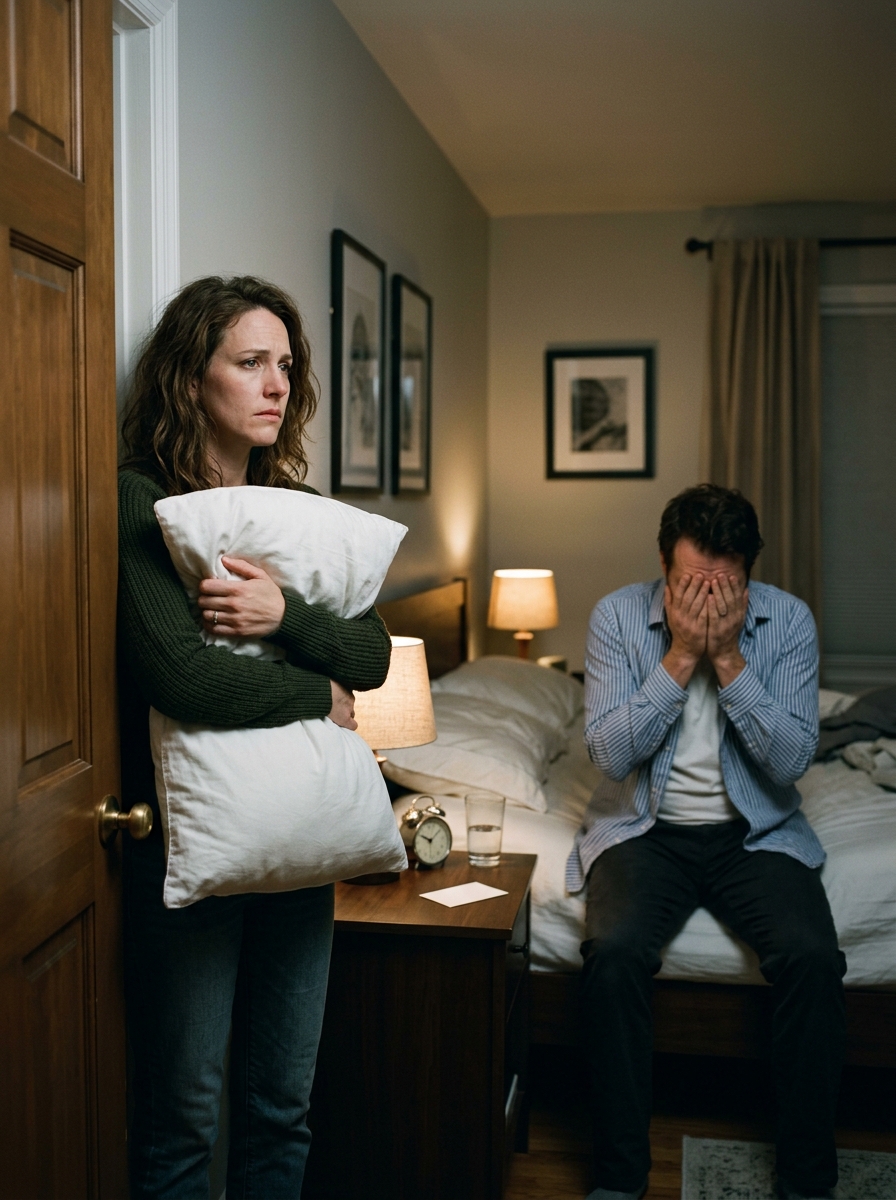
At home, Owen moved through the kitchen as if every surface might break. He asked before passing behind her. He avoided brushing her shoulder when reaching for a glass. When she sat beside him on the couch, he folded his hands in his lap.
By Thursday, his caution had become its own kind of distance.
“You can sit normally,” Elise said.
“I am sitting normally.”
“You’re six inches from falling off the couch.”
“I don’t know what contact is okay.”
“You could ask.”
“I’ve been trying not to make you manage me.”
She muted the television. “Avoiding me also makes me manage you. Now I’m monitoring whether you’re miserable.”
“I am miserable.”
The honesty startled them both.
Owen exhaled. “I’m not saying you have to fix that. I’m saying I’m scared to touch you and scared not to. I feel like every choice proves something bad.”
Elise studied him. He looked tired. Not theatrically shattered, not waiting to be rescued. Just tired.
“Ask one real question,” she said.
He thought for a moment. “Would it feel okay if I held your hand?”
She looked at his open palm.
“No.”
His fingers closed, but he did not sigh or turn away.
“Okay,” he said. “Thanks for telling me.”
They watched the rest of the show without touching.
Ten minutes later, Elise rested her socked foot against his ankle.
Owen glanced down.
“Don’t make it important,” she said.
He looked back at the television. “I won’t.”
That tiny contact lasted until the credits.
***
At their next appointment, Nia asked what joking had meant in the families where they grew up.
Owen sat back. “My dad teased everyone.”
“What happened if the person didn’t laugh?”
“He’d say they were too sensitive.”
Elise looked at him.
Owen heard it too.
His father had teased Owen’s mother about the reading glasses on a chain around her neck, the gray in her hair, the way her jeans fit after she had Owen’s younger brother. None of it counted as cruelty because he grinned when he said it. Everyone else’s job was to prove they understood the grin.
“I thought I was different from him,” Owen said.
“You are different in plenty of ways,” Nia replied. “That doesn’t mean you didn’t learn his escape route.”
“And mine was silence,” Elise said.
Her mother had treated appearance as a constantly changing report card. At thirteen, Elise had been praised for declining birthday cake. At sixteen, her mother had smoothed a hand over the front of her prom dress and asked whether she wanted shapewear.
Owen knew those stories. He had once told Elise that her mother’s comments were cruel.
“You knew my mother had made my body feel public,” Elise said to him. “Then you made it funny.”
His eyes filled, but he did not look away.
“Yes,” he said.
Nia asked Owen to offer his apology then—not the broad, panicked apology from the parking lot, but one that named his choices without predicting what Elise should do with it.
Owen unfolded a piece of paper.
His hands shook hard enough to make the page whisper.
“When you asked whether the green dress made you look bigger, you were asking if you were safe with me,” he read. “I answered by making your body a punch line. When you told me it hurt, I acted like your reaction was the problem because I was nervous about being late and ashamed of what I’d said.
“The next morning, I accepted your silence because it was easier for me. After that, I saw you turn off lights and change in other rooms. I told myself I was respecting your privacy, but I also knew there was a chance it went back to that night. I didn’t ask directly because I was afraid of the answer.
“I am sorry for the joke. I am more sorry that I left you alone with it. I don’t expect this apology to make you comfortable with me. I don’t expect forgiveness on a schedule. I want to become someone you can tell the truth to, even when the truth is that you don’t want me near you.”
He lowered the page.
Elise’s eyes burned.
For five years, she had imagined this moment as a courtroom victory. She would present the exact evidence, and Owen would finally understand. In those fantasies, understanding always brought immediate relief.
The real thing hurt differently. His apology did not erase the hotel mirror. It did not return the years when she had experienced affection as an inspection.
But it did not ask her to erase those things either.
“I need to say something too,” she said.
Owen remained still.
“I told myself you should know without my saying it. Every time you failed to figure it out, I added it to the case against you.”
He opened his mouth, but she raised a hand.
“That doesn’t make the first conversation my fault. I tried then. You shut me down.”
“I know.”
“But later, there were times you asked what was wrong, and I gave you an answer designed to end the conversation. Part of me wanted you to keep asking anyway. I wanted you to prove you could see through me.”
“Why didn’t you tell me?”
“Because if I told you and you minimized it again, I thought I would have to leave.”

More From This Author