STORY
I Mowed My 82-Year-Old Neighbor’s Lawn—Hours Later, The Sheriff Opened My Mailbox
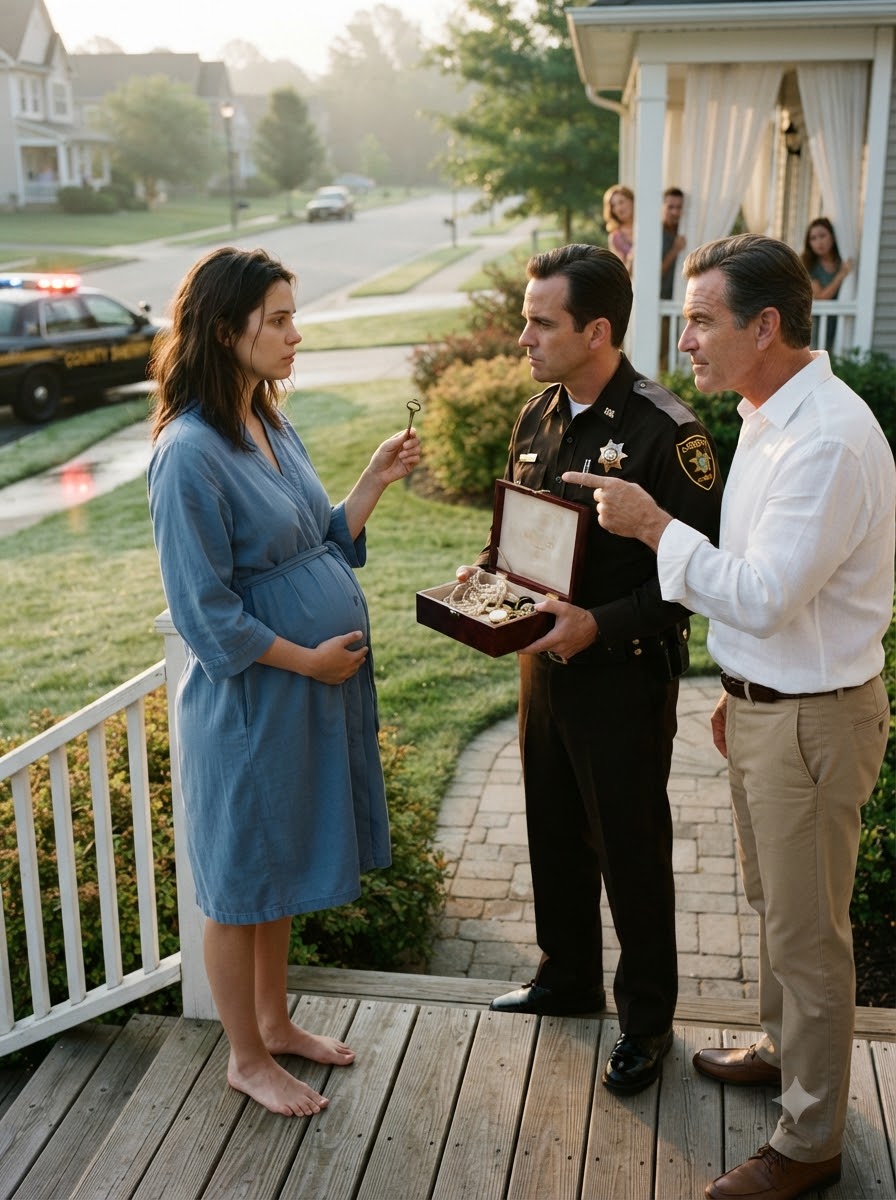
“Last Will and Testament and Elder Abuse Restraining Petition of Eleanor Mae Higgins,” Sheriff Miller read aloud.
The morning air felt thick enough to choke on, heavy with July humidity and the diesel exhaust of two idling county patrol cars. On the curb, the red and blue emergency lights swept across the wet grass of my front yard and reflected off the windows of the neighboring houses, where half the street had gathered in their bathrobes to watch the pregnant woman at number 412 get arrested.
Richard Higgins didn’t look like a grieving nephew anymore. The polished, arrogant smirk he had worn five seconds ago—when he was demanding I be put in handcuffs—fractured into raw panic.
He lunged forward across my porch steps, reaching for the thick manila envelope in the sheriff’s gloved hands. “That’s a forgery!” Richard barked, his voice cracking high in his throat. “She was senile! That crazy old woman didn’t even have a lawyer, and if she signed anything yesterday, this little gold-digger coerced her into it!”
Deputy Alvarez stepped between them instantly, planting a firm palm against Richard’s linen-shirted chest and shoving him back a step. “Step back, sir. Keep your hands at your sides or you’ll be the one sitting in the back of the cruiser.”
I stood by my front door, one hand braced against the wooden frame and the other cradling the heavy curve of my thirty-four-week belly. Inside me, the baby kicked hard against my ribs, reacting to the adrenaline surging through my veins. My ankles were still swollen from spending three hours the afternoon before pushing Mrs. Higgins’s rusted rotary mower through knee-high weeds in ninety-five-degree heat, and my back felt like it was splitting in two. Yet for the first time since the sirens had woken me at 6:30 A.M., my hands weren’t shaking.
I looked across the low privet hedge toward Mrs. Higgins’s driveway, where the ambulance doors had just closed behind her body. My throat tightened with a grief so sharp it stole my breath. She had been eighty-two, tiny as a bird, with silver hair she still pinned up with tortoiseshell combs every morning. While my ex-husband Ryan had abandoned me the week my pregnancy test turned positive—emptying our bank account and leaving me to drown in a mortgage I couldn’t afford—Eleanor Higgins had been the only person on Oak Creek Lane who ever treated me like a human being.
And now I understood why she had gripped my wrist so tightly on her porch yesterday afternoon.
*Promise me you’ll check your porch cupboard tomorrow morning at seven sharp,* she had whispered, pressing that tarnished brass key into my sweaty palm. *Don’t let him take what isn’t his.*
Sheriff Miller didn’t let Richard’s outburst rattle him. He was a twenty-year veteran in our county, a man with silver temples and deep creases around his eyes who had seen every ugly family feud small-town probate could produce. Slowly, methodically, he slid the rest of the contents out of the manila envelope we had just unlocked from my old cedar milk-delivery cupboard.
There were three stapled legal packets bearing the embossed gold seal of Arthur Pendelton, the oldest estate attorney in town, along with a handwritten letter on Mrs. Higgins’s pale blue stationery and a compact black digital media player already connected by a cord to the tiny green lens wedged behind the cedar slats.
“Well, Mr. Higgins,” Sheriff Miller said, his gravelly voice carrying clearly to the neighbors watching from the sidewalk. “According to this notarized affidavit, your aunt wasn’t senile at all. In fact, she passed a full cognitive competency evaluation yesterday at 4:00 P.M., administered right in her living room by Dr. Aris Thorne and witnessed by two licensed hospice nurses while Mr. Pendelton recorded the signing.”
Richard’s face went the color of wet ash. “Four o’clock?” he stammered, his eyes darting wildly between me and the house next door. “That’s impossible. I was there at ten in the morning, and she could barely walk to the kitchen!”
“Because you spent forty minutes screaming at her until her blood pressure spiked to two hundred over one-ten,” I said quietly.
Every head turned toward me. I hadn’t known that part yesterday when I was mowing her grass, not for sure, though I had heard a man’s muffled shouting through her screen door before a silver Mercedes sped out of her driveway. Now, looking at the top page in the sheriff’s hand, the pieces clicked together with chilling clarity.
Sheriff Miller adjusted his glasses and read from the sworn statement attached to the front of the packet.
“‘On Tuesday, July 14th, at approximately 9:45 A.M., my nephew, Richard Vance Higgins, entered my residence without invitation,'” the sheriff read, each word landing like a hammer on concrete. “‘He placed a durable power of attorney and a quitclaim deed on my dining table and demanded that I sign over title to my home and my late husband’s municipal bond portfolio. When I refused, he knocked my nitroglycerin tablets off the table, kicked them under the refrigerator so I could not reach them, and stated that if I died without signing, he would inherit everything anyway as my sole blood heir.'”
A collective gasp went up from the edge of the lawn. Mrs. Gable, who lived across the street and had been whispering behind her hand ten minutes ago when the sheriff pulled the stolen jewelry box out of my mailbox, clapped both hands over her mouth.
“She’s lying!” Richard shouted, sweat breaking out across his forehead in the morning sun. “She was an eighty-two-year-old woman on heart medication! She dropped her own pills! Look at the mailbox, Sheriff! You found her pearls and my uncle’s gold Patek Philippe watch inside *her* mailbox!” He jabbed a shaking finger straight at my face. “That woman over there is two weeks away from losing her house to the bank! Everyone knows her husband left her broke! She mowed the grass to get inside the house, waited until my aunt died, robbed the bedroom, and hid the box in her own mailbox to move it later!”
It was a desperate lie, clumsy and frantic, because what kind of thief hides stolen goods inside their own roadside mailbox? Yet five minutes ago, before the key had come out of my pocket, it had almost worked. Richard had arrived at 6:15 A.M., allegedly to “check on his beloved aunt,” called 911 upon finding her dead, and immediately directed the responding deputies to a supposed trail of footprints leading from her back patio toward my yard—and straight to my mailbox.
“Let’s take a look at how that jewelry box got into the mailbox, shall we?” Sheriff Miller said calmly.
He didn’t even need his patrol tablet. The small digital monitor inside the cedar cupboard had its own four-inch playback screen, wired directly to two weatherproof trail cameras Mrs. Higgins’s late husband, a retired electrical engineer, had installed under the eaves of both our porches years ago after a string of neighborhood package thefts. I hadn’t even known the camera on my porch cupboard was still active; Mr. Higgins had wired it into his own garage circuit before he passed.

More From This Author