STORY
My Daughter-in-Law Dumped My Pot Roast—Then Her Old Name Exposed a Farm Scam
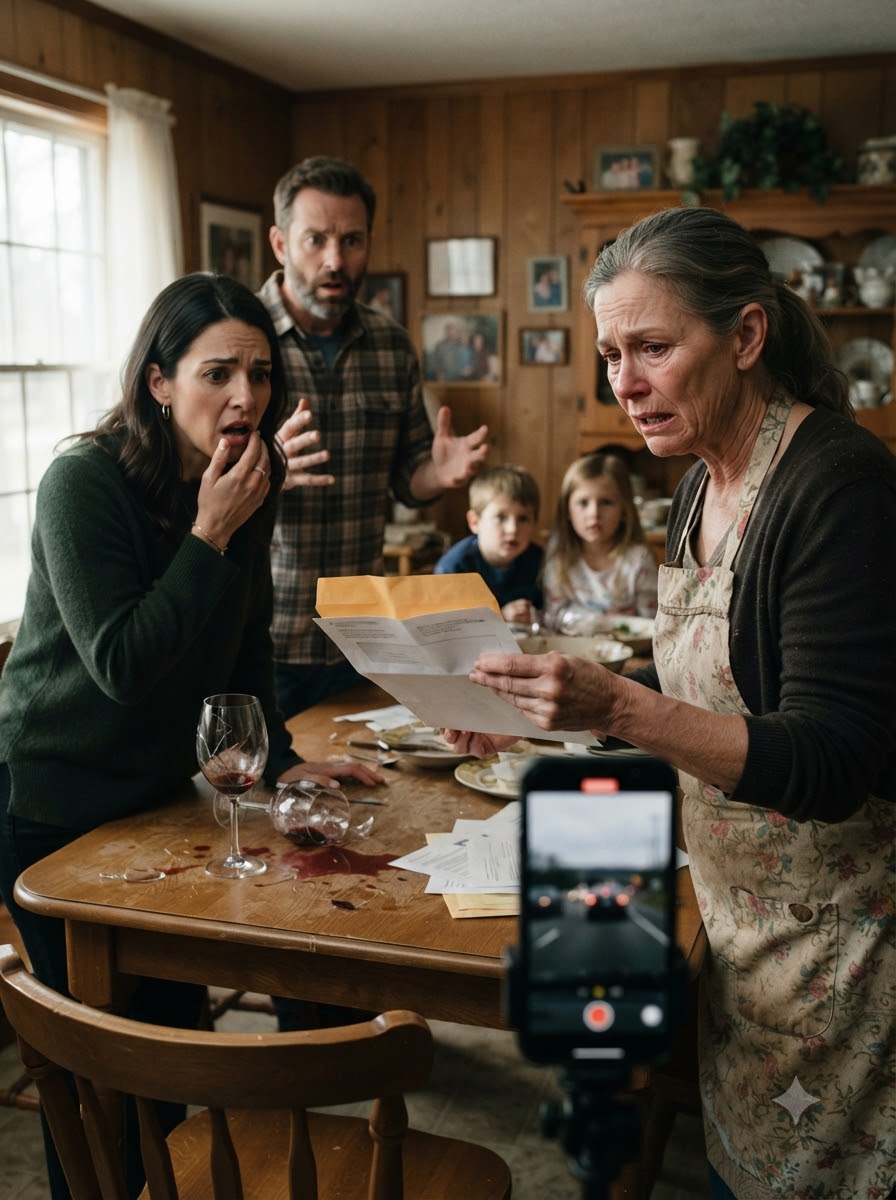
“Monica Elise Voss changed her name to Monica Elise Lane in 2016. That part is legal. The issue is what occurred before the change.”
Alan picked up the first page.
His eyes moved across it.
Then he looked at his wife.
“What is this?”
Monica said nothing.
Luis explained.
“In 2014, under the name Monica Voss, she was charged in another state with exploitation of an at-risk adult and document fraud. The victim was an eighty-two-year-old man for whom she provided informal caregiving services.”
Alan’s hand began to tremble.
“She was never convicted,” Monica said quickly. “The charges were dismissed.”
“Dismissed after the victim died and the estate settled,” Luis said. “The civil judgment was not dismissed. She was ordered to repay twenty-seven thousand dollars and barred from handling the man’s financial accounts.”
Sarah slid another document across the table.
“That judgment was concealed on Monica’s loan application when she and Alan purchased their townhouse.”
Alan stared at the pages.
“Why didn’t you tell me?”
Monica’s eyes flashed.
“Because you would have judged me.”
“You lied about who you were.”
“I changed my name after a horrible period in my life.”
“You told me your maiden name was Parker.”
For the first time, Monica looked genuinely trapped.
The process server’s second envelope had been addressed to Monica Elise Voss because that was the name on the civil judgment. The investigator had confirmed that the same person had used the same forged-signature method against the previous victim.
The second revelation was not only that Monica had a criminal past.
It was that she had been repeating the same pattern.
She befriended older people. She learned their routines. She offered to “help” with paperwork. Then she created documents that gave her access to property or money.
Daniel’s farmhouse and the forty acres were not an unexpected temptation.
They were her next target.
Alan lowered himself into the chair he had knocked over.
“Did you marry me for this?”
Monica turned on him.
“Don’t be ridiculous.”
“Did you know the farm was worth nearly two million dollars?”
“Of course I knew. Anyone could look it up.”
“Did you marry me knowing my mother owned it?”
“I married you because I loved you.”
“Then why did you tell Jenkins it was already yours?”
Monica began to cry.
The tears came suddenly and perfectly. She pressed a hand to her mouth, shoulders trembling.
“Your mother has poisoned you against me,” she whispered. “She’s always treated me like an outsider. I made one mistake because I was desperate, and now everyone is acting like I’m some monster.”
I looked at her.
“One mistake is forgetting an appointment. One mistake is overcooking a roast. You prepared a forged deed, impersonated me, redirected an eighteen-thousand-dollar lease payment, and tried to take my land.”
“I never got the money!”
“Because Mr. Jenkins called me.”
“You were going to get it back!”
“You cannot steal something less successfully and call it a misunderstanding.”
Alan covered his face.
Monica turned toward him.
“You’re going to let her destroy our family?”
Alan looked up.
“You destroyed it when you lied to me.”
She stared at him as though he had spoken in a foreign language.
The investigator told Monica she was being taken into custody for questioning. The arrest itself would come after the prosecutor finalized the charges, but the warrants had already been signed.
As Luis read her rights, Monica’s composure vanished.
She shouted that the documents were planted. She accused Mr. Jenkins of harassing her. She said Sarah had manipulated the evidence. She claimed I had forged the forged deed to frame her.
Then she accused Alan of knowing everything.
“You knew your mother was going to leave the farm to us!” she yelled. “You said she’d be easier to handle after Daniel died!”
Alan went white.
“That’s not true.”
“You said she was lonely and scared!”
“I never said that.”
“You said if I stayed patient, she’d sign.”
The words hung in the dining room.
Alan looked at me.
I saw the moment he understood that even if Monica had been exaggerating, she had been telling him pieces of the plan for years.
He had chosen not to ask questions.
That was his betrayal, separate from hers.
Monica was charged with felony uttering a forged instrument, attempted theft by deception, identity fraud, and exploitation of an at-risk adult. The county also filed a civil action to prevent her from transferring or hiding assets.
The financial investigation widened.
The two elderly widows whose payments had gone into Sunday Table Events recovered their money. One of them had nearly lost her home after Monica filed paperwork claiming to be her property manager.
The bank froze Monica’s business account. The remaining funds were returned to the victims.
The forged assignment deed was declared void. Mr. Jenkins’s lease remained in place, and I renewed it for five years at the same annual rate.
The civil court ordered Monica to reimburse my legal fees, the county’s investigation costs, and the money she had taken from the other women. She had little left after the townhouse was sold.
Alan filed for divorce.
For several months, he lived in a small apartment across town. He saw Lucy and Caleb on weekends, and the children sometimes came to the farmhouse with him.
The first visit after Monica’s arrest was difficult.
Alan stood on my porch with his hands in his jacket pockets.
“I’m sorry,” he said.
The apology was not enough to erase seven years of insults or the way he had laughed while Monica dumped my food into the trash.
But it was the first honest thing he had offered me in a long time.
“I should have believed you,” he continued. “I should have noticed what she was doing. I kept telling myself you were being stubborn because it was easier than admitting I had married someone I didn’t know.”
I looked past him at the orchard.
“You chose comfort over truth.”
“I know.”
“And you let my grandchildren learn that it was acceptable to mock me in my own home.”
His face crumpled.
“I know that too.”
I did not invite him in immediately.
Forgiveness was not a door that swung open because someone finally knocked. It was a house that had to be rebuilt, board by board.
So we started slowly.
Alan came on Saturdays to help Mr. Jenkins repair the west fence. He brought groceries. He washed dishes. He learned how to make Daniel’s gravy.
The first time he cooked it, he burned the onions.
I told him so.
He laughed awkwardly, then tried again.
It took nearly a year before I hosted Sunday brunch.
This time, Alan arrived with eggs, bread, and a bowl of fresh strawberries. Lucy carried flowers from her mother’s garden. Caleb brought a handwritten card that said, Grandma, your house smells good.
We ate at the oak table.
Nobody criticized the wallpaper. Nobody complained about the coffee. Nobody asked when I planned to “modernize” the farmhouse or whether I had reconsidered my will.
After breakfast, Alan stood and gathered the plates.
“I’ll wash,” he said.
“You’ll dry,” I replied. “Lucy can wash.”
Lucy grinned and tied on an apron.
Sunlight poured through the windows, brightening the scratches in the old table and the faded blue curtains Daniel had hung decades earlier.
The farmhouse no longer felt like a place where people came to take something.
It felt like mine again.
I still cooked pot roast on Sundays.
I still used Daniel’s recipe, still added extra onions, and still let the gravy simmer until the whole house smelled warm and alive.
An old-folks’ home, Monica had called it.
Perhaps she had been right about one thing.
It smelled like history.
It smelled like the life I had built, the life she had tried to steal, and the life I had finally learned not to apologize for protecting.

More From This Author