STORY
My Daughter Said I Had No Say—Then the Bank Opened Gerald’s File

Gerald’s actual signature in recent years had become unsteady. The letters leaned downhill. He had begun using a stamp for routine checks because his hand cramped.
The signature on the amendment was the old one—the confident looping signature he had used before the disease had taken his strength.
Ruth took the document to the original attorney.
He studied it for less than a minute before asking, “Who gave you this?”
“Someone who wants me frightened.”
The attorney held the page beneath a lamp.
“This is not a valid amendment,” he said.
“Because of the signature?”
“Because the trust requires two witnesses and notarization. This has one witness line filled in, no witness signatures, and a notary acknowledgment that refers to a document of four pages. This is six.”
Ruth felt her stomach twist.
“Could Gerald have signed it anyway?”
“He could have signed anything. That wouldn’t make it valid.”
The attorney then showed her something else.
A notice filed with the county recorder two days after Gerald’s death. It claimed the house had been transferred to Caroline under a deed signed by Gerald six weeks earlier.
The deed carried the same old signature.
The same notary stamp.
The same impossible confidence.
Ruth took copies of everything.
She contacted the bank. She contacted the county recorder. She contacted adult protective services, who opened an investigation into financial exploitation. She contacted the police, who asked her to bring every original and copy she possessed.
For three months, Ruth said nothing to Caroline.
Caroline continued to call.
At first, she sounded concerned.
“Mom, you’re being very strange.”
“I’m grieving.”
“We’re all grieving.”
“You seem to be managing.”
“What is that supposed to mean?”
Later, concern became anger.
“You’re letting some lawyer fill your head with nonsense.”
Then accusation.
“You’ve always been jealous of me.”
Ruth listened without defending herself.
She had spent her life explaining her intentions to people who had already decided what they were.
This time, she saved every message.
The deeper investigation uncovered the first layer of the deception.
Caroline had taken Gerald to a mobile notary’s office two days before his death. The notary, a woman named Linda Voss, had signed an affidavit stating that Gerald appeared confused, repeatedly asked where he was, and could not explain the documents placed before him.
She had refused to notarize the trust amendment.
But Caroline had not left empty-handed.
Before the meeting, she had obtained Gerald’s old signing stamp from a desk drawer. Linda had seen her press it onto an unrelated medical authorization while pretending to help him fill out paperwork.
The notary had reported the incident, but the report had been filed under the name of the assisted-living facility rather than Gerald’s. It had nearly been missed.
The second layer was worse.
The signature on the deed had not been stamped.
A handwriting examiner determined that Caroline had traced Gerald’s old signature from a 2017 tax document. Under magnification, the pressure marks showed a slow, deliberate drawing rather than a naturally written signature.
The bank found that Caroline had attempted to submit the forged amendment and transfer documents to three institutions.
Two rejected them because the notary information did not match.
The third accepted the beneficiary form into a pending review queue.
That third institution was the branch where Ruth now sat.
Daniel Mercer reached the end of the file on his tablet.
“Mrs. Callaway,” he said, “our legal department has confirmed that the account remains governed by the 2019 trust. No distribution will be made under the document submitted by Caroline.”
Caroline pushed back from the table.
“This is absurd.”
Daniel continued. “We have also placed a fraud hold on the attempted beneficiary change.”
“You can’t accuse me of fraud because of a clerical error.”
“We are not making an accusation. We are preserving evidence.”
“I was trying to help my uncle.”
“You submitted a form after his death with a notary acknowledgment dated after his death.”
“I didn’t prepare that form.”
“Who did?”
Caroline’s eyes moved toward Michael.
He looked down.
Ruth felt a sadness deeper than anger.
Michael had known.
Perhaps not every detail. Perhaps he had told himself Caroline was only trying to protect what belonged to the family.
But he had known enough to be afraid.
Caroline pointed at Ruth.
“She’s doing this because Gerald promised her everything. She manipulated him for years.”
Ruth did not move.
Daniel closed the tablet.
“The trust was signed in 2019 when Mr. Callaway was found competent by his physician and represented by independent counsel. It was reviewed again in 2022.”
Caroline laughed sharply.
“By then, he wasn’t competent.”
“According to his medical records, he was.”
“No, he wasn’t.”
“According to the people who treated him, he was.”
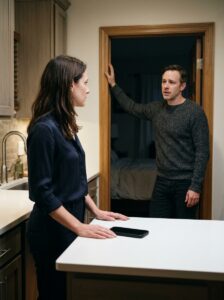
The conference room door opened.
A woman in a navy suit stepped inside. Ruth knew her from the courthouse.
Attorney Evelyn Hart had represented Gerald when he created the trust. Beside her stood Linda Voss, the mobile notary, and Detective Aaron Bell, who had been assigned to the financial crimes unit.
Caroline’s expression changed.
The denial remained, but the confidence vanished.
“You brought them here?” she asked Ruth.
“I asked them to attend.”
“You planned this.”
“I investigated it.”
Evelyn placed a sealed envelope on the table.
“Caroline, you are hereby notified that the Callaway estate will seek recovery of all legal fees, costs, and damages resulting from the fraudulent filings.”
Caroline stared at the envelope.
“This is family.”
“That is not a legal defense,” Evelyn said.
Linda Voss stepped forward.
“I remember your uncle,” she said. “I remember that he could not identify the document you wanted notarized. I refused to notarize it.”
Caroline’s lips parted.
“You’re lying.”
“I made a written report that afternoon.”
“You were confused.”
“I was not the one who was confused.”
Detective Bell placed a second file beside Evelyn’s envelope.
“The signature on the deed was traced,” he said. “We found the source document in your home.”
Caroline looked at Michael.
He flinched.
“What did you do?” she whispered.
His face collapsed in on itself.
“I didn’t know about the signature.”
“You knew about the deed.”
“I knew you were trying to get the house transferred.”
“You told me to do it.”
“I told you to talk to a lawyer.”
“You told me it was ours.”
“No,” Ruth said quietly. “You told him it was yours.”
Caroline turned toward her mother.
Something raw finally broke through her anger.
“You were going to take it all from me.”
“No.”
“You always favored Gerald.”
“I loved Gerald.”
“You loved being the good sister. You loved making me look selfish.”
Ruth looked at her daughter—the child whose fever she had watched through the night, whose lunches she had packed, whose first apartment deposit she had paid, whose wedding dress she had helped choose.
“I spent three months trying to stop you from committing a crime,” Ruth said. “I did not spend three months trying to punish you.”
Caroline’s face crumpled, but Ruth did not reach across the table.
For years, every crisis had ended with Ruth comforting Caroline, even when Caroline was the one who had caused it.
This time, the comfort belonged elsewhere.
The legal fallout moved quickly.

More From This Author