STORY
My Daughter’s Recital Exposed What Her Mother Tried to Hide About Grandpa Roger
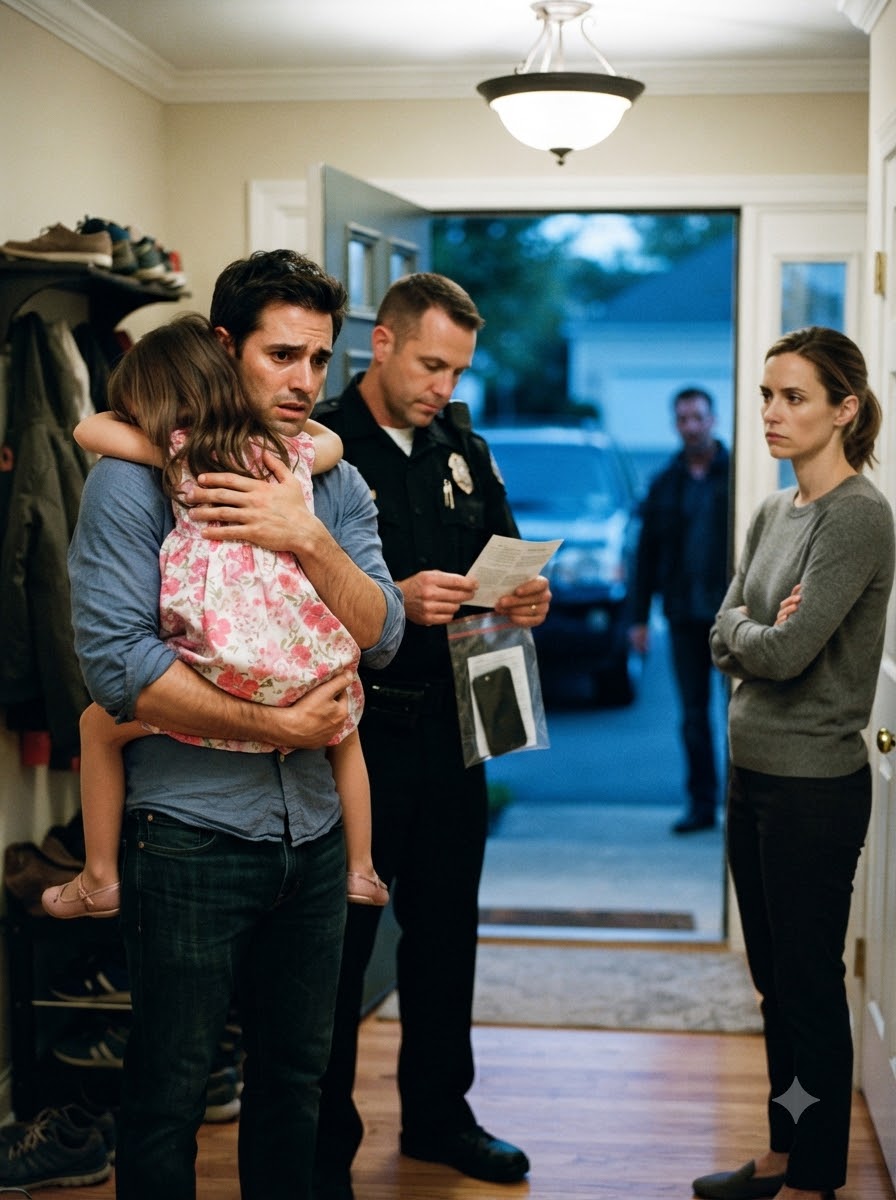
The officer’s partner came around the other side of the car with a notepad. Neither moved toward Roger’s SUV.
I shifted Lily higher in my arms and pulled the folded recital program from my pocket.
The nurse’s sentence was written across the back.
The officer read it.
Then he asked me to tell him exactly what had happened.
I did.
I said Lily had shown me bruises. I said she identified Roger. I said she had previously disclosed the abuse to Claire. I said Claire had dismissed it. I told him I had called the pediatric line and had not questioned Lily beyond what was necessary.
Claire laughed once, sharply.
“He’s making this sound insane,” she said. “My father has never hurt that child.”
The SUV stopped at the end of the driveway.
Roger climbed out.
He was sixty-three, broad-shouldered, and still wearing his work jacket from the hardware store. His eyes went immediately to Lily.
“What is this?” he demanded.
The officer raised a hand.
“Stay by your vehicle, sir.”
Roger ignored him and took one step forward.
“I said stay there.”
Claire moved toward her father.
“Dad, he’s accusing you of—”
“I know exactly what he’s doing,” Roger snapped. “He’s trying to punish us because he doesn’t like how we help with Lily.”
The second officer asked me to bring Lily to the patrol car so she could be out of the adults’ hearing.
I carried her there.
Before we reached it, Roger shouted, “That child is a liar when she’s frightened!”
The officer turned.
“Sir, do not address the child.”
Roger’s face reddened.
“I’m her grandfather.”
“And she is a minor in a potential abuse investigation.”
The words changed the air.
Until then, Claire had behaved as if this were a marital argument. Roger had behaved as if he were being inconvenienced.
Now they understood that other people had entered the story.
The officers separated us. Lily and I went to the hospital. Claire and Roger were told not to approach us or contact Lily until investigators completed an emergency assessment.
At the hospital, a child-abuse nurse examined Lily in a private room. She spoke gently and used anatomically correct language. She asked Lily to describe what happened in her own words.
I sat beside her, saying almost nothing.
Lily told the nurse that Roger had squeezed her arm when she cried. He had struck her back with a wooden spoon. He had made her kneel on the laundry-room floor with her hands behind her head. Once, he had forced her to stand outside in the cold because she “needed to learn obedience.”
The nurse documented every statement.
Then she asked Lily whether anyone knew.
Lily looked at me.
“Mom knew.”
The nurse asked what Claire had said.
“She said if I told Dad, he would take me away from my family.”
The nurse did not react visibly, but her pen stopped for half a second.
The medical examination found bruising in several stages of healing. The doctor photographed each injury using the hospital’s evidence system. A social worker contacted child protective services. A detective met us before midnight.
By then, I had received twenty-three messages from Claire.
You are destroying our family.
Please don’t say anything until we talk.
You know my father loves her.
This is not what happened.
Then, at 1:14 a.m.:
If you take Lily from me, I will tell them you kidnapped her.
I saved every message.
The next morning, a detective named Mara Ellis came to our temporary room.
She was calm, direct, and careful not to promise outcomes.
“Mr. Bennett, we need to understand the household dynamics,” she said. “Has Lily ever been afraid of your father-in-law before?”
“Yes.”
“Have you witnessed anything?”
“I’ve heard him call her soft. I’ve seen her freeze when he raises his voice. I thought it was a personality conflict.”
Mara nodded.
“Did you know your wife had been told about the injuries?”
“I knew last night.”
“What makes you believe she knew before that?”
I showed her the messages Claire had sent. I also opened the shared family calendar.
Roger’s visits were labeled “piano pickup.” Twice a week, Claire had marked them as appointments. But on several dates, the pickup time changed after the fact. There were long gaps between when Lily left school and when she arrived at piano lessons.
Mara asked for access to the calendar history.
I gave it to her.
That afternoon, detectives searched Roger’s house under a warrant. They found the wooden spoon in a kitchen drawer, though Roger insisted it was used only for cooking. A forensic technician photographed a faint reddish-brown stain on the handle. The stain was later identified as Lily’s blood from a small split in her skin.
They also found a notebook in Roger’s garage.
It was not a diary. It was a list.
Lily — Tuesday — cried for 14 minutes.
Lily — Thursday — refused to kneel.
Lily — Saturday — lied about spilling juice.
At the bottom of one page, Roger had written: Claire says not to tell Dad. He undermines discipline.
That single sentence turned the investigation.
Claire was no longer merely a mother who had failed to recognize danger.
She had participated in concealing it.
When detectives interviewed her, she initially denied knowing about any bruises.
Then she said Lily had shown her “a little discoloration” but denied it was serious.
Then she claimed Lily had exaggerated because I was “too permissive.”
Finally, when confronted with the notebook, Claire said she had asked Roger to handle Lily’s behavior because I was never firm enough.
“I didn’t think he would hurt her,” she said.
The detective placed a printed message on the table.
It was from Claire to Roger, sent three weeks earlier.
If she keeps crying, don’t leave marks where Dad can see them.
Claire stared at the page.
“I meant don’t scare her,” she whispered.
Mara Ellis leaned forward.
“You wrote, ‘Don’t leave marks where Dad can see them.’”
“I was worried he would notice.”
“Who?”
“Her father.”
“Why would you be worried about him noticing marks if you believed your father was not hurting her?”
Claire began to cry.
But it was not the desperate crying I had seen when Lily was born or when Claire’s mother died. It was controlled, almost strategic. She covered her face, waited, and looked up as if grief itself should be accepted as an answer.
“I was trying to keep the family together,” she said.
Mara did not soften.
“You kept a child in contact with someone who injured her.”
Claire looked at me through the glass partition.
“You’re enjoying this,” she said.
I felt something inside me go still.
“No,” I said. “I’m surviving it.”
The legal process took months.
Roger was arrested and charged with aggravated child abuse and unlawful restraint. The wooden spoon, the photographs, the hospital records, the notebook, and Lily’s recorded interview formed the center of the case.
Claire was charged with child endangerment and obstruction after investigators proved she had concealed evidence and coached Lily to stay quiet. Her attorney argued that she had been manipulated by her father. The prosecutor acknowledged that Roger had controlled much of the family for years, but made clear that fear did not erase Claire’s decisions.

More From This Author