STORY
My Father Broke My Jaw Over Mom’s Memorial Money—Until Her Sealed File Opened
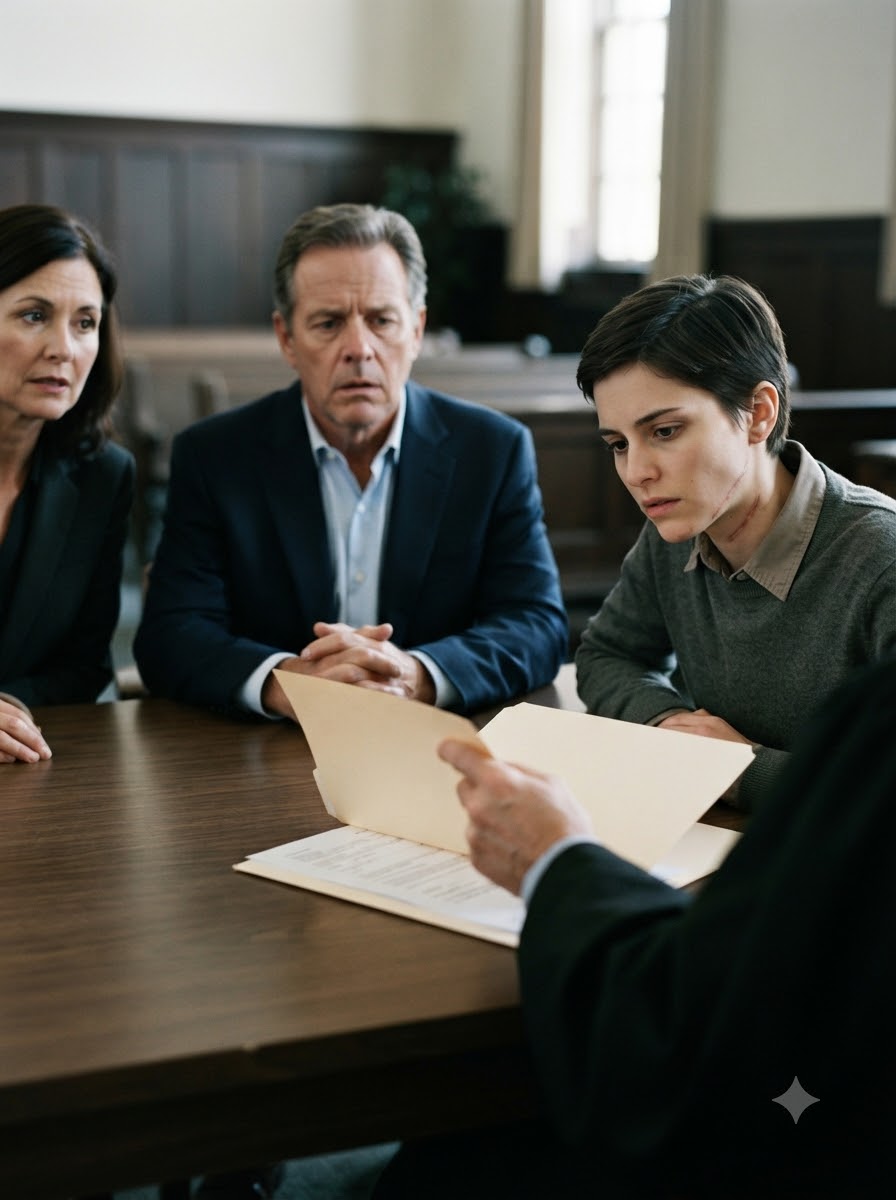
The clerk brought forward a thick envelope bearing the stamp of Mom’s attorney. It had been sealed with red wax and signed across the flap by two witnesses.
Dad stopped looking bored.
His attorney leaned toward him and whispered.
The judge confirmed that the conditions for opening the envelope had been met. Mom was deceased. Dad had contested the estate. The documents inside were relevant to ownership and her final instructions.
The clerk cut the seal.
Priya removed the first page.
It was a notarized declaration from Mom.
Her name appeared at the bottom.
So did Dad’s.
He had signed as a witness.
The room seemed to shrink around him.
The declaration stated that Mom had paid for the house almost entirely through earnings from her nursing job, even though the deed had later been placed in both names. It explained that Dad had repeatedly pressured her to surrender control of her accounts. It documented the injuries in the medical file and described the safety plan she had created with her attorney.
Then came the sentence that changed the estate dispute.
Mom had established a separate memorial fund containing the proceeds from the sale of her personal property. The money was to be used for a stone in the garden behind the church where her parents were buried. Any remaining funds were to be placed in a trust for me, because I was the only child who had provided her regular care during her illness.
The garage-sale money had never belonged to Dad.
It had never even belonged to the household.
It belonged to Mom’s memorial fund.
The final pages contained a transfer agreement, signed by Dad six months earlier.
He had signed it because Mom told him it was a routine property acknowledgment. The document stated that her jewelry, clothing, tools, kitchenware, and personal effects remained hers alone and that proceeds from their sale would be distributed according to her written instructions.
Dad stared at the page.
His attorney asked to review the signature.
The judge handed him a copy.
“It’s not binding,” Dad said.
His voice was suddenly thin.
The judge looked at him. “You signed it.”
“I didn’t know what it was.”
“You testified earlier that you reviewed the household documents before the garage sale.”
Dad’s face hardened. “She was sick. She wasn’t thinking clearly.”
Priya placed the medical file on the table.
“That claim is contradicted by every physician who treated her,” she said. “And by the attorney who met with her privately four times.”
The judge opened the first medical report. Mom’s doctor had documented that she was alert, oriented, and capable of understanding financial decisions. The attorney’s notes confirmed that Mom had read every page aloud before signing.
Then Priya revealed the final piece.
Mom had recorded a video statement at her attorney’s office.
It showed her seated at a desk, thinner than I remembered but steady and clear. She identified Dad by name. She explained the memorial plan. She stated that she was leaving him nothing beyond property already held jointly by law, and that he was not to take money from her personal effects.
Then she looked directly into the camera.
“If he says I was confused,” she said, “remember that he has said that every time I disagreed with him.”
Dad’s attorney objected.
The judge overruled him.
The video continued.
“I want my daughter to know that protecting my wishes is not an act against the family. It is an act of love toward me. She has spent her life being told that silence keeps peace. It does not. It only hides the person making the damage.”
I could not look at Dad.
I looked at the screen and listened to Mom’s voice fill the courtroom.
When the video ended, there was no sound for several seconds.
Dad tried one last time.
He said Mom had been manipulated by me. He said I had forged the paperwork. He said the medical photographs could have been taken from anyone. He said the transfer agreement was meaningless because he had not understood it.
The prosecutor reminded the court that Dad’s signature had been witnessed by Mom’s attorney and notarized. Detective Alvarez testified that the original documents had been recovered from the locked cabinet before I knew they existed. The doctors confirmed Mom’s capacity. The witnesses confirmed the assault.
There was nowhere left for him to move.
The judge ruled that the $1,847 belonged to Mom’s memorial fund. The estate claim was dismissed. Dad was ordered to repay the legal costs caused by his false claim and surrender any property he had removed from the house.
The criminal case ended with a conviction for aggravated assault and attempted theft. Because of his age and lack of prior convictions, Dad avoided a lengthy prison sentence, but the judge imposed probation, mandatory anger-management treatment, restitution for my medical bills, and a strict no-contact order.
He was required to pay for the reconstruction costs insurance had not covered.
He never did so willingly. His wages were garnished, and the house was eventually sold to satisfy the judgment.
My sister apologized after the verdict. She said Dad had frightened her for years, too, but she had not known how to stand against him.
My brother returned the tools.
I did not immediately forgive either of them.
Forgiveness, I learned, was not a door other people could demand I open because they were tired of standing outside it.
The memorial stone was installed in the church garden eight months after the assault.
It was simple: pale granite, a carved border of vines, and Mom’s name beneath the words she had chosen herself.
She had wanted it to say, “She made room for growing things.”
I stood there on a cold morning while the stone was set into the ground. My jaw ached in the damp air. My scar pulled when I smiled. I still carried a numb patch along my cheek, a permanent reminder of the moment my father decided I was easier to hurt than to hear.
But the money had done what Mom wanted.
The marker stood among the flowers, clean and solid and impossible to bargain away.
For years, Dad had taught us that family meant surrendering to the loudest person in the room. He had mistaken fear for loyalty and silence for agreement.
Mom had spent her final year quietly undoing that lesson.
She left the evidence in a locked cabinet. She left the instructions with her attorney. She left her signature beside the truth. And she left me the courage to speak after he was certain I would not.
I had thought the memorial stone was the thing I was fighting to save.
I was wrong.
I was fighting to prove that my mother’s wishes had value, that my life had value, and that the person who had controlled both of us for decades no longer had the final word.
This time, he did not.
Mom did.

More From This Author