STORY
My Ultrasound Found a Capsule—Then Javier Revealed What He Planned at Delivery
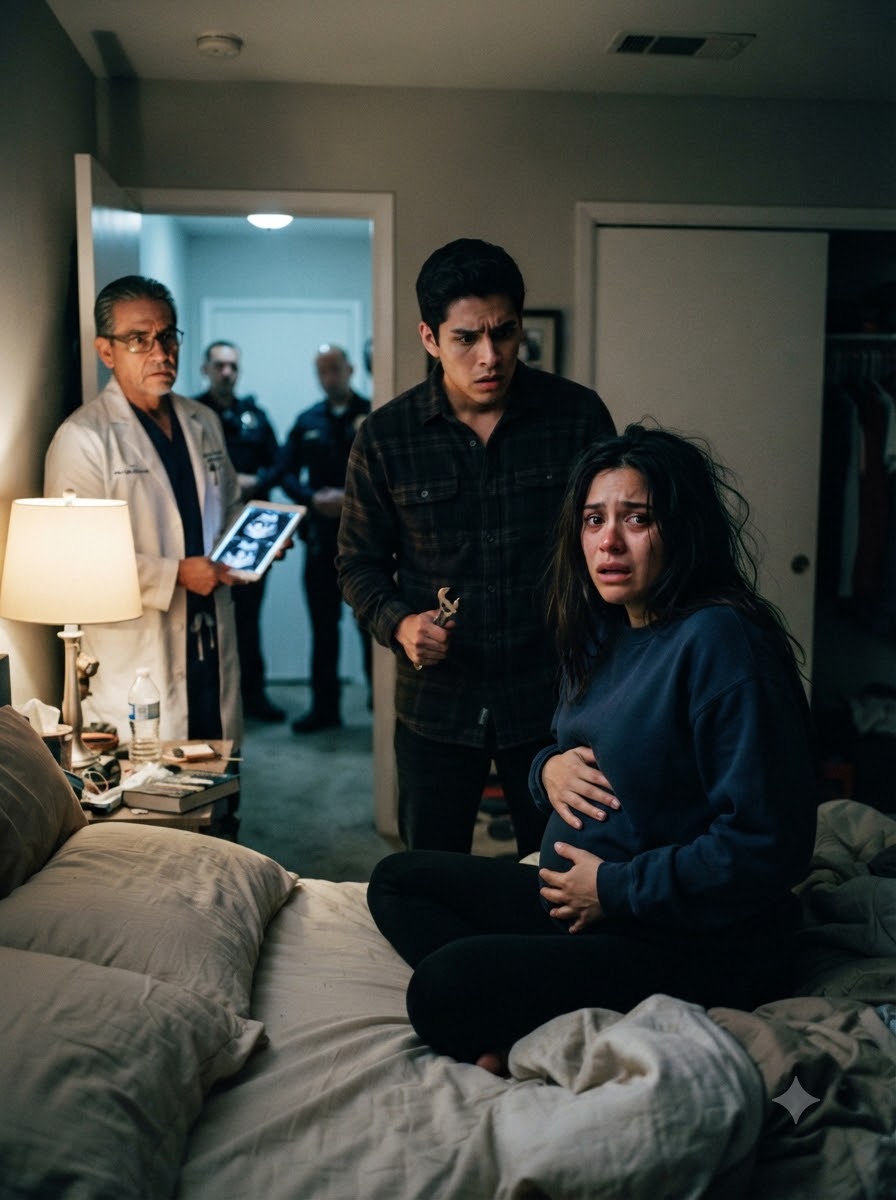
I did not know whether he was watching me at that moment.
So I waited.
At dawn, while Javier showered, I went into his office.
I had entered that room hundreds of times, but never alone. He kept the door locked whenever he was away. That morning, it stood open because he had forgotten to turn the key.
His desk was immaculate. Medical journals. Prescription pads. A framed photograph of us at our wedding.
I opened the bottom drawer.
Inside were three folders labeled with dates.
The first contained copies of my blood tests. Several values had been marked in red. The second held receipts from a medical supplier. The third was labeled with my name and a word I had never seen before.
Protocol R-17.
My hands began shaking.
The folder contained photographs of ultrasound images, all taken from angles Javier had never shown me. The object was visible in each one. A few notes were written beside the images.
“Stable placement.”
“No migration.”
“Fetal viability excellent.”
“Removal at birth.”
At the bottom of the folder was a consent form bearing my signature.
I read it twice before understanding what I was seeing.
The signature looked like mine, but the letters were stiff and uneven. The document stated that I had volunteered for an experimental implant designed to monitor fetal development and had agreed to participate in a private research program.
I had never signed it.
Beneath the form was a copy of my passport and a bank statement showing a payment of $180,000 into an account under Javier’s name.
I heard the shower turn off.
I shoved everything back into the drawer and closed it just as the bathroom door opened.
Javier appeared in the hallway wearing a towel.
“What are you doing?”
I turned toward him with my hand on my belly.
“I was looking for the blood pressure machine.”
His eyes moved to the drawer.
Then to my face.
For one second, something cold and naked appeared in his expression.
Then it vanished.
“It’s in the bedroom,” he said.
He walked toward me.
I forced myself not to move backward.
“You should be resting,” he said. “Your pulse is elevated.”
“I had a bad dream.”
His hand rose toward my face.
I flinched.
He noticed.
That small movement changed the air between us.
Javier lowered his hand slowly.
“What happened?”
“Nothing.”
He smiled.
But his smile no longer belonged to my husband. It belonged to a man who had realized the lock on a cage was not holding.
That afternoon, Dr. Morales arranged the MRI through a colleague at a hospital outside the city. She told me to leave my car at home, bring no personal devices, and tell no one where I was going.
The MRI confirmed that the object was not organic.
It was a medical-grade capsule embedded in the soft tissue near the uterine wall. It had been placed without a surgical scar, most likely through a specialized injection device. The radiologist could not identify its purpose from the image, but he found something else.
A second, smaller structure extended from the capsule.
A filament.
It ended near a blood vessel but did not enter it.
Dr. Morales sent the images to a biomedical engineer she trusted. The engineer recognized the design.
It was an implantable telemetry device.
Not a simple tracker.
It could record temperature, heart rate, hormone changes, and the levels of certain medications. It was used in restricted clinical trials involving high-risk pregnancies.
But the device had been modified.
The engineer found a concealed radio component and an encrypted data chip.
“It may be transmitting,” he told us. “And whoever installed it may have been able to alter or trigger something remotely.”
Dr. Morales stared at me.
“What kind of something?”
“Possibly a localized drug release.”
The room went silent.
Then the engineer explained that an experimental reservoir could release a small dose of medication through the filament. Not enough to be immediately obvious, but enough to induce contractions, affect blood pressure, or interfere with clotting.
My fear had been right.
Javier had not merely implanted an object in me.
He had built a mechanism that could create the medical emergency he planned to use as an excuse.
The second revelation came from the financial records.
Dr. Morales connected me with a hospital investigator, Samuel Ortiz, who specialized in physician misconduct. He traced the number on the receipt in Javier’s folder to a private fertility company called Novacell.
Novacell had been conducting an illegal pregnancy-monitoring program under the direction of a man named Dr. Rafael Rivas.
Javier’s father.
He had died six years earlier.
The company had collapsed after several patients complained of unexplained complications. But its remaining assets had been purchased by a holding firm controlled by Carmen.
My pregnancy was not an accident in the way I had believed.
Javier had married me knowing I was healthy, young, and from a family with a history of uncomplicated births. He had convinced me to stop using contraception after eight months of marriage. Carmen had helped arrange the appointments. The herbal tonics had contained compounds that affected ovulation and implantation.
They had selected me.
The $180,000 payment was only the first installment. The full contract promised $1.2 million if the pregnancy reached delivery and the fetus was transferred to a private adoption network.
The baby was intended for a wealthy couple who had already paid Novacell.
Javier and Carmen had planned to make my death look like an obstetric emergency. Javier would deliver the child, remove the device, falsify the records, and collect the remaining money.
The baby would be declared a legitimate family inheritance.
I was not the mother in their story.
I was the container.
Samuel Ortiz urged me to let him contact law enforcement immediately. But we needed proof that could survive Javier’s denial and Carmen’s influence.
So Dr. Morales and I made a plan.
I returned home carrying a hidden recorder supplied by the investigators. I acted frightened and apologetic. I told Javier I had gone to another clinic because I had been anxious, but I insisted the doctor had found nothing unusual.
He watched me without blinking.
“Nothing?”
“Nothing serious.”
“What did she say about the ultrasound?”
“That the baby was fine.”
His shoulders relaxed almost imperceptibly.
Then I asked, “Did you ever put anything inside me during one of my examinations?”
The change in his face was immediate.
He laughed too loudly.
“Are you accusing me of something?”
“I’m asking.”
“You’re pregnant and paranoid. You’ve been reading nonsense online.”
He came closer.
“Do you know how dangerous it is to distrust your doctor? Especially when he’s your husband?”
I stepped back.
His expression hardened.
“Who have you been talking to?”
“No one.”
“Carmen says you’ve been acting strangely.”
There it was.
I looked at him.
“Why does your mother know how I’m acting?”
He slapped me.
The sound was small, almost polite.
The shock was not from the pain. It was from the certainty that the last barrier had fallen.
Javier stared at his hand.
For a moment, I thought he might apologize.
Instead, he said, “You made me do that.”
The recorder captured every word.

More From This Author