STORY
The HOA Tried Towing My Coast Guard Boat—Then Agents Opened Diane’s Folder
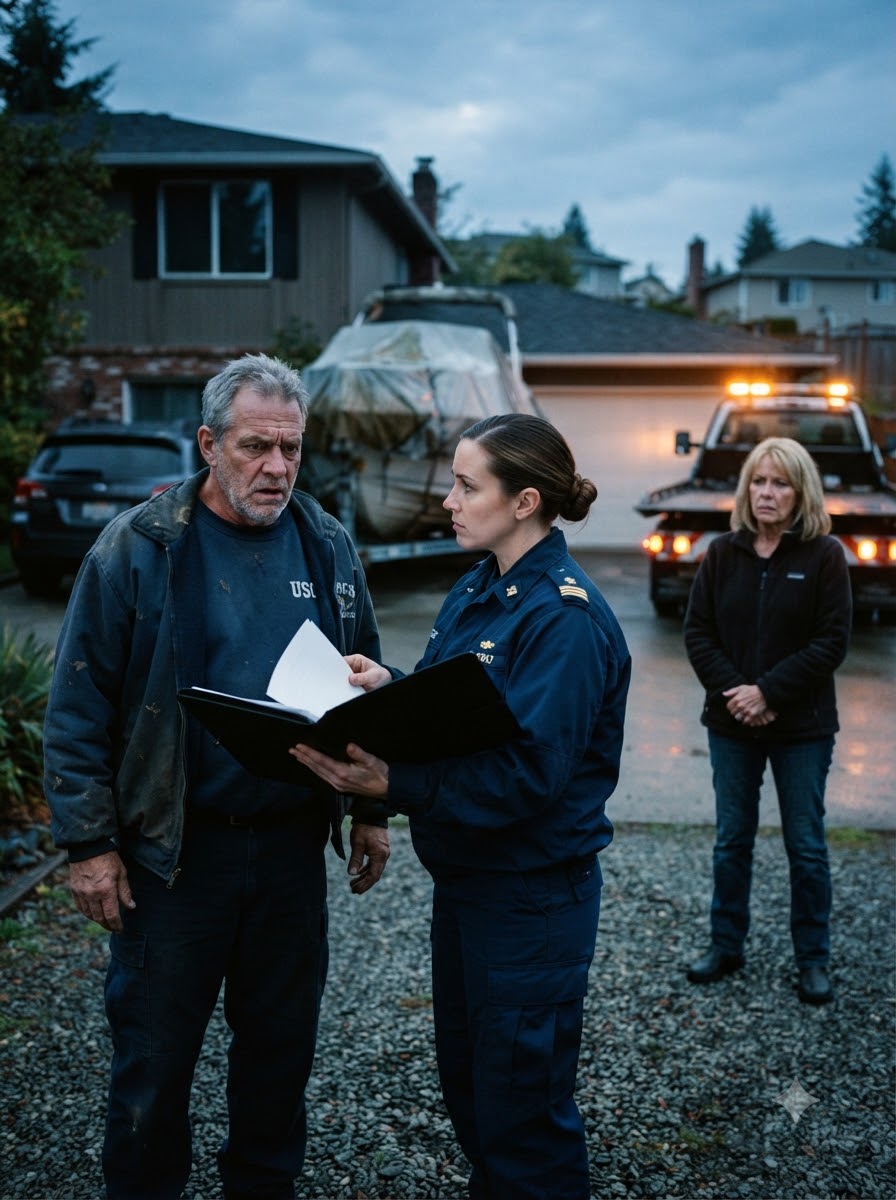
The lead agent looked at me.
“Mr. Mitchell, preserve your recording.”
Then he signaled to two members of his team.
“We have her signed order. Serve the warrant.”
Diane’s face changed.
“This is absurd. A warrant for what?”
“Fraudulent attempted conversion of federal property and related records,” the agent said. “The warrant covers the HOA office and electronic systems used to create this order.”
“You can’t search our office over a neighborhood violation.”
“We can search it because your signature is on a materially false declaration involving government property.”
Diane looked toward the gathering neighbors.
“This is Owen’s fault. He baited us.”
I almost laughed.
“You sent trucks into my driveway.”
“You brought that boat here knowing it violated the rules.”
“The covenants allow temporary service vehicles with written approval.”
“Approval from me.”
“Approval from the property owner and the relevant agency. I read the covenants.”
Her confidence flickered.
She had counted on me being too numb to read anything.
The agents left one SUV beside my driveway and drove the others toward the HOA clubhouse. Commander Ward remained while the tow operators removed their equipment.
Rick came to me with his jaw clenched.
“She told us the owner was refusing to identify the vessel.”
“I gave her everything.”
“She paid a rush fee in cash.”
That detail made Commander Ward look up.
“How much?”
“Eight hundred.”
“Do you have a receipt?”
Rick nodded slowly.
“And the envelope.”
By eight fifteen, the patrol boat was untouched, Dawson Recovery was gone, and Diane’s SUV was still at the curb because agents had taken her keys while they copied information from her phone.
The public humiliation she had planned for me had reversed itself.
But the boat was only the first layer.
At ten thirty, agents emerged from the HOA office carrying six evidence boxes, three computers, and the gray fireproof case Diane kept beneath her desk.
By noon, our neighborhood portal had gone offline.
That afternoon, Vice President Martin Hale knocked on my door. He looked as if he had aged ten years since breakfast.
“Can we talk?”
Lily sat at the kitchen island pretending to work on a scholarship essay. She watched him with Ellen’s ability to make silence feel like testimony.
Martin placed a stack of bank statements on the table.
“The agents found two sets of financial records.”
One set had been shown to the board.
The other came directly from the bank.
Over three years, nearly $184,000 had moved from HOA reserves into a company called Mercer Community Compliance.
Diane had described those payments as legal review, emergency landscaping, security patrols, drainage surveys, and code enforcement.
Mercer Community Compliance shared a post-office box with her brother, Calvin.
It had no employees, no business license, and no visible operations.
The $2,500 “special enforcement assessment” she had demanded from me did not appear in any board minutes because the board had never approved it.
There were nineteen similar assessments.
Most had targeted elderly residents, widows, deployed service members, and families dealing with medical emergencies. People least likely to attend meetings or hire lawyers.
Mrs. Alvarez had paid $1,200 after Diane threatened to place a lien over faded shutters.
Kevin Brooks had paid $3,000 to stop the HOA from foreclosing on his home during his wife’s chemotherapy.
Ellen had been on the list too.
Martin slid a copy of a ledger toward me.
My wife’s name appeared beside a payment of $4,800, dated six weeks before her death.
The note read: OFF-BOOK RESOLUTION—MITCHELL FENCE/BOAT ACCESS.
My throat closed.
“What is this?”
“I hoped you could tell me.”
I couldn’t.
Ellen had managed our household bills during her illness because she said it made her feel normal. After she died, I had avoided opening some of her personal files. They still smelled faintly of the lavender lotion she used.
Lily stood.
“Mom sold her necklace.”
I looked at her.
“What necklace?”
“The gold one Grandma left her. Mom said she needed money for a surprise for you.”
We found the pawn receipt in Ellen’s desk.
She had sold the necklace for $2,100. The rest had come from a savings account she had maintained since before our marriage.
Tucked behind the receipt was a printed email from Diane.
PAY THE COMPLIANCE SETTLEMENT BY FRIDAY OR OWEN’S SECURITY CLEARANCE MAY BE CONTACTED REGARDING REPEATED COVENANT VIOLATIONS.
Diane had threatened a dying woman with damage to her husband’s career.
Ellen had paid without telling me.
Lily began to cry first.
I didn’t.
Not then.
I sat in Ellen’s chair with the email between my hands and felt something colder than anger settle into place.
The next morning, Commander Ward called.
The federal case covered the attempted seizure and false statements, but the financial records pointed to state crimes. County investigators were joining the search.
They needed witnesses.
Cedar Ridge gave them plenty.
The emergency HOA meeting was held in the clubhouse three nights later. More than a hundred residents filled a room designed for sixty.
Diane arrived with a lawyer and her husband, Thomas. Their adult son waited near the rear wall, pale and furious.
Diane still dressed like a president. Navy suit. Pearl earrings. Leather folder.
She took the microphone before Martin could open the meeting.
“This community is under attack by a disgruntled resident and overzealous federal employees.”
People began shouting.
She raised her voice.
“I acted on advice from our management vendors. Any irregularities were administrative. Mr. Mitchell knowingly stored prohibited equipment to provoke a confrontation.”
Martin switched on the projector.
The first image was Diane’s signed towing order.
The second was the federal notice she had acknowledged.
The third was her text demanding $2,500.
She pointed at me.
“He manipulated those messages.”
Kevin stood near the aisle.
“I recorded you telling the driver to take the boat.”
Mrs. Alvarez rose beside him.
“I watched you refuse the federal letter.”
Rick Dawson entered through the back door with his attorney.
“I have the cash envelope,” he said. “Her fingerprints ought to still be on it.”
Diane’s lawyer whispered urgently, but she shoved his hand away.
“This is misogyny. A strong woman enforces standards, and suddenly every man in the room calls her a criminal.”
Then Lily walked to the front.
I had not asked her to speak.
She carried Ellen’s email and the pawn receipt.
“My mother was dying when you threatened her.”
Diane stared at her.
“I never threatened your mother.”
Lily placed the papers beneath the document camera.
Diane’s email filled the screen.
A sound moved through the room, not quite a gasp and not quite a growl.
Thomas Mercer looked at the screen, then at his wife.
“You said the Mitchells donated that money to the storm fund.”
Diane’s face emptied.
Her son pushed away from the wall.
“You told us your consulting income paid for my condo.”
“No family discussion,” her attorney said sharply.
But it was too late.
Martin displayed the bank transfers. Payments to the shell company. A check for the son’s down payment. Charges for a Mediterranean cruise. Tuition payments. A kitchen renovation at the Mercer home.
Diane tried one final escape.
“Calvin handled the company. I signed what he gave me.”

More From This Author