STORY
Valentina Couldn’t Sit in Class—Her Drawing Exposed an Earlier Report
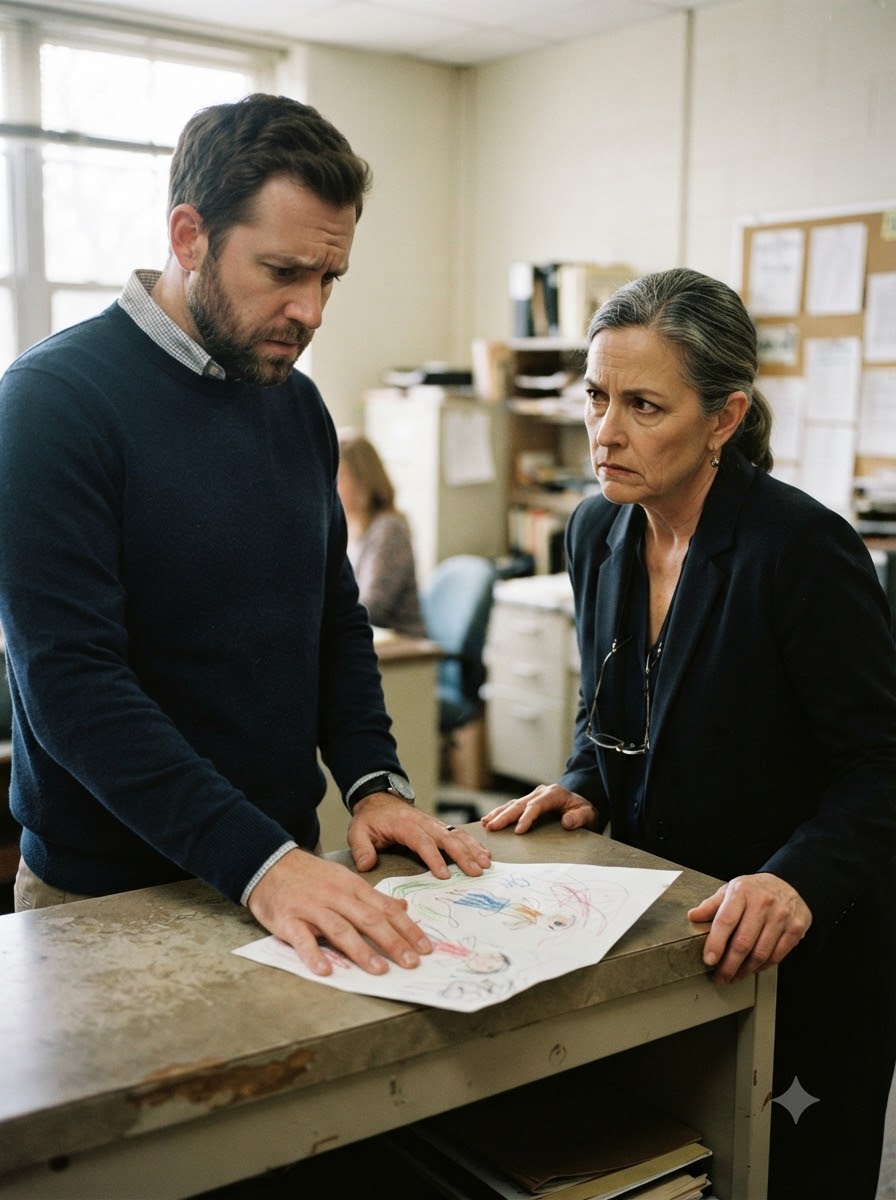
Martinez opened the folder.
She examined the police report first, then the drawing, then Daniel’s written account of the exchange at the gate.
“Who else saw the man speak with you?” she asked.
“Two students were waiting near the gate. Their families can be contacted. The crossing guard was there too.”
Detective Aaron Lewis studied the drawing.
“What do you believe the chair represents?”
Daniel hesitated.
“I don’t know. I’m not claiming I do. I’m reporting what happened and what she drew.”
That distinction mattered.
Martinez nodded.
“Good.”
Brooks stepped forward.
“This is exactly what I was worried about. He is interpreting ordinary childhood behavior as evidence of abuse.”
Martinez turned to her.
“Did you document the child’s statement from Thursday?”
Brooks opened her mouth.
“No formal report was made by the school.”
“You were present when officers interviewed her.”
“Yes.”
“Did you notify the district’s mandated-reporting officer?”
Brooks’s silence lasted too long.
Daniel felt the air change.
Martinez looked at him. “Did you report to the hotline?”
“Yes.”
“When?”
“Friday evening.”
Brooks gave a short laugh.
“So now we’re treating a teacher’s speculation as a verified accusation?”
Detective Lewis closed the folder.
“No one said verified. We said serious enough to investigate.”
The investigation began that day.
A school nurse reviewed the attendance records and discovered that Valentina had been marked absent three times in the previous month on days when classmates remembered seeing her arrive late. The explanations listed “stomach illness” and “family appointment.”
The nurse also found two earlier notes in the electronic system describing difficulty sitting and a change in Valentina’s behavior.
Both notes had been edited after they were entered.
The original versions were recovered from the district server.
One read: “Student cries when asked to sit. Says home has rules about chair.”
The revised version said: “Student prefers standing during independent work.”
Another original note said: “Student appears fearful when adult male visitor approaches gate.”
The revised version said: “Student shy around unfamiliar adults.”
The edits had been made using Principal Brooks’s administrator credentials.
Brooks denied making them.
Then the district technology director produced the access logs.
The edits had been made from the principal’s office computer at 5:42 p.m. and 5:49 p.m. on the same evening.
Brooks said her assistant must have used the computer.
Her assistant, Maribel Cho, denied it.
“I was at my daughter’s appointment,” Maribel said. “I have the check-in receipt.”
When confronted, Brooks claimed she had corrected “unprofessional wording.”
Martinez asked why the changes removed references to fear and pain.
Brooks said nothing.
The physical evidence surfaced two days later.
A county investigator visited Valentina’s home with a warrant after the child told a forensic interviewer that there was a “red chair in the laundry room.”
Valentina had not described what happened in detail. The interviewer did not press her.
The home was a narrow rental behind a tire shop. Daniel was not present, but he learned what happened from the investigator’s report.
In the laundry room, officers found a wooden chair with one leg repaired by silver tape. Red crayon marks covered the wall behind it.
The crayon marks were the same shade and pattern as those on Valentina’s drawing.
A drawer nearby contained a broken belt, a bundle of printed school forms, and a phone.
The phone belonged to Valentina’s stepfather, Marcus Hale.
The forms were copies of school records that should not have been in his possession. On one, a handwritten note read: “She talks at school.”
Another said: “Brooks says teacher is causing trouble.”
The phone contained messages between Marcus and Elaine Brooks.
At first, Brooks had written: “Keep her home if she complains again. We cannot have this become a school matter.”
Marcus replied: “She will say nothing if she knows what happens.”
A week later, after Daniel called the police, Brooks sent another message.
“Do not come to the school angry. I am handling Carter.”
Marcus answered: “Then handle him.”
The second layer of the revelation was worse than the first.
Marcus had not been acting alone.
Brooks had known about Valentina’s fear before Daniel ever called 911. She had learned about the chair from the nurse’s notes and from a conversation with Valentina’s mother, Sofia Reyes.
Sofia had gone to the school office three weeks earlier after Valentina came home crying and complained that her legs hurt. She asked whether her daughter had fallen during recess.
Brooks told her Valentina was “dramatic” and suggested that Sofia stop allowing “outside influences” to make the child anxious.
Sofia accepted the explanation because Marcus had told her Valentina was clumsy.
But she had not known Brooks was suppressing records.
She had not known Marcus was threatening the child.
When investigators showed Sofia the recovered messages, she covered her mouth.
“No,” she whispered.
Martinez placed the phone on the table.
Sofia read the message again.
“Is that why she kept asking me if teachers could be fired?”
No one answered.
Sofia began to cry.
“I thought she was scared I would lose my job,” she said. “Marcus told me children say things to break up families.”
Marcus was arrested that afternoon on suspicion of child abuse, criminal threats, and obstruction. The exact charges were later expanded after prosecutors reviewed the evidence and interviewed additional witnesses.
Elaine Brooks was placed on administrative leave.
She did not go quietly.
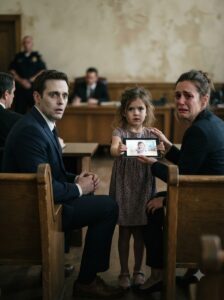
At the district hearing, Brooks wore a navy suit and spoke about dedication, reputation, and years of service.
“Everything I did was intended to prevent panic,” she said. “There was never proof that Valentina was in danger. Mr. Carter made assumptions and encouraged a narrative.”
Daniel sat behind the district’s attorney with his hands folded.
Brooks looked directly at him.
“He wanted to be a hero.”
Daniel said nothing.
Then the district attorney played the audio from the front gate.
The crossing guard had recorded part of the exchange on a small security device attached to her vest. The audio was muffled, but Marcus’s voice was clear enough.
“Don’t stick your nose where it doesn’t belong.”
The district attorney played the school security footage next.
It showed Brooks standing outside the conference room while officers interviewed Valentina. It showed her entering the teachers’ lounge with Daniel. It showed her pointing at him and then placing one finger across her lips.
The technology director explained the altered records.
Maribel Cho testified about Brooks’s instructions to “clean up” the file.
Then Sofia took the stand.
She described asking Brooks for help.
“I told her Valentina was afraid of the chair at home,” Sofia said. “I used those words because my daughter had said them. Principal Brooks told me not to make a family problem into a school problem.”
Brooks shook her head.
“That is not what happened.”
Sofia looked at her.
“You told me my daughter was trying to control me.”
“I said she was confused.”
“You told me she needed discipline.”
Brooks’s attorney objected.
The hearing officer allowed the testimony.
Finally, Valentina’s drawing was displayed.
No one claimed it proved the entire case. It did not need to.
It showed what a child had been unable to say directly.
A chair.
A circle of red.
A room with no safe person in it.

More From This Author