STORY
They Started a Thirty-Night Intimacy Challenge—Then She Told Him What Her “Yes” Had Been Hiding
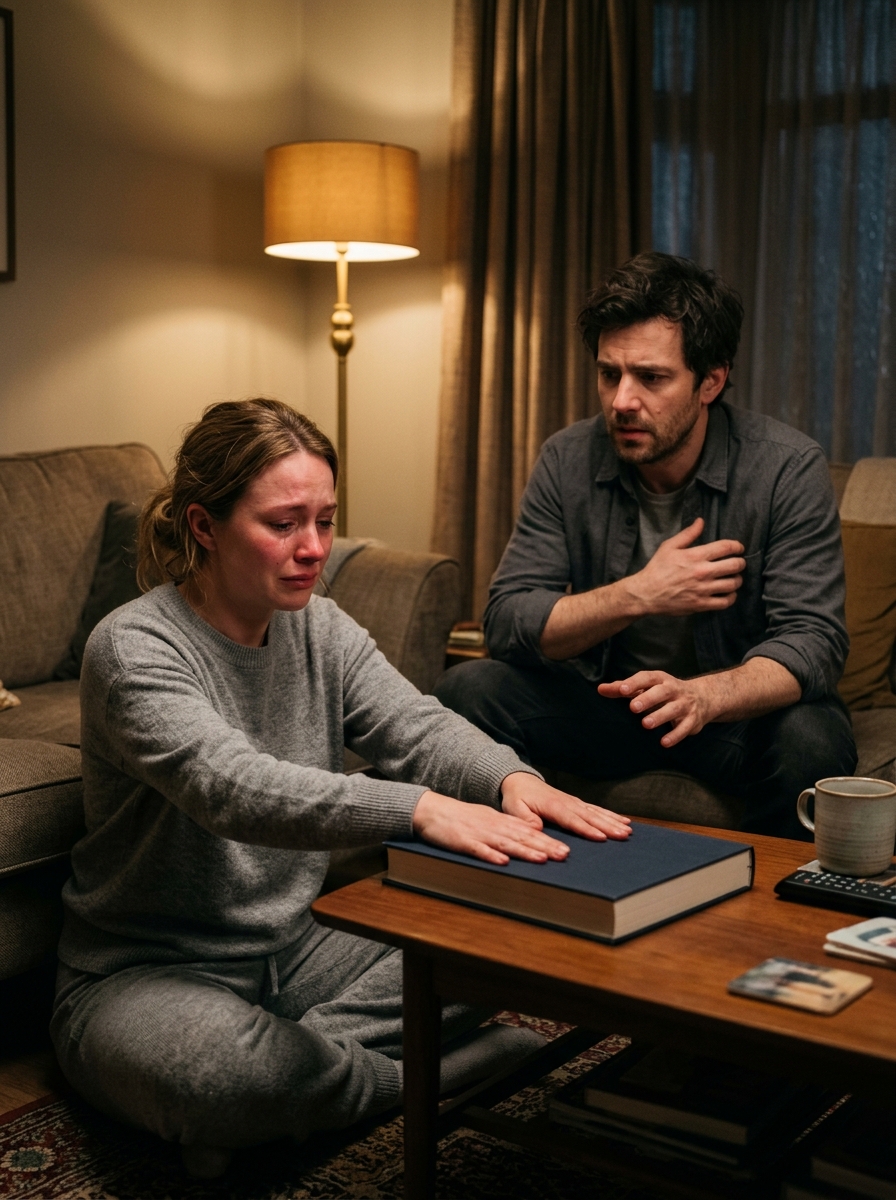
Theo’s hand hovered in the air for a second before he lowered it to his own knee.
“Did I hurt you?” he asked.
“No.”
“Did I scare you?”
“No.”
He waited, visibly trying not to fill the silence with the next question. That restraint, more than anything, made Nadia cry harder.
“I’m exhausted,” she said.
The room was warm, the lights low, the curtains drawn against a wet February night. On the coffee table, the book lay open to a page headed RECEIVE: SEVEN MINUTES OF UNDIVIDED ATTENTION. Beneath it, in cheerful print, the author had written, *The person receiving should not perform. They should simply allow themselves to be known.*
Nadia had read that sentence three times before Theo came back from the kitchen.
“It says I don’t have to do anything,” she said.
“You don’t.”
“It says I can use only three responses: yes, no, or pause.”
“You can use anything you want.”
“That’s not what the book says.”
Theo’s mouth tightened. “We don’t have to obey the book.”
“But we have been.”
He looked toward the shelf where they had placed the book six nights earlier, as if the first six evenings had happened in another room.
Nadia pushed herself upright on the sofa. Her heart was still racing from the moment she had taken his hand away. She had not meant to make the gesture dramatic. She had only needed space between his palm and her body before she lost the ability to speak.
Theo had been following the prompt exactly. He had turned off the overhead lights. He had put his phone in the hall. He had asked whether the room temperature felt comfortable. He had even remembered not to light the cedar candle she usually liked because the scent had given her a headache the previous week.
He had done everything correctly.
That was the problem.
“You told me I was beautiful,” she said.
“You are.”
“I said, ‘Thank you.’”
“You usually say thank you.”
“I said it like a receptionist.”
Theo blinked.
“Like I was confirming an appointment,” she continued. “Thank you for your compliment. Your attention has been received. I’m sorry, but all emotional availability is booked through Thursday.”
A startled laugh escaped him, then disappeared when he saw her face.
“I didn’t hear that,” he said.
“I know.”
“I didn’t think you were pretending.”
“I wasn’t pretending that I love you.”
“That’s not what I asked.”
“No.” She looked down at her hands. “It isn’t.”
For six nights, Nadia had given him polished pieces of herself. Some had been real. Some had been edited. Some had been assembled from things she had read, watched, or learned from other women who seemed to move through closeness without stopping to calculate the cost.
“I’ve spent my whole life figuring out what expression is expected,” she said. “When to laugh. When to lean in. When to say something was nice even if I was waiting for it to end. I thought marriage would be the place I could stop doing that.”
Theo’s face shifted with pain.
“I didn’t know you were doing it with me.”
“Neither did I. Not all the time.”
“That’s not a small thing, Nadia.”
“I know.”
“Were you acting every time we were together?”
She looked at him. “No. But sometimes I was acting while something real was happening. Those aren’t the same thing.”
He turned his wedding ring around his finger. He did that when he wanted to stay calm.
“Give me an example.”
She almost said *the first year we lived together*. Instead, she said, “When you touch me without warning.”
“I’ve asked you about that.”
“You’ve asked if I’m okay after you’ve already done it.”
His expression hardened, not with anger but with the reflex of someone trying to defend a record. “If you said stop, I stopped.”
“I know. You have always stopped when I said stop.”
“That matters.”
“It does.”
“Then what are we talking about?”
Nadia rubbed her palms over her thighs. “We’re talking about what happens before I say stop. We’re talking about the fact that I can feel you waiting for me to reassure you. We’re talking about how, when I say no, you respect the word but become so quiet that I end up comforting you. I start thinking about your face instead of my own body.”
Theo looked away.
“I don’t punish you,” he said.
“I didn’t say you did.”
“You’re making it sound like I do.”
“I’m telling you that your disappointment has consequences even when you don’t intend it to.”
The rain tapped the glass in small, persistent bursts.
Nadia had spent the last year trying to explain this without using words that sounded like accusations. She had called it timing. Stress. A need for transition. A bad week. She had blamed the museum, her migraines, the laundry, the neighbors, her hormones, the fact that the bedroom felt too warm.
She had not said: *Sometimes my nervous system closes the door before my heart has decided whether it wants company.*
She had not said: *I want you, but I cannot always move at the speed of your wanting.*
And she had certainly not said: *I am beginning to wonder whether the way I move through the world has a name.*
“I’m on a waiting list for an adult evaluation,” she said.
Theo went very still.
“For what?”
“I don’t know yet.”
“That sounds like something you would know.”
“I’ve been reading about sensory processing. Masking. The way some people learn to imitate ease so nobody notices how hard ordinary things are. I’m not diagnosing myself. I’m trying to understand why I can spend eight hours at work being perfectly pleasant and then come home unable to answer a simple question without feeling like I’m failing.”
“Why didn’t you tell me?”
“Because I didn’t want to become another project.”
His eyebrows drew together.
“You love projects,” she said. “You love a plan. You love finding the right system and making it work.”
“I love helping.”
“I know. That’s different from being willing to sit beside something you can’t fix.”
Theo absorbed that in silence.
Nadia reached for the book and closed it. The cover made a soft, final sound.
“I don’t want to finish it,” she said.
He nodded once. “The challenge.”
“The challenge.”
“Not us?”
She wished he had not asked so quickly. She wished she had a clean answer ready, something that could be placed on the table between them and examined from every angle.
“I don’t know,” she said.
His face emptied.
She hated herself for the instinct that rose in her—the urge to take the words back, soften them, offer him a sentence he could sleep with. *Of course us. I’m just tired. Tomorrow will be better.*
Instead, she held still.
“I know I want to find out,” she added. “But I don’t want to promise that the marriage is fine just because I can make tonight easier.”
Theo nodded again, slower this time.
“Okay,” he said.
The word was gentle. It was also wounded.
Nadia waited for the familiar pull to repair it. She waited for the impulse to reach across the space, kiss his cheek, and turn her honesty into something he could forgive.

More From This Author