STORY
They Started a Thirty-Night Intimacy Challenge—Then She Told Him What Her “Yes” Had Been Hiding
It came.
She let it pass.
***
Nadia and Theo had never been the kind of couple their friends described as distant.
They hosted crowded dinners in their narrow row house. They sent each other photographs during the day: an unusually shaped carrot, a dog wearing yellow boots, the sunset reflected in an office tower. Theo knew which stories Nadia told when she was tired and which ones she told when she wanted to be admired. Nadia knew that Theo hummed when he was worried and became excessively interested in household repairs when he was sad.
They had been married for eight years and together for eleven. They had survived a cross-country move, a year of Theo’s unemployment, Nadia’s mother’s long illness, and the period when every conversation seemed to end with one of them saying, “We should probably talk about this.”
Their affection had not disappeared.
It had become conditional in ways neither of them had named.
They kissed hello. They slept tangled together when Nadia wasn’t overheated. Theo still reached for her in the dark, and she still liked the weight of his hand when she was the one who had asked for it.
But intimate moments had begun to carry too much information.
If Nadia wanted closeness, Theo heard *we’re okay*.
If she didn’t, he heard *you’re no longer wanted*.
A request for space became a referendum. A kiss became evidence. A quiet evening in bed had to mean something before either of them could relax inside it.
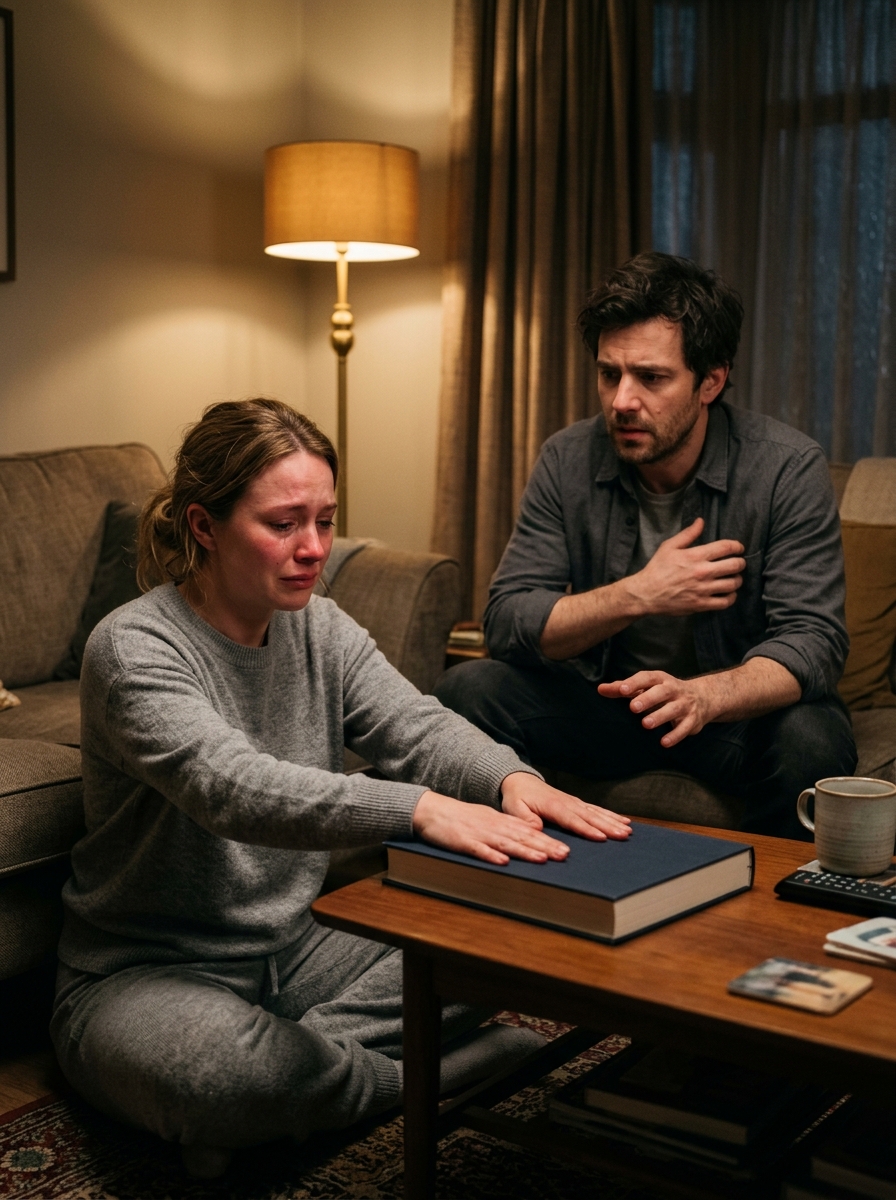
The book entered their marriage on a Thursday afternoon.
Theo found it in a used bookstore near his office. It was called *The Open Door: Thirty Days of Attention*, written by a couples therapist with a photograph of two laughing people on the back cover.
He placed it on the kitchen counter beside Nadia’s keys.
“Please don’t say it’s another relationship workbook,” she said.
“It’s an intimacy challenge.”
“That is worse.”
“It’s not about sex.”
“Everything that says it’s not about sex is usually very interested in sex.”
Theo turned the book around so she could see the cover. “It’s thirty days. One prompt a night. You don’t have to buy anything except maybe index cards.”
“Are index cards involved?”
“Not yet.”
She picked up the book. “What happens if we fail?”
“The author says there’s no failing.”
“That’s how you know there’s a hidden score.”
He laughed. Nadia liked making him laugh. It was one of the things she did without effort.
She flipped through the pages. The prompts sounded manageable. Share a memory that still makes you laugh. Sit together without phones. Name something you want protected. Ask for one kind of touch and one kind you do not want.
That last line stopped her.
“What?” Theo asked.
“Nothing.”
“You made a face.”
“I have several faces.”
“Noted.”
She put the book down. “It might be useful.”
His excitement came on too quickly, bright and boyish. “Really?”
“It has instructions.”
“I thought you hated instructions.”
“I hate being expected to know what people mean without being told.”
Theo looked at her for a second. “Then we’ll try it.”
They agreed on one rule: neither of them would treat the thirty days as a test of whether the marriage could be saved. The book was supposed to create attention, not prove anything.
That first night, the prompt asked them to name something they wanted protected.
Theo answered first.
“Curiosity,” he said. “I want us to protect the part of us that still gets interested in each other.”
Nadia looked down at the tea between her hands.
“The hour after I get home,” she said.
“Protected from what?”
“Questions.”
He considered this. “All questions?”
“For twenty minutes.”
“Can I ask if you want tea?”
“You can offer tea.”
“Without a question?”
“You’re learning already.”
He smiled. She smiled back. The response was genuine.
That was the difficulty. Nothing had been entirely false.
***
The first few nights gave them small successes.
On the second night, they each chose an object from the house and explained why they had kept it. Theo brought in a cracked green bowl from the back of a cabinet. It had belonged to his grandmother and had been repaired twice with gold glue.
Nadia chose a museum badge from her first conservation job.
“You kept that?” Theo asked.
“I was twenty-four. I thought the director had chosen me because he could see I was special.”
“Did he?”
“He chose me because I was the only applicant who didn’t misspell the name of the collection.”
Theo laughed so hard he had to put the bowl down.
On the third night, the prompt asked them to sit shoulder to shoulder for ten minutes without speaking.
Theo set a timer.
Nadia heard it ticking from across the room.
At minute four, she became aware of the seam in her jeans. At minute six, she wondered whether Theo could hear her breathing. At minute eight, he shifted, and she fought the urge to ask if he was uncomfortable.
When the timer chimed, Theo leaned his head against hers.
“That was nice,” he said.
Nadia said, “Yes.”
She had meant, *I liked being beside you without having to produce a conversation.*
He heard, *The exercise worked.*
The next night’s prompt was to write down one thing they admired and read it aloud.
Theo wrote, *You make people feel safe enough to tell the truth.*
Nadia’s throat tightened.
Her first draft for him had been, *You keep trying even when you don’t know what to do.* She had crossed it out because it sounded like praise for effort rather than love.
She wrote instead, *You make rooms feel inhabited.*
He smiled in the soft, pleased way he had when she gave him something he could keep.
“What does that mean?” he asked.
“It means the room changes when you’re in it.”
“Good change?”
“Yes.”
Another genuine answer.
Another edited one.
By the sixth night, Theo had begun referring to the prompts as if they were appointments.
“We have Night Six after dinner.”
Nadia would answer, “I know.”
The words were harmless. Her body heard pressure.
On Night Six, the book asked them to tell each other one thing that helped them feel wanted.
Theo took a long time before answering.
“I want you to initiate sometimes,” he said.
Nadia felt the old contraction beneath her ribs.
He saw it. “Not as a requirement.”
“It sounds like one.”
“I’m telling you what I miss.”
“I understand.”
“I don’t want you to do it because you think you’re supposed to.”
“That’s good.”
“I want you to want to.”
Nadia looked at the page between them. The book suggested that each partner respond only with gratitude, not explanation or defense.
She had wanted to say, *I want to want to. I often do want to. But by the time I understand that, you’re already asking, and my wanting has turned into a performance review.*
Instead, she said, “I can try.”
Theo touched her wrist.
She let him.
He mistook that for an answer.
***
Night Seven was called “Receiving.”

More From This Author