STORY
The Joke Her Husband Forgot Was the Reason She Stopped Letting Him Touch Her
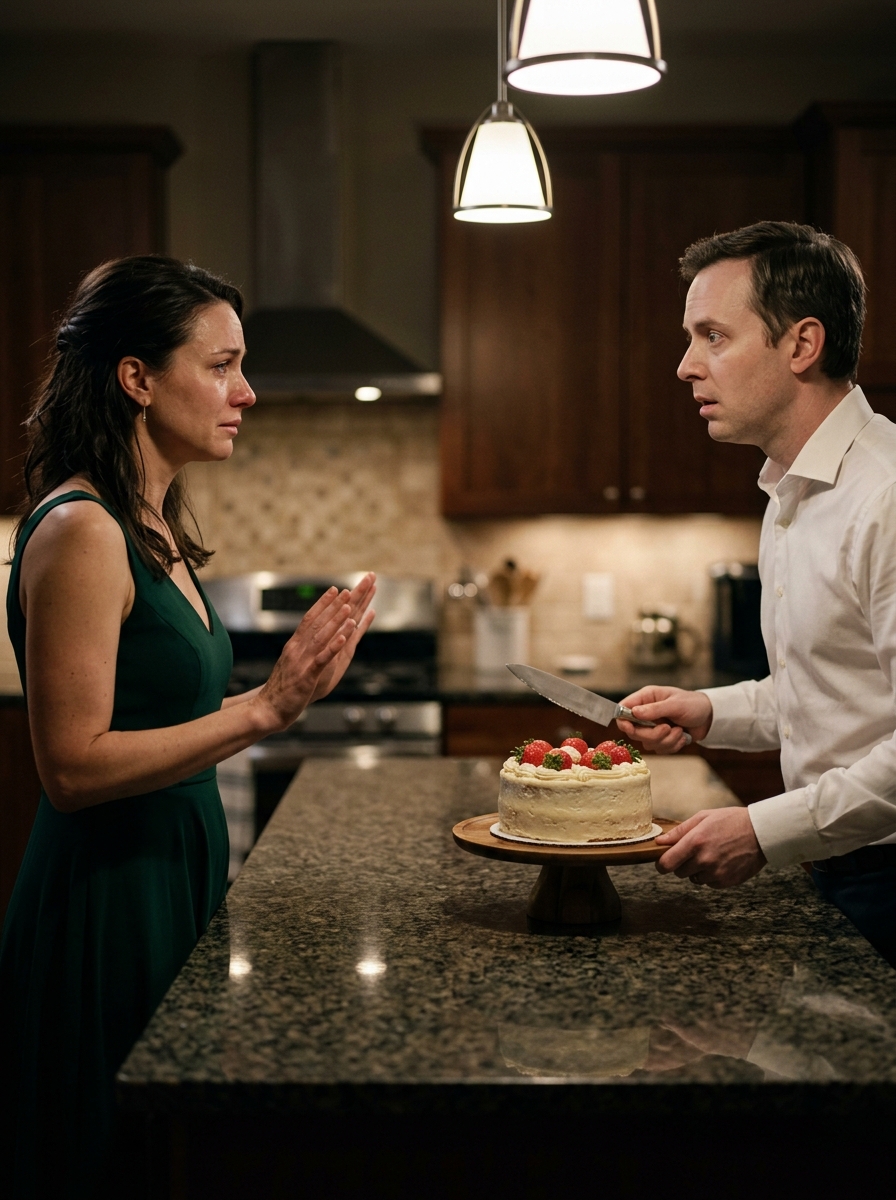
“What did I say?” Elliot asked.
His voice had changed. Until then, he had been trying to understand the shape of the emergency. Now he seemed to understand that the emergency had a date, a location, and his own voice attached to it.
Mara looked at the anniversary cake between them. The icing had begun to soften beneath the kitchen lights. Elliot had made it himself, though “made” meant he had bought a plain cake from the bakery near his office and added strawberries in a careful circle. He was good with circles. He restored old houses for a living and could make a crooked room look intentional.
For eight years, he had been able to repair almost anything except the thing neither of them had been willing to name.
“At Daniel’s lake house,” she said. “Three years into our marriage. August. You were wearing those red swim trunks you pretended not to care about.”
A startled breath escaped him. Not a laugh. The memory had found one corner of the room before the rest of it arrived.
“Daniel’s birthday,” he said.
“Yes.”
“You asked me if the suit was pulling.”
“I asked you if I looked okay.”
“I thought you meant the suit.”
“I meant me.”
He lowered his eyes.
Mara had planned to say the words calmly. She had planned to explain them in chronological order, like an editor marking a manuscript: this happened, then this, then this. But memory was not an orderly document. It was a body reacting before a mind could summarize.
She could still feel the rough cotton of the towel in her hands. She could still see the blue of the swimsuit, darker at the seams where it had been damp. She could still hear the deck boards creak under Daniel’s feet.
From the waist up, you’re a knockout. The rest is a little ambitious for that suit.
Elliot had said it as though he had thought of something clever. Daniel’s wife, Tessa, had laughed. Someone by the grill had repeated the last part. Elliot had laughed harder because other people were laughing.
Mara had smiled, because a smile was what a person used when she wanted the moment to end.
“I don’t remember saying it,” Elliot said.
“That doesn’t make it less true.”
“I know.”
“You don’t know yet.”
The words came out sharp. She had spent five years waiting for this conversation and was not going to let him skip to the part where he proved he was sorry.
Elliot sat across from her. He did not reach over the table. That mattered, though she hated that it mattered.
“Was that the day?” he asked. “Is that when you stopped wanting me?”
Mara looked at him. “I didn’t stop wanting you in one clean motion.”
He nodded once, as if taking notes.
“I stopped trusting what wanting me meant to you,” she continued. “There’s a difference.”
The kitchen window reflected them back: two people seated at opposite ends of a table set for an anniversary dinner neither of them had eaten. Mara wore a black dress with sleeves to her elbows. Elliot had changed into a clean shirt after work, leaving a faint smear of drywall dust near his wrist.
“For a while,” she said, “I could still be close to you if the room was dark. Then I needed a shirt on. Then I needed to be the one who reached first. Eventually, I stopped reaching.”
Elliot rubbed his thumb over the edge of the table.
“I thought you were tired.”
“I was.”
“I thought work was getting to you.”
“It was.”
“I thought maybe you were depressed.”
“I was lonely.”
His face tightened.
Mara hated the look. Not because it was false, but because it invited her to step across the table and make it easier for him.
“You asked me,” he said. “I know you think I didn’t, but I asked.”
“You asked at midnight, after I had already turned you down.”
“I asked because I missed you.”
“You asked what was wrong in the same tone you used when the dishwasher was making a strange noise.”
“That’s not fair.”
“No,” she said. “It isn’t. But it’s what it felt like.”
He leaned back. His first instinct was to argue, she knew. Elliot believed in clarifying facts. He believed that if two people could agree on what had happened, they could usually agree on what to do next.
But the facts were not the whole wound.
He had made the joke. She had laughed. He had forgotten. She had carried it into every room where he looked at her.
“I should have known,” he said.
Mara folded her hands in her lap. “Maybe. But I also should have told you.”
The admission did not relieve either of them.
***
The night after the lake house, Elliot had brought her a glass of water.
She had gone upstairs early, claiming a headache. In the bathroom, she had changed out of the swimsuit and put on a long T-shirt. She remembered standing in front of the mirror, turning slightly, inspecting the places he had made visible by naming them.
There was nothing wrong with the suit. It fit. She had bought it because she liked the square neckline and the broad straps. She had spent two weeks deciding whether she was allowed to wear it.
Elliot had knocked on the bedroom door.
“Do you want anything?”
“No.”
“Are you sure?”
“I’m fine.”
He had accepted the answer. That was part of what she had resented later. He had accepted it so completely.
He came upstairs and sat beside her on the bed. She could feel the mattress dip, then rise when he stood again.
“Do you want to come back downstairs?” he asked.
“No. I’m tired.”
“All right.”
He had kissed the top of her head. Mara had kept her eyes closed and waited until his footsteps faded.
The next morning, he had acted normal. Not cruelly normal. Not carelessly. Just normal enough that she had felt foolish for being changed.
She did not tell him on the drive home.
She did not tell him when he suggested they stop for lunch.
She did not tell him that night when he pulled her close and she moved away, saying she was too warm.
She told herself she was protecting the marriage from one stupid sentence. Then she told herself she was protecting herself from having to explain why one stupid sentence mattered. After a few months, the explanation felt too old to bring into the room. After a few years, it felt like evidence against her.
Who waits five years to say, You embarrassed me in a swimsuit?
Someone who has been embarrassed for five years, she thought now.
“I should have told you,” she said again.
Elliot’s expression shifted. “You were afraid I’d think you were overreacting.”
“I was afraid you’d say you didn’t mean it.”
“I would have.”
“I know.”
He flinched.
“That isn’t the same as saying you wouldn’t have cared,” she added. “But when someone says they didn’t mean something, the person who got hurt is suddenly expected to prove why it hurt anyway.”

More From This Author