STORY
My Son’s Wedding Quilt Exposed Why His Fiancée Wanted Our Orchard Deed
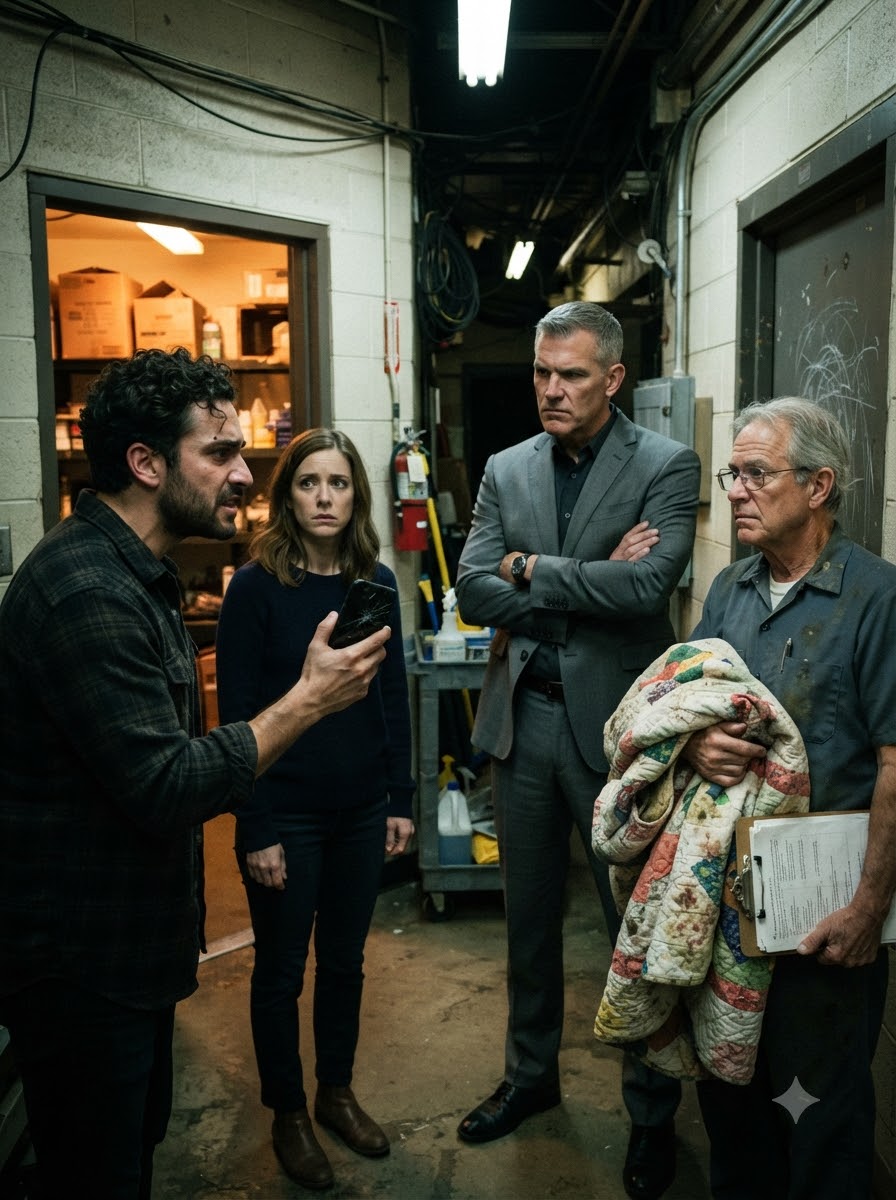
Thirty minutes before my son’s rehearsal dinner, a stranger handed me the quilt I had made for his wedding.
It was stuffed inside a clear kitchen-garbage bag.
Coffee grounds clung to the plastic. A dark stripe of grease soaked one corner, right through the white border where I had embroidered Caleb’s initials.
For a moment, I couldn’t breathe.
I had spent nine months sewing that quilt from my late husband’s dress shirts. Blue checks from Sunday mornings. A red plaid square from the shirt he wore every Christmas. Pale cotton from the one Caleb’s father had worn the day our son graduated from college.
It was supposed to lie across the foot of the bridal suite bed so Caleb would feel that his father, Thomas, was with him.
Instead, someone had thrown it into the venue dumpster.
The man holding it wore a maintenance uniform with a name patch that said ORTIZ. He was perhaps sixty-five, with silver hair and the upright posture of someone who had spent his life refusing to slouch.
“Mrs. Mercer?” he asked.
“Yes.”
“I’m Rafael Ortiz. Facilities supervisor.”
He glanced toward the ballroom doors. Inside, the florist was lighting candles while Marissa’s bridesmaids laughed over champagne.
Mr. Ortiz lowered his voice.
“I believe you’ll want to see what else I found.”
He handed me a crumpled clipboard.
The top page was damp around the edges, but the words in the center were clear.
LETTER OF INTENT FOR COMMERCIAL ACQUISITION.
The property description listed eighty acres in Bellweather County.
Mercer Family Orchard.
My land.
Below it was an offer from Halcyon Ridge Development for $1.4 million. The stated purpose was “mixed-use retail and luxury residential construction.”
At the bottom, two names appeared beneath the words CO-MANAGING PARTNERS, M&D LAND HOLDINGS, LLC.
Marissa Vale.
Damien Cross.
The document was dated fourteen months earlier.
Three weeks before Marissa accepted Caleb’s proposal.
My fingers went numb.
Damien was the tall man in the gray suit Marissa had introduced to us as her cousin.
I turned the page.
There were property maps, projected commissions, and a timeline built around “transfer of Mercer beneficial interest following marriage.” A handwritten note beside the final phase read:
C signs waiver by June. M controls disposition upon triggering event.
Attached to the back was a folded ultrasound printout from a clinic in Dallas.
A patient number appeared at the top. Beneath it was Marissa’s full name.
Gestational age: seventeen weeks.
And in the emergency contact section, typed beside “father of child,” was Damien Cross.
The rehearsal dinner was about to begin.
Caleb believed the baby was his.
Mr. Ortiz looked at the quilt in my arms.
“I saw the bride and the man in the gray suit by the loading dock,” he said. “He carried the clipboard. She carried that bag. When they saw me coming, they tossed both and walked away.”
“You saw them throw out the quilt?”
“Yes, ma’am.”
“Did they say anything?”
His jaw tightened.
“The bride said nobody wanted ‘thrift-store grandma energy’ in the photographs. Then she laughed.”
The words hurt, but not nearly as much as the signature on that contract.
I forced myself to think.
“When did this happen?”
“Ten minutes ago.”
“Do you have cameras near the loading dock?”
“Yes.”
“Please make sure that footage isn’t deleted.”
His expression changed. He understood this was no longer about an insult.
“I’ll lock the files personally.”
I thanked him and carried the quilt into an empty service office. My hands trembled as I laid it across a metal desk.
The grease had spread into one of Thomas’s blue shirt squares.
I remembered cutting that shirt after his funeral. I had cried so hard I couldn’t keep the scissors straight.
Now grief sharpened into something cleaner.
I photographed every page on the clipboard. Then I called my older sister, Elaine, who had practiced real-estate law for thirty-two years.
She answered on the second ring.
“You’re supposed to be drinking champagne,” she said.
“Go somewhere private.”
She heard my voice and stopped joking.
I sent her the photographs.
While she read, I stared through the office window at the hallway. Bridesmaids drifted past in silk dresses. A waiter carried trays of wine. Somewhere nearby, Marissa was preparing to toast a future she had apparently priced at $1.4 million.
Elaine called back four minutes later.
“Do not give these papers to Caleb yet.”
“What?”
“Listen to me. The letter of intent isn’t a final sale, but it proves planning. The LLC is real. I checked the state registry. Marissa and Damien formed it sixteen months ago.”
Before Marissa had even met my family.
Elaine continued.
“The handwritten note concerns me. What exactly did Caleb sign?”
“A premarital agreement last month. Marissa called it a waiver. She said she wanted no claim to his family property, so Caleb thought it proved she wasn’t after money.”
“Did he have his own lawyer?”
“No. Marissa’s lawyer said it was simple.”
Elaine swore softly.
“Send me the agreement if you have it.”
I did. Caleb had emailed me a copy after signing because I had asked for one. At the time, its language had seemed dense but reassuring.
Elaine called again.
“That document is not a clean waiver,” she said. “It contains a power-of-attorney clause buried in an exhibit. If Caleb becomes incapacitated, his spouse can direct assets held for his benefit. It also says he consents to conversion of inherited agricultural property if the trustee deems it economically necessary.”
“I’m the trustee.”
“For now. But the trust amendment Caleb signed two weeks ago nominates his spouse as successor trustee.”
I gripped the desk.
Caleb had told me Marissa wanted paperwork settled before the baby came. She had sat at my kitchen table, one hand resting on her stomach, speaking tenderly about protecting the orchard.
Thomas and I had put the land into a family trust years ago. Caleb was the beneficiary, but I controlled any sale while I lived.
Marissa couldn’t sell the orchard merely by marrying him.
But if she replaced me as trustee—or created the appearance that I could no longer serve—she could push a sale through.
“What triggering event?” I asked.
“I don’t know yet,” Elaine said. “Don’t confront her until we do.”
I looked again at the handwritten note.
M controls disposition upon triggering event.
Then I remembered Marissa’s sudden concern about my memory.
For six months, she had corrected me in front of Caleb over things I had never forgotten.
“You already told us that story, Diane.”
“You misplaced your keys again.”
“Are you sure you took your blood-pressure pills?”
Once, she moved a dinner reservation from seven to six and told Caleb I had confused the time. Another afternoon, my truck keys vanished from their hook and appeared inside the freezer.
Caleb had gently suggested I schedule a cognitive evaluation.
I had blamed stress.
Now I opened the clipboard folder and examined every sheet.
Behind the ultrasound was a photocopy of a petition that had not yet been filed.
PETITION FOR DETERMINATION OF INCAPACITY AND APPOINTMENT OF EMERGENCY FIDUCIARY.
Petitioner: Caleb Mercer.
Except the signature at the bottom wasn’t Caleb’s.

More From This Author