STORY
Patrick Brought a Realtor to Walter’s Ranch—Then the Surveyor Opened Her Map
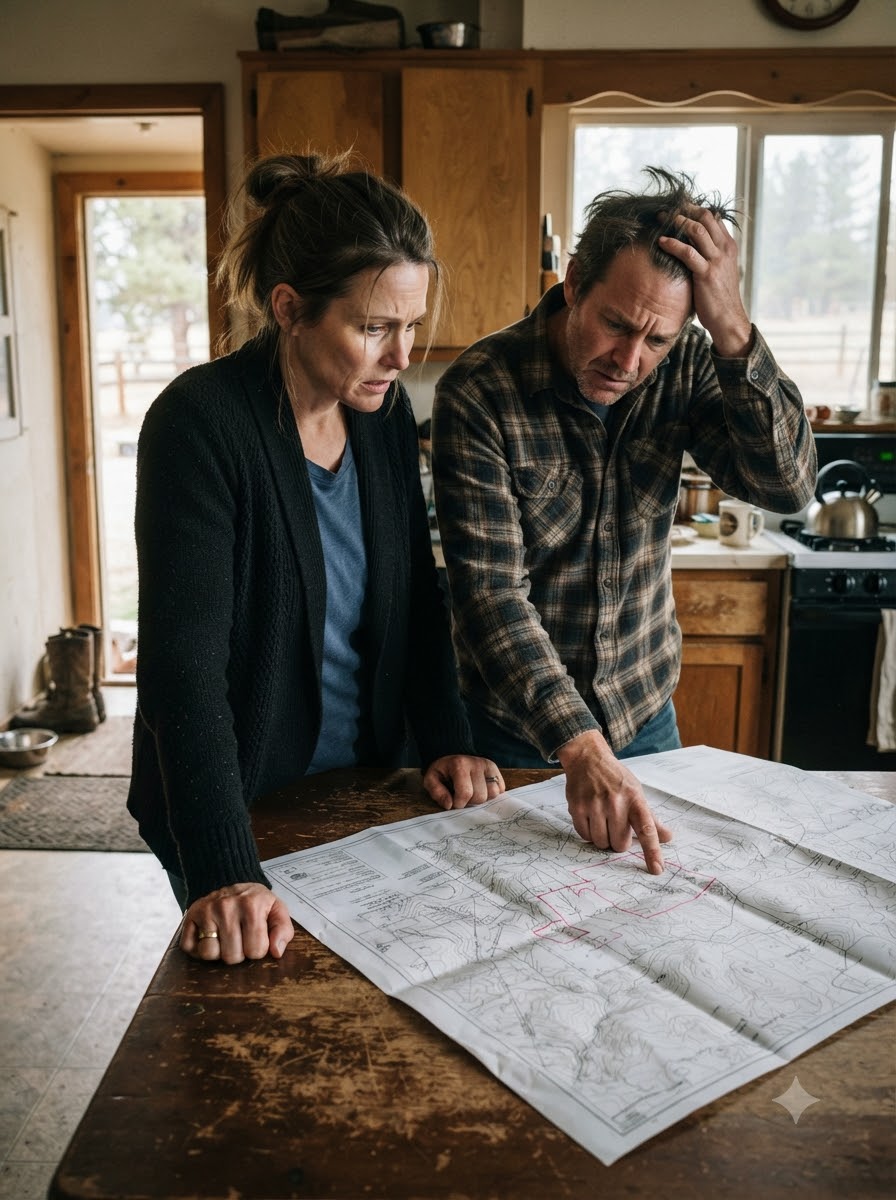
The first thing Patrick did after his father died was cancel my credit cards.
The second was arrive at my ranch with a real estate agent.
Walter’s obituary had not even appeared in the local paper. The funeral home was still waiting for me to approve the final wording when Patrick’s black SUV rolled through the front gate, followed by a silver sedan with a magnetic real estate sign on its door.
I watched them from the kitchen window.
The late-November wind pushed dry grass flat across the pasture. Beyond it, the cottonwoods stood bare and black against a hard gray sky. Walter had loved that view. He used to say the ranch looked most honest in winter, when nothing was hiding behind leaves.
I had been awake for thirty-six hours. My husband had died three days earlier in the hospital after a short, brutal fight with pneumonia. His boots were still beside the back door. His reading glasses rested on the arm of his chair. A half-finished cup of coffee sat on the counter, the surface filmed with dust.
Then Patrick walked into my kitchen without knocking.
His sister, Melissa, followed him on speakerphone through the phone he held in one hand. The real estate agent trailed behind, already looking around.
“Elaine,” Patrick said. “We need to discuss the property.”
He dropped a photocopy on the kitchen table.
It was a will dated 1998.
“Dad left the ranch to us,” he said. “You have until Friday to pack your truck.”
The agent moved toward the windows.
“Please don’t take pictures inside the house,” I said.
She glanced at Patrick.
“It’s going on the market,” he replied.
“Not today.”
“Actually, Elaine, you don’t get to decide that.”
I looked down at the photocopy. Walter’s signature was on the last page. The document left “the ranch and all adjoining real property” to Patrick and Melissa in equal shares. It also stated that Walter’s then-wife, Susan, could remain in the residence for her lifetime.
Susan had died in 2007.
I set the paper down.
“You had this all ready,” I said.
Patrick’s mouth tightened. “Dad was very clear about his wishes.”
“Your father was very clear about a lot of things. For example, he was clear that he didn’t want you here while I was grieving.”
“He isn’t here to object.”
The words landed harder than I expected.
Melissa’s voice crackled from the phone. “Elaine, this is not personal. We’re simply following the will.”
“Then why did you cancel my cards?”
A silence followed.
The previous night, I had stood in a grocery store checkout line while my replacement card was declined. Then my gas card had failed at the fuel station. When I called the bank, I was told that an authorized user had reported Walter’s death and requested that several accounts be frozen.
Patrick had been an authorized user on one of Walter’s old business accounts.
He had used it to start dismantling my life before Walter’s obituary existed.
“That was a temporary security measure,” he said.
“You canceled cards in my name.”
“Those accounts belonged to Dad.”
“The account statements came to my address. The cards had my name embossed on them.”
“Everything is being sorted out.”
Behind him, the real estate agent lifted her phone and took a picture of the stone fireplace.
I stepped between her and the room.
“Leave.”
Patrick laughed once, without humor.
“You really think you can throw us off our own property?”
I looked past him, toward the front gate.
A white county surveyor’s truck had just turned onto the gravel drive.
Patrick followed my gaze.
“What is that?”
“Someone I called this morning.”
The surveyor parked beside the cattle guard. A man in a red cap climbed out with a tripod and a metal case. He raised a hand to me through the glass.
Patrick’s expression changed.
“What did you do?”
“I did what you should have done before you brought a photographer into my house.”
The real estate agent lowered her phone.
Patrick grabbed the will from the table. “This proves ownership.”
“No,” I said. “It proves you found an old piece of paper.”
He stepped closer. “My father owned this land.”
“Your father owned a great deal of land.”
“And you married him twelve years ago.”
“Yes.”
“When he was sick and broke.”
I stared at him.
That was the story Patrick had always preferred. It allowed him to imagine that I had arrived at the ranch with nothing but a suitcase and a plan to take what belonged to his family.
The truth was less flattering to him.
When I married Walter, the ranch was three hundred ten thousand dollars in arrears to the farm credit bank. The barn roof had collapsed over the east stalls. Half the fencing was down, the irrigation pump was failing, and the cattle operation was losing money every month.
Patrick lived in Phoenix and sold commercial insurance. Melissa lived outside Boston and had not visited in four years.
Neither of them had offered Walter a loan.
Neither had come when the bank threatened foreclosure.
I had sold my townhome in Denver. I used the proceeds to pay off the bank note, repair the barn, replace the pump, rebuild the fences, and buy new breeding stock. Walter and I worked side by side for twelve years. I handled the books, payroll, feed contracts, insurance, and veterinary schedules. He handled the cattle, the machinery, and the land.
We had not simply lived here.
We had rebuilt the place.
Patrick knew that. He just didn’t believe it counted.
The surveyor entered after I unlocked the door. His name was Thomas Rusk, and he had worked for the county for twenty-six years. He nodded politely at Patrick.
“Mr. Harrow,” he said.
Patrick’s face went pale. “You know him?”
“Everyone in this county knows Thomas.”
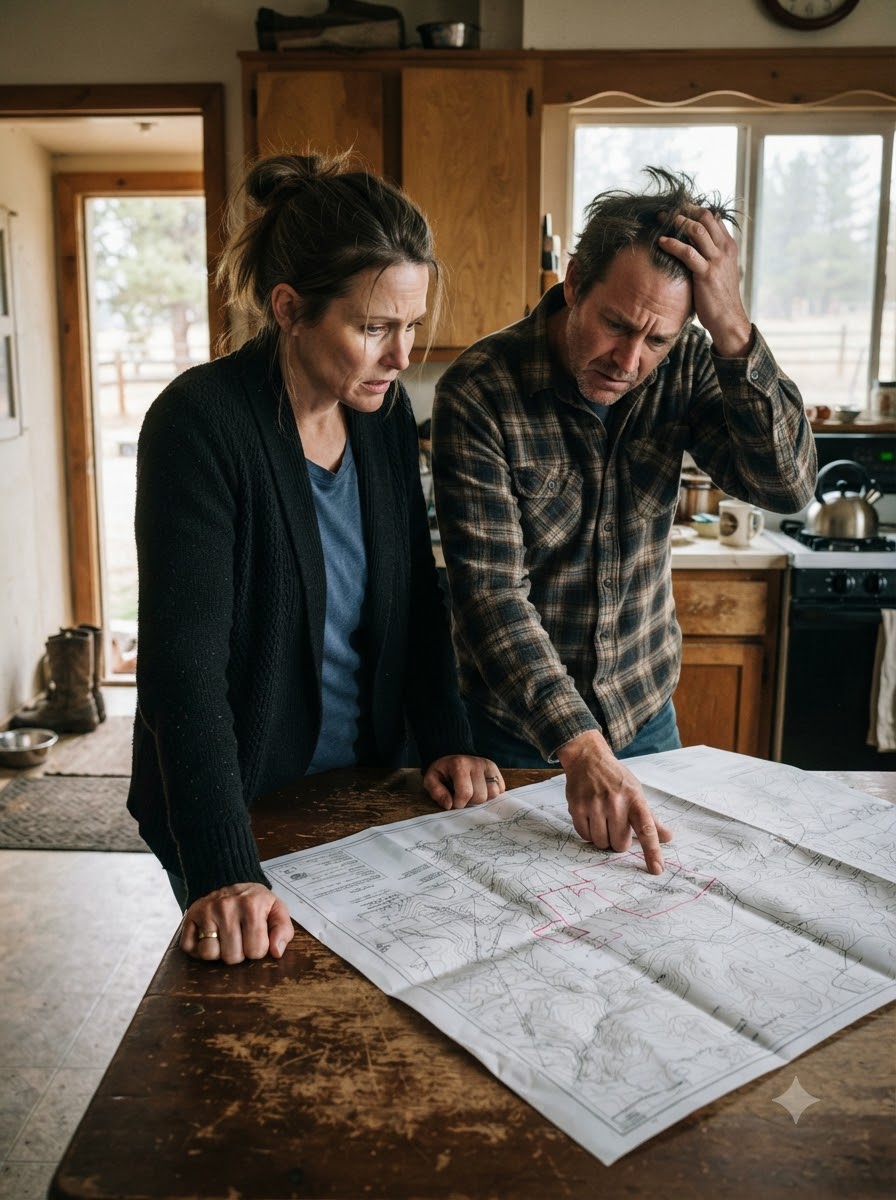
Thomas opened his case and removed a stack of county maps.
“Elaine asked me to confirm the parcel boundaries and locate several recorded easements.”
Patrick snatched one of the maps.
“What does that have to do with this will?”
Thomas looked at the photocopy. “Which will?”
“The one dated 1998.”
Thomas scanned the first page. “This covers Parcel A.”
Patrick stared at him. “It covers the ranch.”
“No,” Thomas said. “It describes a two-acre tract running from the county road to the old mailbox.”
He tapped the map.
“The original ranch was divided into three legal parcels in 2016. Parcel A is the access strip. Parcel B is the main ranch property. Parcel C is the water and utility corridor.”
Melissa’s voice rose through the speaker. “That’s impossible.”
Thomas looked at me.
I nodded.
He continued. “The description in this will predates the division by eighteen years. The document may transfer Parcel A if it was still owned by the decedent at death. It does not automatically transfer property that was later conveyed to another owner.”
Patrick turned to me. “You knew about this.”
“I knew what Walter and I signed.”
“You forged something.”
The accusation echoed through the kitchen.
Thomas’s expression hardened. “Be careful.”
Patrick thrust the will toward me. “Dad would never cut us out.”
“He didn’t,” I said. “Not entirely.”

More From This Author