STORY
Uncle Walter’s Birthday Deed Hid Brenda’s Plan to Take His Ranch
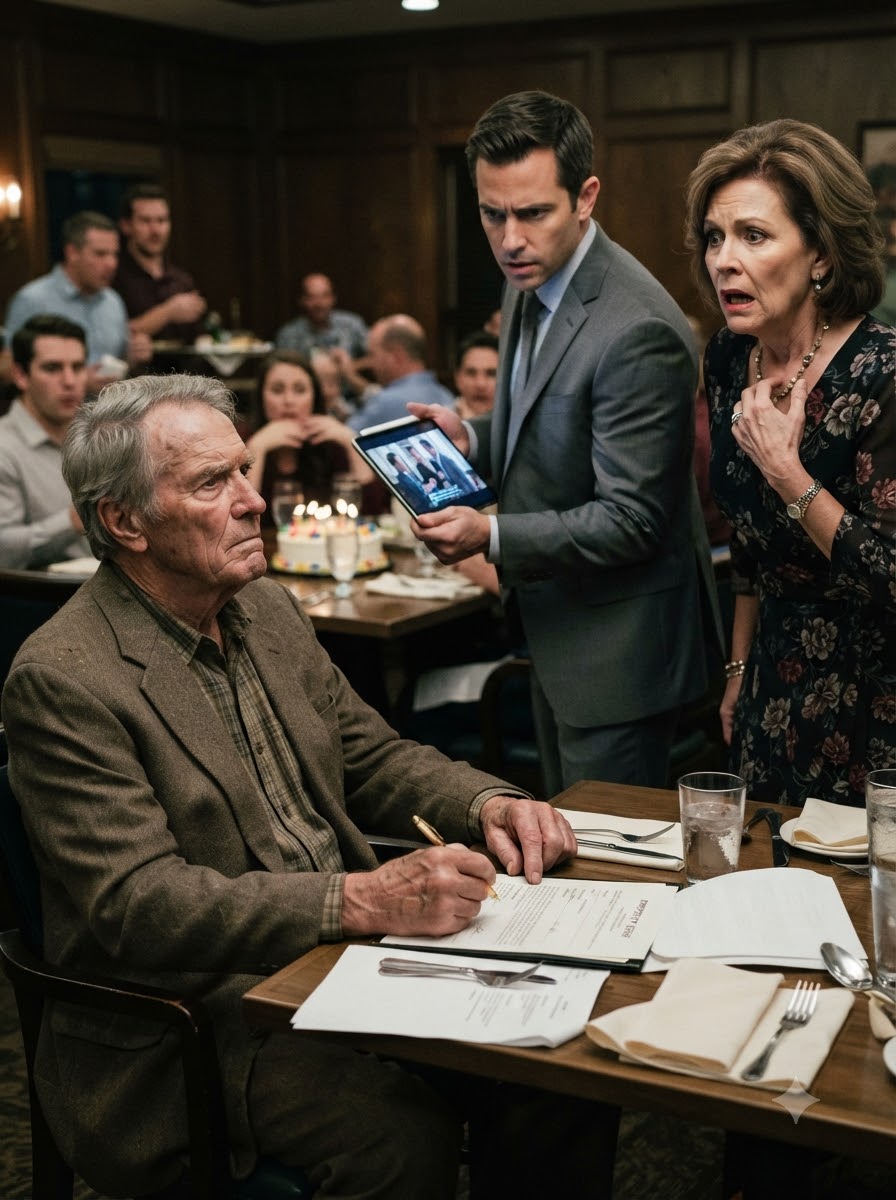
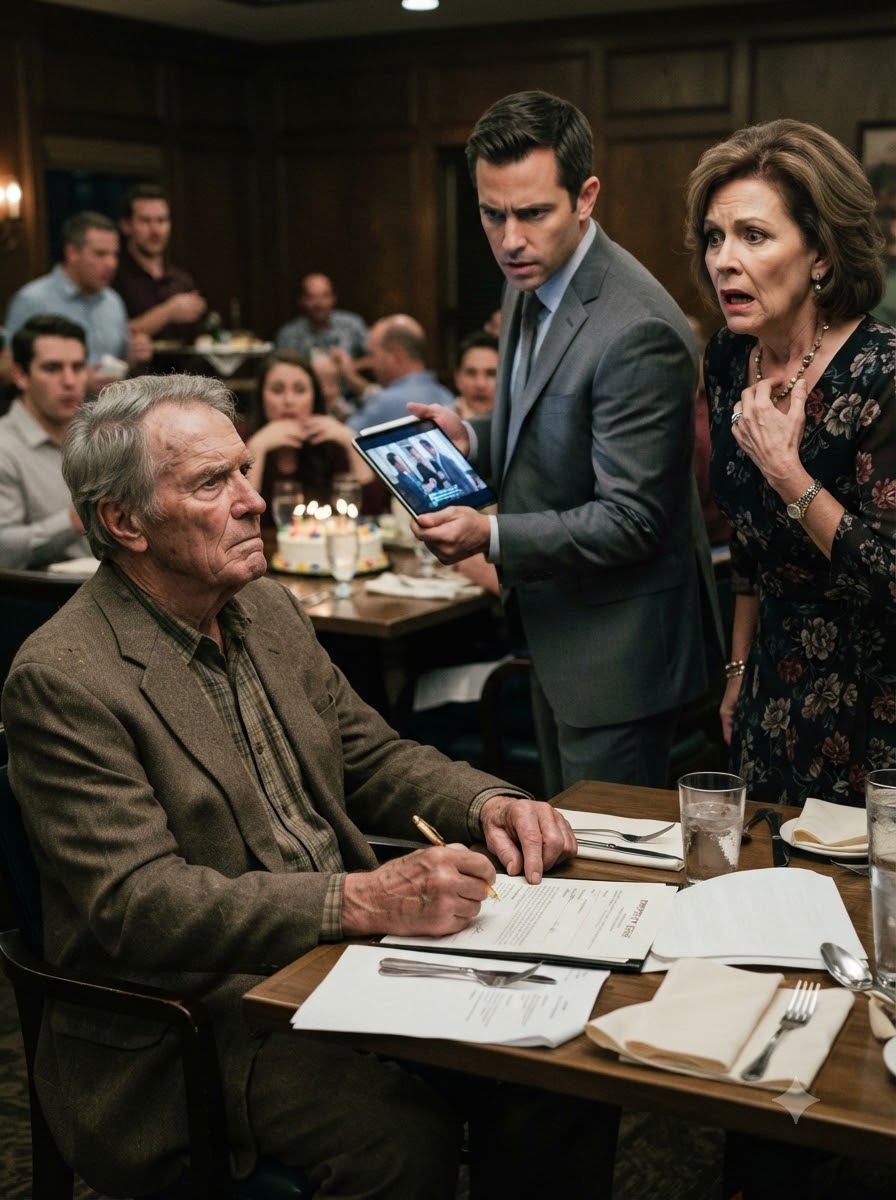
The gold pen was already in Uncle Walter’s hand when the notary slid the quitclaim deed across the linen tablecloth.
Aunt Brenda stood behind him with one hand on his shoulder, smiling toward three raised phones.
“Just sign where she put the little flags,” she said, loudly and slowly, as if Walter were a confused child. “Then we can get back to your party.”
Thirty relatives watched from the country club banquet hall.
The remains of an enormous birthday cake sat beneath a banner that read HAPPY 80TH, WALTER! Someone had placed a paper crown on his head. His dark suit was too large, the sleeves hanging over his knuckles.
I knew why. Brenda had chosen it.
She’d told us Walter’s own clothes smelled like his cattle barn and that an important family occasion demanded dignity.
Now my uncle stared at the line where his signature was supposed to go.
The document would transfer his two-hundred-acre ranch to Brenda and her three sons for ten dollars and “love and consideration.”
Nobody had read that language aloud.
Brenda’s eldest son, Dale, leaned over Walter’s other shoulder.
“Go on, Uncle Walt. It’s just estate planning.”
Something in Walter’s face made my stomach tighten.
He wasn’t confused.
He was furious.
Brenda mistook his silence for hesitation. She squeezed his shoulder hard enough to wrinkle the oversized jacket.
“We’ve discussed this,” she said. “You don’t want the government taking everything when you die.”
Walter turned his head and looked at her hand.
Then he looked across the table at me.
I was Brenda’s niece, the daughter of her late sister. I had spent most of the party feeling like I’d been invited as camouflage. Walter and I were close, but Brenda had seated me beside the kitchen doors while she and her sons surrounded him.
Earlier, when I asked whether Walter wanted help adjusting his hearing aids, Brenda had laughed.
“The batteries are dead. He can’t hear a blessed thing.”
Yet now Walter tapped the small device behind his right ear.
Across the room, Attorney Samuel Vance lifted his iPad.
Until that moment, most of the family thought Vance was merely one of Walter’s old ranching friends.
Walter placed the gold pen carefully on top of the deed.
“No,” he said.
The single word silenced the room.
Brenda’s smile remained in place, but the color drained from her cheeks.
Walter reached into his jacket, took out his phone, and tapped the screen. A chime sounded through the banquet hall’s speaker system.
Then Dale’s voice filled the room.
“Once the old goat signs the quitclaim tonight, we’ll have him declared incompetent by July and put him in the county home.”
Nobody moved.
The recording was so clear I could hear ice clinking in a glass.
Then Brenda’s younger son, Curtis, laughed through the speakers.
“County home? He’ll last six months.”
A third voice belonged to Mason, Brenda’s youngest.
“Long enough for the transfer to stick. That bypass money hits, we sell the frontage, split the rest, and bulldoze that nasty little house.”
Brenda snatched at Walter’s phone.
He pulled it away.
Her fingernails scraped his wrist.
“Turn that off!” she shouted.
The speaker crackled, and then Brenda’s own voice rolled over the white tablecloths and crystal glasses.
“Keep your voices down. He’s thirty feet away.”
Dale answered, “You said his hearing aids were dead.”
“They are. I took the batteries out before we left his house.”
“You’re sure?”
“I watched him put them in the dresser.”
On the recording, Brenda gave a small, satisfied laugh.
“He trusts me now. That’s what the casseroles were for.”
The audio stopped.
For a few seconds, the only sound was the country club’s air-conditioning.
Walter removed the paper crown and set it beside the unsigned deed.
“My hearing aids don’t use replaceable batteries,” he said. “They’re rechargeable.”
Dale took one step backward.
Brenda looked from Walter to Vance and then to the guests. Her face reorganized itself into wounded innocence.
“This is a misunderstanding.”
“No,” Vance said. “It’s a recording.”
Brenda pointed at him.
“You recorded a private conversation.”
“You were discussing a crime in a coatroom at a crowded country club,” he replied. “And Walter’s hearing aids captured what he could personally hear. We’ll let the proper authorities decide the rest.”
That should have ended it.
But the recording was only the first layer.
For most of Walter’s life, Brenda had treated him as the family embarrassment.
He had inherited the ranch from their father, but only after buying out his siblings’ shares over twenty years. He worked cattle, repaired his own fences and drove a dented Ford pickup with a passenger door that had to be lifted before it would close.
Brenda called him “the weird old hermit.”
At Christmas, she rolled her eyes when he arrived in flannel. When her sons were teenagers, they taped a cardboard sign reading FARM BOY to the back of his truck.
Walter saw it and said nothing.
That was his habit. People mistook his restraint for weakness because they never understood the effort it took.
Then the state announced the new commercial bypass.
A proposed interchange would sit beside nearly a mile of Walter’s frontage. Within weeks, developers started calling.
One preliminary offer valued a strip of his land at $3.4 million. The rest of the ranch would become even more valuable once water and sewer lines reached the interchange.
That was when Brenda rediscovered brotherly love.
She brought beef casseroles to a cattle rancher.
She cleaned his kitchen without being asked. She made medical appointments for him, although Walter still drove himself into town twice a week. She started telling neighbors he was “slipping.”
Three months before the party, Walter called me.
“Has Brenda asked you whether I forget things?” he said.
“Yes.”
“What did you tell her?”
“That you remember every dollar I borrowed from you for college.”
He laughed, but only briefly.
Then he told me things had been moved in his house.
A property-tax statement vanished from his desk and reappeared in Brenda’s tote bag. His filing cabinet had fresh scratches around the lock. Someone had called his bank pretending to confirm the balance of his savings account.
Walter didn’t want to believe Brenda was behind it.
Vance did.
He had represented Walter for thirty years. He advised him to install two small security cameras and replace the locks. He also arranged a cognitive evaluation with a neurologist before Brenda could begin building her case.
Walter scored near perfectly.
His only real impairment was hearing loss caused by decades around tractors and machinery.
That was why Vance recommended the new hearing aids.
They were directional Bluetooth models that could connect to Walter’s phone, amplify nearby speech and save audio notes. With Walter’s permission, Vance configured the phone to back up recordings to a secure folder accessible from his iPad.
Brenda never asked what kind of hearing aids they were.
She saw an old man and assumed technology belonged to everyone but him.
The cameras soon caught her in Walter’s office.
She arrived with a casserole, waited until Walter went to check a water trough, and used a key she wasn’t supposed to have.

More From This Author