STORY
I Paid for Mom’s Nurse—Her Photo Frame Caught Brenda With the Deed
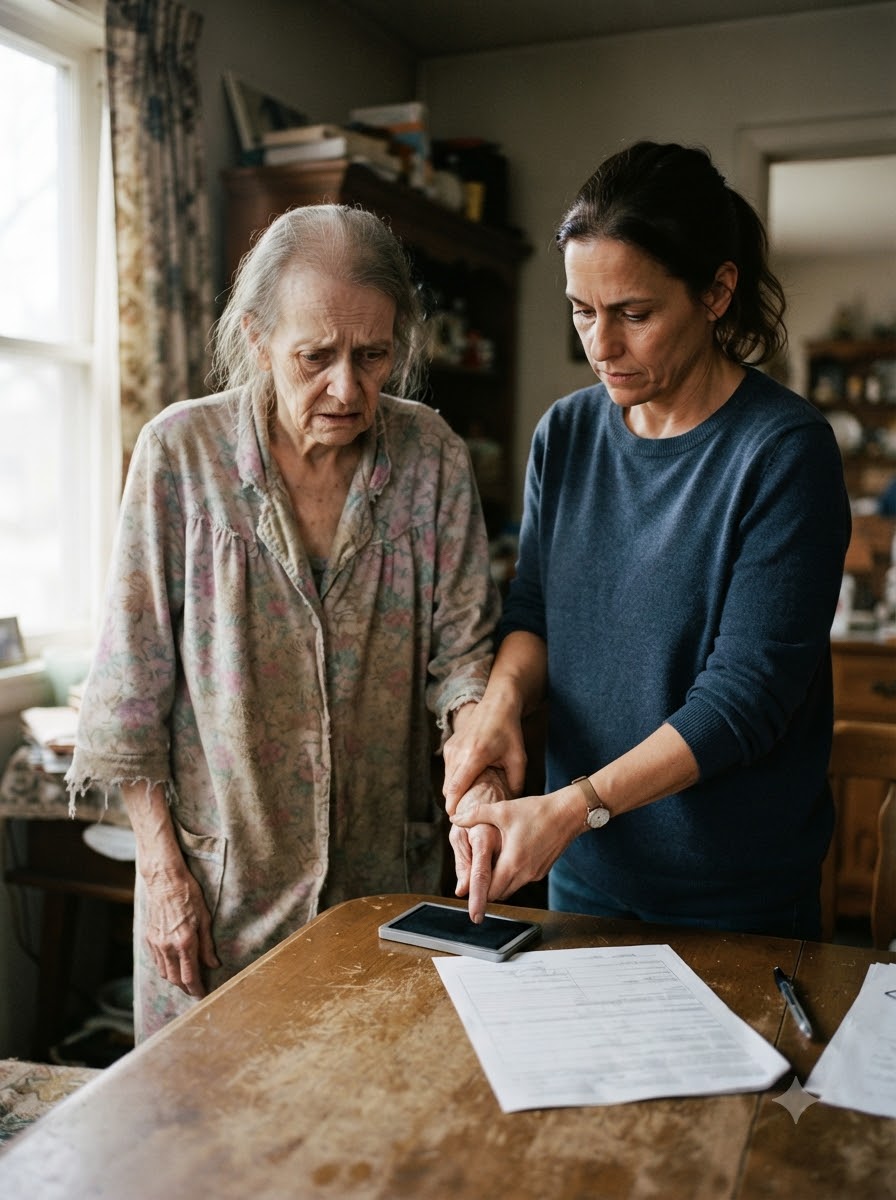
At 1:15 on a Tuesday afternoon, my mother was crying in her own living room while my sister-in-law held her thumb over an ink pad.
I watched from a hospital office in Chicago, my hand frozen on the trackpad of my laptop.
“Please,” Mom said. “I want to call my daughter.”
“You already did,” Brenda told her. “She said to get this done.”
Mom looked toward the digital photo frame on the mantel. I had sent it so I could wave to her between shifts. She didn’t know its camera was on, or that I could hear every word.
Brenda pushed her hand down. Beside them, a man in a navy suit straightened a stack of papers.
“Stop crying, Margaret,” Brenda said. “Press your thumb right here or you won’t get lunch until five.”
Mom’s bathrobe had a brown stain down the front. She was trembling. Behind her, the thermostat read 58.
For two years, I had wired my older brother Victor $3,200 every month for a private daytime nurse.
There was no nurse in the room. There was no one to help Mom except the people frightening her.
The man in the suit checked his watch. “We need the authorization today. Once the deed transfers to your LLC on Friday, the cash buyer wires $540,000.”
Brenda said, “Victor knows.”
That was when I started recording the stream to my laptop.
I stayed quiet long enough to capture Brenda guiding Mom’s inked thumb onto a page. Then I called the Virginia Adult Protective Services emergency hotline from my office phone, gave them the address, and described what I was watching.
The woman on the line asked whether Mom was in immediate danger.
“Yes,” I said. “They’re withholding food to make her sign away her house.”
She told me to call local police too. I did. Then I booked the 3:40 flight to Dulles.
I had taken the Chicago transfer because Victor told me he could manage things at home. Mom had been eighty then, newly diagnosed with Alzheimer’s. She still knew us, still argued over crossword answers, but she had started leaving the stove on.
Victor offered to move into her paid-off Colonial in Virginia with Brenda. He said a nursing home would break her heart. I agreed, grateful enough that I didn’t ask why a daytime nurse needed to cost $3,200 a month when Victor and Brenda were living there rent-free.
Every month he emailed an invoice from Chesapeake Home Care. Every month I paid it.
I called Mom on Sundays. Sometimes she sounded sleepy. Sometimes she asked where her blue coat had gone or why the kitchen smelled strange. Victor said those were ordinary symptoms. Brenda told me not to upset her with too many questions.
The photo frame had been my attempt to be present without making another difficult phone call. Victor put it on the mantel the previous night. He texted me a picture of Mom smiling at it.
By Tuesday afternoon, that smile felt like one more thing he had arranged for me to see.
At the airport, a police officer called back. He said two officers had gone to the house. Brenda had told them Mom was confused, well fed, and signing routine paperwork for repairs. Mom had said little. The suited man was gone.
The officer sounded cautious. “We didn’t see an active threat. Adult Protective Services will follow up.”
I asked him to note the thermostat, the threat about lunch, and the papers. He said he would. Before we hung up, I emailed a copy of the recording to the police department and the APS intake worker. I kept the original untouched.
I landed after dark and rented a car. From the parking lot, I called Mom’s longtime neighbor, Mrs. Bell.
She had lived next door since I was nine. When I asked whether she had seen a nurse coming and going, she was silent for a moment.
“Honey,” she said, “I haven’t seen anyone like that. Brenda told me they changed agencies.”
“Did you see Mom?”
“Not since Christmas. I used to bring her soup. Victor said visitors made her agitated.”
I spent the night in a hotel fifteen minutes away, not because I wanted to wait, but because the APS worker asked me not to confront Victor before she had spoken with her supervisor. She planned to visit first thing in the morning.
At six, I opened the folder where I kept two years of invoices. They looked convincing at a glance: a logo, a mailing address, service dates, Mom’s name. Looking closer, I saw that each invoice listed the same number of care hours, even in February. The numbers at the bottom increased neatly by one each month.
I searched for Chesapeake Home Care. There was a home-health company with a similar name across the state, but not at the address on Victor’s invoices. That address belonged to a mailbox store.
At eight, I called the number printed under the logo. It rang through to a recorded message with no company name.
The APS worker, Ms. Alvarez, met me in the hotel lobby at nine. She watched the video with headphones, then asked me to send her the invoices and bank-transfer records.
“Your mother may still be able to tell us what she wants,” she said. “But we need to hear it without anyone coaching her.”
I told her about the officers’ visit. She nodded. “We’ll go together. Let me do the talking.”
Victor opened Mom’s front door wearing a pressed shirt and the expression he used whenever he thought I was being dramatic.
“You flew in for this?” he asked.
I looked past him. The house smelled of lemon cleaner laid over something sour. Mom was sitting at the dining table in yesterday’s bathrobe, both hands wrapped around a mug.
Brenda stood behind her.
Ms. Alvarez introduced herself and asked to speak with Mom privately. Victor stepped into the doorway between them.
“My sister is stirring her up,” he said. “She watches a camera for ten minutes and thinks she knows what care looks like.”
“I watched long enough,” I said.
Brenda’s face tightened. “That frame has a camera?”
Ms. Alvarez asked Victor to step aside. For one long second, he did nothing. Then Mom saw me.
“Annie?” she said.
I went to her. She smelled like cold skin and stale coffee. When I hugged her, I felt how loose her robe had become across her shoulders.
“I’m here,” I said.
Brenda reached toward Mom’s chair. “She already ate breakfast.”
“I didn’t,” Mom whispered.
Ms. Alvarez heard her. She asked Brenda and Victor to wait in the hall while Mom and I sat in the kitchen. They argued, but a second APS worker had arrived by then, and eventually they moved.
Mom couldn’t explain the papers. She remembered a man who had called her “dear” and said her house needed saving. She remembered Brenda saying lunch would be late.
When Ms. Alvarez asked whether she wanted Victor and Brenda to keep living with her, Mom stared at the tabletop.
“I don’t want them angry,” she said.
That answer frightened me more than a clear no would have.

More From This Author