STORY
My Son Tried Selling My Home—Then My Lawyer Opened Harold’s Hidden Folder
“Just sign here, Mom.”
My son turned the pen so its point faced me.
Derek sat across my kitchen table in the same chair where Harold had eaten breakfast for forty-one years. His wife, Renee, stood by the sink with her arms folded, trying to look patient.
Between us lay a stack of papers thick enough to hide a knife.
I glanced at the first page. The heading read VOLUNTARY PROPERTY TRANSFER AND RESIDENTIAL PLACEMENT AGREEMENT.
The words blurred for half a second.
Three weeks had passed since I buried my husband.
Three weeks since Derek had stood beside me at the cemetery, one hand under my elbow, telling everyone he would take care of me.
Now I understood what he had meant.
“You said these were insurance forms,” I said.
“They’re part of getting everything organized,” Derek replied. His voice had the slow, careful tone people use with a confused child. “The house is too much for you. Meadow View has an opening, but we have to move quickly.”
“I never said I wanted to move.”
Renee sighed. “Margaret, nobody wants to lose independence. But at your age, safety has to come first.”
At my age.
I was seventy-three, not dead.
I looked down again. The agreement authorized Derek to select a real estate agent, approve repairs, accept an offer, collect proceeds, and arrange my permanent admission to Meadow View.
One clause stated that I was signing after “a documented decline in judgment.”
My hands went cold.
“Who documented that?”
Derek shifted in his chair. “Dr. Patel has concerns.”
“Dr. Patel told me my blood pressure was excellent.”
“He may not have told you everything.”
That lie was so smooth it frightened me more than anger would have.
I closed the folder.
Derek pushed it back toward me. “Mom, don’t make this difficult.”
I looked into the face of the boy whose fevers I had sat through, whose college tuition Harold and I had paid, whose first divorce attorney I had quietly covered when he came to me ashamed.
Then I pushed the pen back across the table.
“You tried to sell my home like I was already dead.”
Renee’s expression hardened.
Derek leaned closer. “No one is selling anything today. We’re creating options.”
“The option where I sign away my house and you place me in a facility?”
“The option where you stop being stubborn.”
I stood.
“Leave.”
For a moment, neither of them moved.
Then Derek gathered the papers with deliberate calm.
“You’re proving our point,” he said. “This irrational reaction is exactly why we’re worried.”
He walked out carrying the folder. Renee followed, pausing at the doorway.
“We’re trying to protect you,” she said.
“No,” I answered. “You’re trying to protect yourselves from waiting.”
After they left, I locked the door.
Then I checked it twice.
My name is Margaret Elaine Caldwell. I had lived in that white two-story house on Ashford Lane since 1983. Harold and I raised Derek there. We refinished the floors ourselves, planted the maple in the front yard, and converted the smallest bedroom into a sewing room after Derek moved out.
Every corner contained evidence that my life had happened.
Derek and Renee had begun circling the house immediately after Harold’s funeral.
At first, they brought casseroles and spoke softly. Derek changed a lightbulb I had not asked him to change. Renee printed brochures for Meadow View and left them near my purse.
They mentioned the stairs, the yard, the winter ice.
Then Derek told me homes on Ashford Lane were selling for more than four hundred thousand dollars.
He tried to sound casual.
But I saw the arithmetic in his eyes.
The day after the kitchen confrontation, I called Dr. Patel.
“Have you documented any decline in my judgment?” I asked.
There was a long silence.
“Absolutely not,” he said. “Why?”
I told him.
He asked me to come in that afternoon. He performed a cognitive assessment, reviewed my medications, and wrote a letter stating that I was mentally competent to manage my personal and financial affairs.
“Keep the original somewhere secure,” he advised.
That was the first piece of evidence.
The second arrived from my neighbor, Nancy Bell.
Nancy had lived next door for nineteen years and possessed the neighborhood’s sharpest eyes. She came over carrying her tablet.
“I thought you should see this,” she said.
A real estate website displayed photographs of my home.
My home.
There was the porch Harold had rebuilt. The dining room with my blue curtains. The upstairs bathroom. Even my bedroom.
The listing was marked “Coming Soon.”
The asking price was $439,000.
The agent was Thomas Greer of Greer Residential Group.
My throat tightened.
“Who took the inside pictures?”
Nancy enlarged one image.
In the mirror over my dresser, faint but visible, stood Renee holding a phone.
I remembered the afternoon. Two days after the funeral, Renee had offered to collect laundry while I met with the minister.
She had not been helping me.
She had been photographing my house.
Nancy had more. A man had visited the side yard asking about property boundaries. He told her the owner’s son was “handling the transition.”
“Did you speak with him?” I asked.
“I did better.”
She opened a video.
The recording showed the man introducing himself as Thomas Greer. His face and voice were clear.
Nancy had asked whether I had approved the sale.
“He has power of attorney,” Greer said, nodding toward my house. “The mother’s going into care.”
I watched the clip twice.
Then I called the only person Harold had trusted more than his own instincts.
Her name was Evelyn Shaw.
Evelyn was a probate and elder-law attorney with silver hair, rimless glasses, and a way of listening that made lies feel nervous before they were even told.
Harold and I had hired her seven years earlier to update our wills.
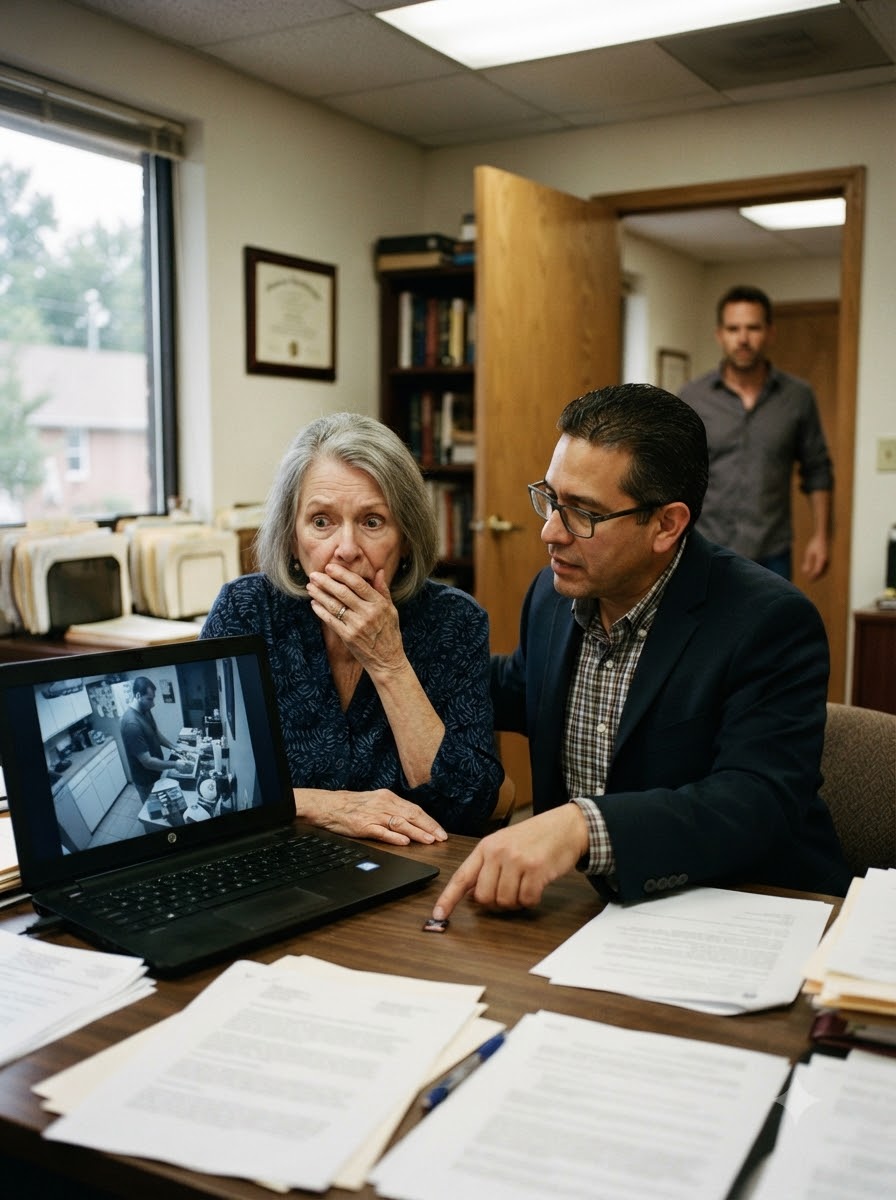
I brought her Dr. Patel’s letter, screenshots of the listing, Nancy’s video, and the Meadow View papers I had photographed before Derek took them.
Evelyn studied everything.
“Did you ever give Derek power of attorney?” she asked.
“No.”
“Did Harold?”
“No. We named each other, with you as successor if neither of us could act.”
Evelyn opened our estate file.
The original documents were exactly as I remembered.
No authority for Derek.
No right to sell my home.
No permission to place me anywhere.
She called Thomas Greer while I sat beside her.
Evelyn identified herself as my attorney and asked what authorization he had received to list the property.
At first, he cited confidentiality.
Then Evelyn told him I was present, competent, and had never approved a sale.
His confidence disappeared.
He emailed a copy of the document Derek had provided.
It was a durable power of attorney bearing my name.
The signature looked like mine from a distance.
Up close, it was wrong.
The loops were too careful. The “M” was shaped the way I had signed Christmas cards twenty years ago, before arthritis changed my hand.
The document claimed I had signed it four days after Harold’s funeral.
It had been notarized by someone named Paul Mercer.
I had never met Paul Mercer.
Evelyn’s face went still.

More From This Author