STORY
Her Husband Left Her in a Blizzard. Then She Opened His Phone.
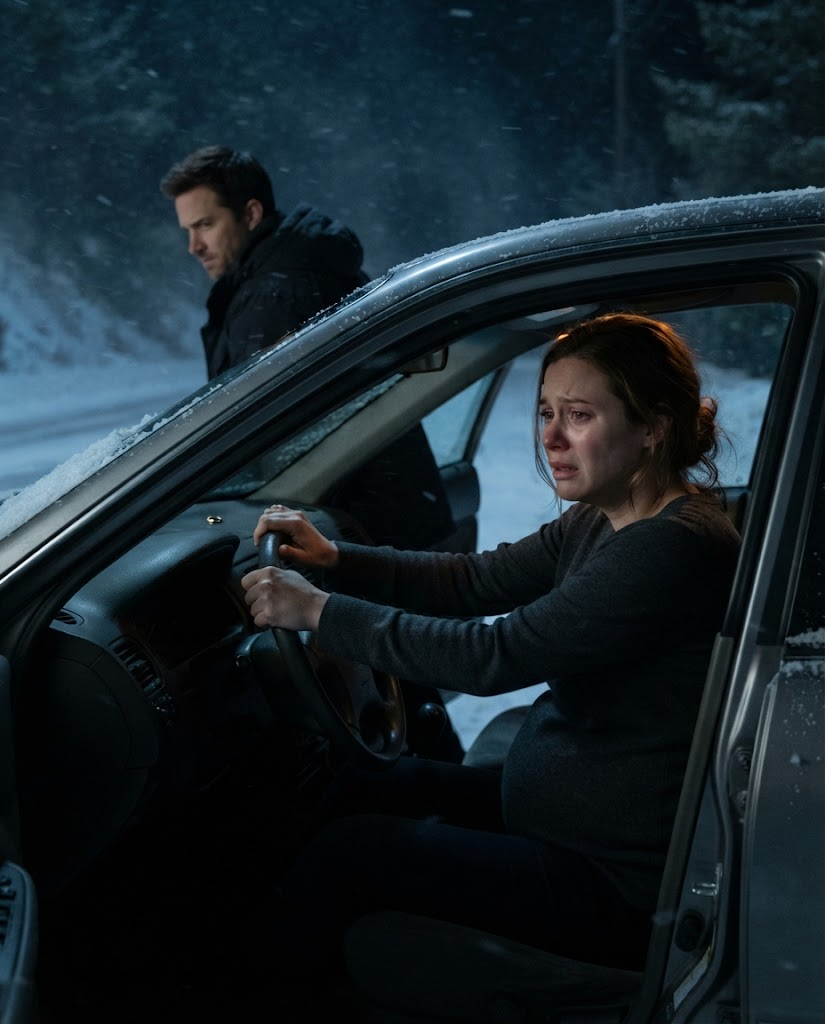

The contractions were seven minutes apart when Derek took off his wedding ring.
Clare watched him place it on the dashboard of their stalled car. Beyond the windshield, snow erased the mountain highway a few feet at a time. She was twenty-nine, nine months pregnant, and still trying to believe her husband had a reason for everything he was doing.
“I’m walking for help,” he said.
“Leave me the keys.”
“I’ll need them to tell somebody what kind of car it is.”
Even through the pain, that sounded wrong.
The small maternity clinic was ten minutes behind them when he first refused to turn around. Her friend Beth, a nurse there, had told Clare to come in when the contractions became regular. Beth’s sister had delivered at the clinic the previous month.
Derek insisted on the larger hospital across the mountain.
“Better equipment,” he kept saying.
Clare had packed the hospital bag herself: a yellow blanket, clothes for their daughter, Ruby, and the blue scarf her grandmother had knitted. Her last appointment had been ordinary. She had expected an exhausting night followed by a baby in a warm room.
Instead, Derek had driven past the clinic turnoff and kept climbing.
At thirty-three, he could make stubbornness sound like confidence. During their six years together, Clare had often mistaken that confidence for steadiness. When her receptionist hours were reduced late in pregnancy, he said he would handle the bills. When she asked why he was working late every night, he said she needed to stop worrying.
Three days earlier, she had found a notice from their life insurance company under a stack of grocery coupons. Derek had requested another copy of her policy. He said he was organizing things before the baby came.
She believed him because believing him was easier than imagining the alternative.
Now the engine was dead. The wipers had stopped halfway across the glass. Derek had tried the ignition twice, then stopped trying.
His regular phone went into the glove compartment.
“Saving the battery,” he said.
Then he opened the door and let the blizzard into the car.
Clare caught his sleeve. “Take me with you.”
“You can’t walk two miles like this.”
“Then stay.”
He pulled free.
He told her to lock the doors and wait. A small light bobbed as he walked away, then disappeared. Later, she would wonder whether it had been a flashlight or another phone. At the time, she had watched it as though watching could bring him back.
She waited through three contractions.
The gold band remained on the dashboard.
Inside it were the words Forever yours and their wedding date. She picked it up, held it briefly, then put it in the cup holder. Her shaking hands could no longer make sense of its weight.
She tried her phone. No signal. She attempted an emergency call anyway, then Derek’s number. Neither connected.
The wool coat she found on the back seat was an old one of Derek’s, separate from the jacket he had worn outside. She wrapped it around herself. Its sleeves hung over her hands.
For several minutes, she counted breaths and told herself help was coming.
Then she remembered his phone.
She reached across the console and opened the glove compartment. His familiar black phone lay beside the vehicle manual. Under it was a cheap prepaid phone with a cracked screen.
She had never seen that one before.
It had no passcode.
The first conversation was already open. Clare touched the newest message.
“If anyone asks, I was home all night,” Derek had written.
The reply came from a contact saved as K: “What about Clare?”
His answer was underneath.
“By morning it won’t matter.”
Clare read it twice. Then she stopped calling his name.
With shaking fingers, she photographed the conversation on her own phone. She took another picture showing the prepaid phone beside the insurance papers, then tucked both phones inside her coat. No signal could carry the pictures anywhere yet, but she would not leave the evidence behind.
A contraction folded her forward. When it eased, she reached across the console and pressed the hazard switch. A faint clicking answered.
Then her water broke.
The pressure changed so suddenly she grabbed the seat.
Ruby was coming, and the only person left to help her was herself.
Clare said Beth’s name aloud, as though her friend might answer from the darkness.
No one answered.
The hazard lights blinked weakly through the snow. She wiped a patch of the side window with her sleeve and saw no headlights.
She considered walking. Then another contraction came, and she could not straighten her legs.
So she stayed where a driver could find her.
She tied her blue scarf around the side mirror, leaving its bright end outside the accumulating snow. She sounded the horn in short bursts until it weakened. Between contractions, she pulled the hospital bag within reach and spread the clean blanket across her lap.
There was no graceful courage in it. She cried. She begged. She was furious at Derek and frightened of the next minute.
But she kept making one small decision after another.
Ruby arrived before anyone reached the car.
Clare remembered very little of those minutes clearly. She remembered the wind. She remembered fumbling with the yellow blanket. Most of all, she remembered the tiny sound her daughter made against her chest.
She tucked Ruby inside the coat and held her close.
“Stay with me,” she whispered.
Once, then again.
She did not know how much time had passed when amber lights appeared beyond the side window.
At first she thought they were another trick of exhaustion.
Then a truck stopped.
Grant Ellis had been returning from a delivery of storm supplies to a county shelter. His company had trucks on both sides of the mountain, and the main interstate had closed after a pileup. The highway had still been open when he began the return trip. Now the weather was worse than forecast, and he was looking for a safe place to stop.
He almost drove past the dark sedan.
The blue scarf caught his headlights. Then he saw one dim hazard light blink beneath the snow.
Grant pulled his truck ahead of the car and called his dispatcher over the radio. Their fleet relay was still reaching the operations desk even where ordinary cell service failed. He gave the mile marker and told her to contact emergency services.
Then he came to Clare’s window.
She saw a broad man in his early fifties, gray in his beard, wearing a work jacket and holding a flashlight.
She unlocked the door.
His expression changed when he saw the bundle inside her coat.
“I had her,” Clare said. “I already had her.”
For one awful second, Grant could not speak.
Then he told the dispatcher there was a newborn.
Clare caught his wrist before he could move away.
“Don’t call my husband.”
“All right.”
“Promise.”
He crouched so she could see his face.
“I’ll tell the responders exactly what you said.”
He brought blankets from his sleeper cab and stayed beside the open door while the dispatcher relayed instructions from emergency personnel. He offered to help her into the heated cab if they directed it, but nobody moved her blindly into another risk.
A county plow reached them first. An ambulance followed in its cleared tracks.
When a paramedic asked whether she could hand over Ruby, Clare could not loosen her arms.
Grant said, “Tell her where you’re taking the baby.”
The paramedic did. He explained that both of them were going together, to the valley hospital accessible from the lower road.
Clare finally let him help.
At the hospital, warmth hurt before it comforted her.
Her daughter needed treatment and close monitoring for cold exposure and low blood sugar. Clare needed care too. The first answers were cautious, and the waiting was long.
A nurse asked for her emergency contact.
“Beth Martin,” Clare said.
Then, after a pause, “And a police officer.”
She handed over the prepaid phone only after asking how it would be documented. She kept her own phone, with its photographs, within sight on the bedside table.
Beth arrived before dawn.
She put one hand against Clare’s cheek, then sat down without asking why Clare had ignored the clinic.
That was the first kindness Clare could bear.
Derek had already made a missing-person report.
According to him, they had argued at home. Clare had taken the car while he stayed behind. His brother Kyle said they had watched a basketball game together all evening.
The officer who took Clare’s account did not announce an arrest at the foot of her bed. He asked careful questions. Which jacket had Derek worn? Who had the keys? Where had she found each phone? Had anyone else seen them leave?
Clare gave him what she knew and said when she did not know.
She described the clinic turnoff. The stalled engine. The ring. His exact excuse for taking the keys.
Then she showed him the photographs.
He asked permission to preserve the phones and sought the authority needed for a fuller examination. The car was towed from the highway for inspection.
The next afternoon, Derek appeared at the hospital.
By then, Clare had told staff she did not want him admitted as a visitor. He stayed beyond the controlled door, pleading into the intercom.
“She’s confused. She just gave birth.”
Clare heard his voice from the hallway when a staff member opened another door.
Her whole body reacted before she could think. For a moment, she was cold again.
Beth reached for the call button.
Clare reached for her phone.
She called the investigating officer and reported that Derek had come. She did not go outside to explain herself. Security asked him to leave.
That evening, his mother called Beth’s phone.
“He’s devastated,” she said. “They need to talk before this gets out of hand.”
Beth looked at Clare, letting her choose.
Clare shook her head.
The call ended.
Grant returned two days later with a paper bag containing Clare’s scarf and the few belongings responders had recovered.
He waited for permission before entering the room.
Ruby lay in a warmed hospital bassinet. Clare could touch her now, and each ordinary movement of the baby’s fingers felt enormous.
Grant placed the bag on a chair.
“That scarf is why I stopped,” he said.
Clare pressed it between her palms.
Later that afternoon, she asked Beth why a hospital administrator had thanked him by name.
Beth hesitated. “You don’t know who he is?”
“He’s a truck driver.”
“He was. He still drives sometimes.”
Grant had founded Ellis Freight thirty years earlier. A business profile Beth found described his privately held logistics interests and estimated his fortune above a billion dollars.
Clare looked toward the chair where he had sat.
The man who had held a flashlight beside her window had enough money to buy things she could barely imagine.
It changed nothing about the moment that mattered.
He had stopped. He had listened. He had believed that she could decide whom to call.
When he returned, she asked why he had been driving that night.
“My first trucks went through that valley,” he said. “The shelter needed supplies. We had a route through before the closures spread.”
“Do you always do your own deliveries?”
“No. More often than my operations manager likes.”
He smiled slightly, then let the silence return.
He did not offer her a mansion. He asked what would help.
Clare said she needed a way to get home that Derek could not follow.
The hospital social worker was already arranging a safety plan. Grant offered transport through his company, and Clare accepted it after the plan was settled. Beth offered her spare room. Clare chose that room because she knew the lock, the neighborhood, and the person on the other side of the wall.
Ruby went home eight days after the birth.
Home, for the moment, meant a bassinet beside Beth’s bed and Clare waking at every change in her daughter’s breathing.
The investigation continued while Clare learned how to feed a baby with hands that still shook.
The prepaid phone did not prove every part of the case by itself. It gave investigators a place to start.
Records connected the contact labeled K to Kyle. Further messages described the highway turnout where Derek expected to be collected. A roadside camera showed Kyle’s pickup passing that way. A neighbor’s doorbell recording showed the brothers returning to Derek’s house well after the time they claimed their basketball evening had started.
The mechanic found evidence that the car’s fuel system had been deliberately disabled. That finding was examined alongside the messages, not treated as a complete explanation on its own.
Investigators also obtained records of Derek’s debts and the insurance inquiries Clare had noticed.
He had lost his job weeks earlier. The late nights had concealed mounting gambling losses and attempts to borrow more money. Clare’s policy was worth four hundred thousand dollars, and he was its named beneficiary.
When his invented alibi began to collapse, Kyle changed his account through his lawyer.
He admitted collecting Derek near the turnout. He admitted helping him lie afterward. He said Derek had told him Clare would not survive the night.
Clare read that statement in her attorney’s office.
Until then, some frightened part of her had kept searching for another explanation. A breakdown. Panic. A husband who had walked the wrong direction and become ashamed.
The statement closed that door.
She set the papers down.
“I want the divorce filed,” she said.
Her attorney had already explained the available steps. Now Clare was ready to take them.
Protective orders and temporary arrangements came through the courts. She changed her passwords, separated her finances, and named Beth as the person to contact in an emergency. Decisions about Ruby were addressed through the family case rather than left to Derek’s claims of fatherhood.
The criminal case took more than a year.
There were interviews, motions, postponed dates, and days when Clare could not bear another voicemail from an unfamiliar number. Her lawyer helped her understand requests before she answered them. Beth watched Ruby when appointments ran long.
Grant checked in occasionally. Sometimes he brought groceries. Once he drove Clare to an interview when Beth had a shift.
His money did not make testimony unnecessary or shorten the nights.
It did help him support a regional emergency transport program after he learned how often storms isolated families. Clare agreed to advise its practical planning once she felt able. She knew exactly what a frightened caller needed to hear and how much a clear destination mattered.
Derek eventually accepted a plea agreement to attempted murder and related charges. At sentencing, the prosecution presented the messages, the mechanical evidence, the insurance records, and Kyle’s account. Derek received a substantial prison term.
Kyle faced consequences for his own conduct under a separate agreement. His cooperation did not turn him into an innocent bystander.
Clare’s divorce was completed. The custody orders gave her sole custody and restricted Derek’s contact under the terms the court set.
None of those papers made her stop dreaming about the car.
For months, a heater switching off could send her heart racing. Snow against a window made her check the locks. Therapy helped gradually. So did Ruby reaching for her with absolute confidence, though Clare refused to make her daughter responsible for healing her.
She returned to work part time and rented a small apartment near Beth.
Grant helped her compare transport options for the emergency program, then offered her paid coordination work when a position opened. Clare asked for the job description and the salary. She wanted an ordinary contract she could read, not a favor she would spend her life repaying.
He gave her one.
She took it.
On Ruby’s second birthday, snow fell softly outside Clare’s apartment.
Beth brought cupcakes. Grant arrived in his work jacket with a wooden toy truck and a gift receipt tucked into the bag.
Ruby pushed the truck across the kitchen floor, making a terrible engine noise.
Clare laughed before realizing she had laughed.
The blue scarf hung beside the front door. She had washed it, repaired the pulled threads, and kept it because it reminded her of a decision she had made when there was almost nothing left to decide.
Derek’s ring was gone. After the case no longer required it, she had asked her attorney to dispose of it.
She did not need to keep everything she had survived.
When Ruby grew sleepy, Clare carried her to the bedroom. The heater clicked on. Snow brushed the glass.
For a moment, she listened.
Then she laid her daughter in her own warm bed and went back to the people waiting in the kitchen.

More From This Author