STORY
My Family Abandoned Grandpa—His Silver Ring Exposed Their Final Betrayal
Three weeks after my grandfather died, my mother sent me a photograph of his empty living room.
The curtains were gone. Pale rectangles marked the walls where his pictures had hung. In the corner, a red SOLD sticker crossed the realtor’s sign outside the window.
Beneath the photograph, she wrote:
We got $118,000 after fees. Your father and I are keeping it against what Dad cost us over the years. Don’t make this ugly.
I stared at the message from my bunk at Camp Lejeune until the words blurred.
My grandfather, Thomas Hail, had spent his final two days in a small Ohio hospital asking whether anyone else was coming.
My parents had not come.
My brother had not come.
I had driven through the night on emergency leave and arrived at dawn, still wearing the same clothes I had left base in. Grandpa had opened his eyes, seen me beside the bed, and smiled.
“Looks like you’re the one who remembered me,” he’d whispered.
I told him the others would come.
He gave the smallest shake of his head.
“They won’t.”
He was right.
After he died, I paid the $6,800 funeral bill myself because my mother said she had “too much going on” and my father said burying people was a waste of money.
Only three of us stood beside the grave: me, Father Brennan, and Grandpa’s neighbor, Walter Pike.
Now my parents had sold his house and divided the money before the dirt on his grave had settled.
I called my mother.
She answered with a sigh. “Claire, I’m at dinner.”
“How did you sell Grandpa’s house?”
“Your father handled it.”
“Dad wasn’t on the deed.”
There was a pause.
Then she said, “Thomas signed papers last year.”
“What papers?”
“I don’t know. Estate papers. He wanted us to have it.”
That made no sense.
Grandpa might have been quiet, but he was meticulous. He stored receipts in labeled envelopes. He wrote down every oil change in a spiral notebook. He once drove back across town because a cashier had given him seventy cents too much.
He would not have transferred his house without telling anyone.
“I want copies,” I said.
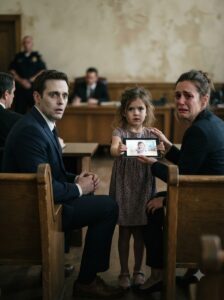
Mother’s voice sharpened. “You weren’t around, Claire. You visited when the Corps allowed it and then disappeared again. Your father and I were the ones dealing with him.”
“You didn’t visit him in the hospital.”
“He was difficult.”
“He was dying.”
“Don’t start judging us because you played the devoted granddaughter for forty-eight hours.”
I looked down at the worn silver ring on my right hand.
I had found it after the funeral in Grandpa’s bedroom, wrapped in faded green cloth at the back of his dresser. It was heavy and smooth, with a tiny engraving inside: a winged dagger above the numbers 11-3-67.
When I was eight, I had asked why he wore it.
“It helps me remember who I am,” he’d said.
Now it was all I had left of him.
“Send me the papers,” I told my mother.
She hung up.
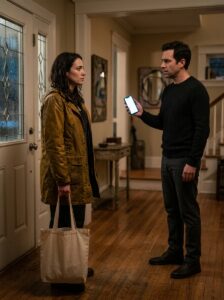
The next morning, my father emailed me a one-page quitclaim deed.
It appeared to transfer Grandpa’s property to my parents for ten dollars. The signature looked like Thomas Hail, but too carefully. Every letter stood upright.
Grandpa’s real signature slanted hard to the right, as if it were pushing into the next word.
The deed was dated twelve days before he died.
On that date, Grandpa had been lying unconscious in intensive care.
I checked the notary’s name.
Melissa Hail.
My brother’s wife.
I called Walter Pike.
He answered on the second ring. “Claire?”
“Did Grandpa ever say he gave the house to my parents?”
Walter was silent long enough that I heard wind rattling something metal near his phone.
“No,” he said finally. “But he was worried they’d try.”
My stomach tightened.
“What do you mean?”
“About a month before he collapsed, your father came by. They argued. Loud enough I heard it from my yard. Your grandfather told him, ‘You’ve taken enough.’ Your father said the house belonged to family.”
“Why didn’t you tell me?”
“Thomas made me promise not to trouble you while you were deployed.”
“I wasn’t deployed. I was stationed two states away.”
“To him, you were serving. That was enough.”
Walter told me Grandpa had begun carrying a small lockbox to his attorney’s office. The last time Walter drove him there, Grandpa said he was “putting the truth somewhere greedy hands couldn’t reach.”
I contacted the county recorder.
The deed had already been recorded, and the house sold to a young couple named Evan and Marisol Trent. Because they appeared to be innocent buyers, undoing the sale would not be simple.
I reported the forged deed to the sheriff’s office.
A deputy took my statement but warned me that inheritance disputes often became civil matters unless the forgery could be proved.
My parents insisted Grandpa had signed at home before he became ill. Melissa claimed she had notarized it there.
Their lie had four matching signatures and a recorded document.
I had suspicion, an empty house, and a dead man.
Then a general saw the ring.
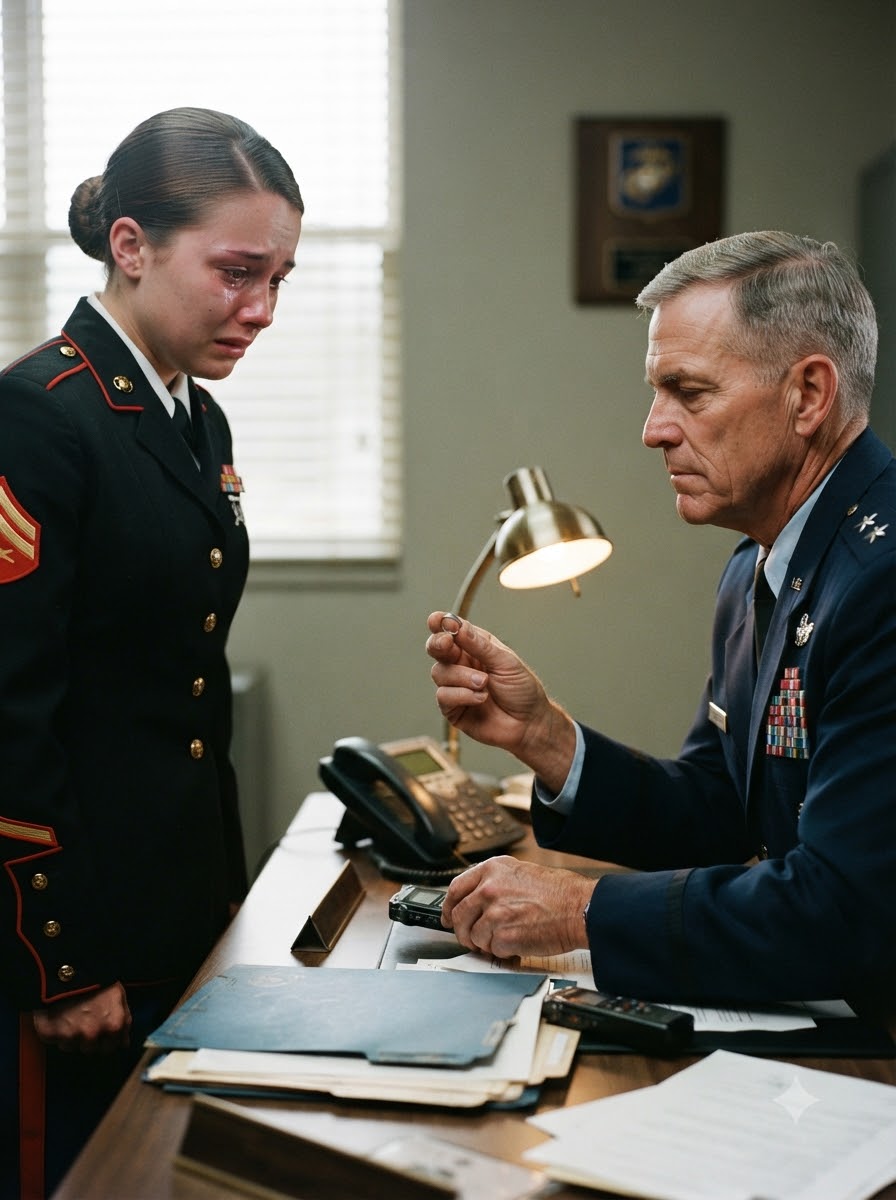
It happened at a formal event honoring veterans. I was speaking with another Marine near the entrance when Lieutenant General Adrian Cole stopped in front of me.
He wasn’t looking at my uniform or nameplate.
He was staring at my hand.
The color drained from his face.
“Where did you get that ring?”
“It belonged to my grandfather.”
“What was his name?”
“Thomas Hail.”
The general swallowed.
Around us, silverware clicked against plates and a quartet played softly near the stage. Yet the moment felt completely still.
“We need to talk,” he said.
He led me into a side corridor and closed a conference-room door behind us.
“Did your grandfather ever tell you who he really was?”
“He said he served. That’s all.”
General Cole took out his phone. His hands were steady, but his breathing was not.
He found an old photograph and held it toward me.
Seven young men stood beside a transport aircraft. Their uniforms were dirty. One had a bandage around his head.
At the edge stood my grandfather.
I recognized his narrow face and the slight tilt of his shoulders. He wore no medals. He wasn’t smiling.
On his hand was the silver ring.
General Cole sat down.
“In November 1967, an American reconnaissance aircraft went down across a border we officially denied crossing. Six men survived. I was one of them.”
I looked again at the photograph.
The general tapped the face of a thin, frightened young Marine.
“That was me. I was twenty-two.”
He explained that Grandpa had been part of a small joint recovery unit sent after them. The mission remained classified for decades because it crossed disputed territory and involved intelligence assets the government would not publicly acknowledge.
The first rescue team was ambushed.
Thomas Hail, then a staff sergeant, took command after his officer was wounded. He moved six injured men through flooded jungle for three nights while enemy patrols searched the area.
On the final night, Grandpa went back alone for a radio operator they had been forced to leave behind.

More From This Author