STORY
My Daughter Rejected My Handmade Quilt on Ground She Thought Was Theirs
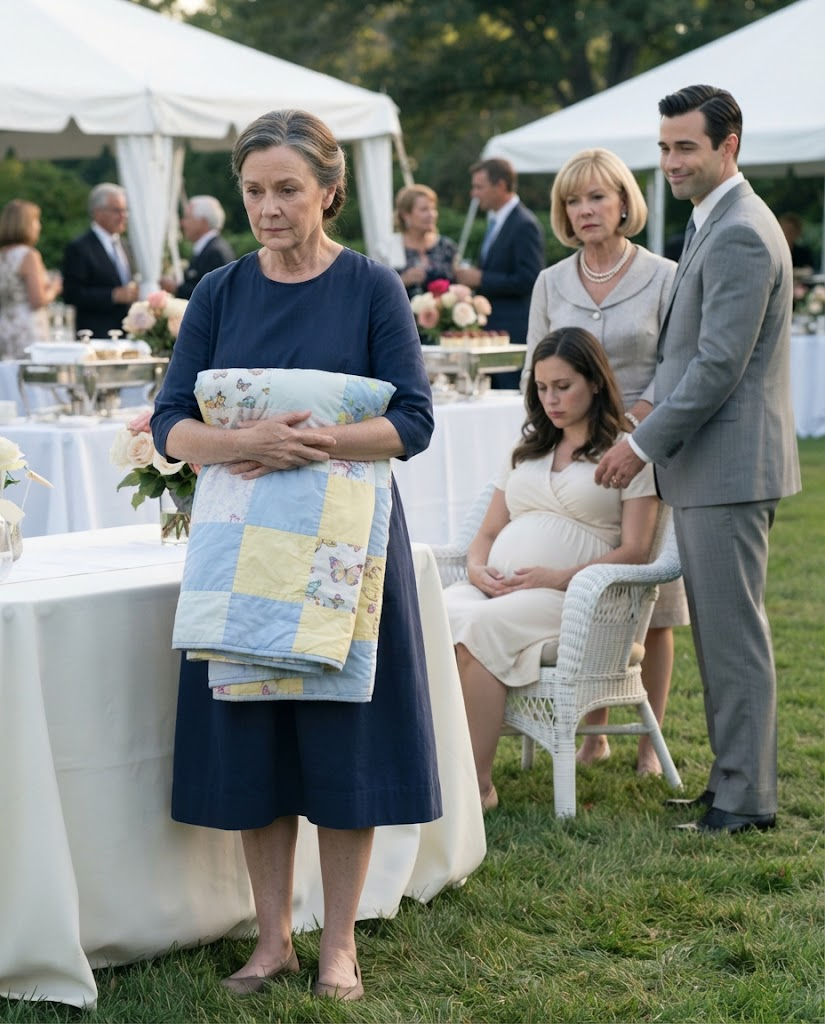

My daughter held the quilt away from her cream dress as if it might leave a stain.
“Mom,” she said, “we registered at Pottery Barn.”
I had spent nine months stitching it. Behind her white wicker chair, a string quartet played beside the rose garden. Guests sat under tents on the lawn of Ashworth Country Club, their gifts stacked in shining paper at her feet.
Her mother-in-law, Diane, touched one corner.
“Oh. This is handmade.”
Then Bradley, Megan’s husband, lifted it out of her lap.
“Your mother means well,” he said. “But this isn’t really what we had in mind.”
A few people smiled. Megan looked down. I walked to the gift table, retrieved the quilt, and folded it. I remember smoothing the blue square twice because my hands had begun to shake.
I was sixty-four. I cooked at Brookhaven Senior Center and lived in an Astoria apartment where the radiator knocked all winter. In Bradley’s family, those facts explained me completely.
The quilt held facts they had never asked about.
Megan’s first blanket. Her butterfly costume from second grade. A strip from the yellow pillowcase she dragged through our apartment when she was sleepy. The blue dress she wore on her fifth birthday, when her father was still alive and held her up to blow out the candles.
I started sewing when she told me they were trying for a baby. By the shower, nine months later, she was six months pregnant. I had imagined explaining each square while she touched it. Instead, I carried thirty-two years of her childhood back across the lawn.
In my Honda, I set the quilt on the passenger seat and sat until I trusted myself to drive.
Bradley’s voice replayed in my head. He used that same patient tone when explaining expensive things to me: which hotels were acceptable, why their mortgage was an investment, why certain people belonged at certain tables.
Last Thanksgiving, Megan had asked me not to mention my work around his colleagues. “They won’t understand,” she’d said.
I had agreed. Now I wondered what my agreement had taught her.
At home, I made tea and opened the fireproof cabinet bolted behind my winter coats. Inside were deeds, account statements, and the records of RMD Holdings.
Thirty-four properties, including the club.
My husband, Martin, and I bought our first duplex in 1991. We lived upstairs, rented downstairs, and did repairs after work. When he died, Megan was eleven. I nearly sold everything. Instead, I hired a plumber, learned to keep proper books, and held on.
There was no spectacular windfall. There were purchases I couldn’t afford, years when I bought nothing, and profits I put back into buildings. Later, competent managers made it possible to keep my kitchen job without pretending I could maintain a portfolio alone.
I liked Brookhaven. People noticed whether you remembered their dietary needs. Nobody asked what your shoes cost.
Megan knew about the first duplex. She believed I had sold it to get us through the years after Martin died. I had never corrected that belief. Privacy had gradually become secrecy, and secrecy had made some things easier than honest conversation.
Ashworth came in 2021. The forty-acre property needed capital its previous owners couldn’t supply. RMD bought the land and buildings and acquired the company operating the club. A general manager ran it. Philip, my property manager, oversaw the investment.
I wasn’t involved in party bookings. I learned where Megan’s shower would be from the invitation.
At first, that coincidence amused me. Afterward, it gave me a question: what did I actually want this place to be?
The next morning, I stopped at the bank for current statements and went to Arthur Harmon’s office. His secretary looked through the leather folder, set down her coffee, and called him out.
Arthur listened to the shower story without interrupting.
“Changing your estate plan is one conversation,” he said. “Changing a business is another. Let’s keep both clear.”
We reviewed the assets. I told him I wanted future charitable giving to serve older people and working families. Then I mentioned Bradley.
His salary, as Megan described it, couldn’t comfortably support the house, the cars, the vacations. That was a question, not evidence. Another question had been waiting at Brookhaven.
Dorothy Ellis, eighty-three, had shown me a letter from her insurer three weeks earlier. She couldn’t understand why a premium was overdue when Bradley’s firm held money to pay it.
He had told her the letter was a computer error. I had helped her find the insurer’s number anyway.
“I didn’t want to accuse my daughter’s husband based on something I didn’t understand,” I told Arthur.
“Then we’ll find someone who understands it.”
He introduced Katherine Voss, a retired forensic accountant who took selected consulting work. Katherine refused to treat expensive watches as proof of anything.
“Start with a transaction,” she said.
I called Dorothy and asked whether she wanted qualified help. She said yes. With her permission, Katherine reviewed her statements and contacted the insurer. Dorothy introduced her to other clients who were equally confused.
Meanwhile, I authorized a review of club records. Bradley’s firm, Harbor Policy Services, had paid for a sponsorship there. The club had its own receipt; we had no right to reach into his private bank accounts.
Two weeks later, Katherine called while the quilt was spread across my table.
“What I found is not small.”
Nine households had supplied records. Bradley’s firm had accepted substantial deposits into what he called premium reserves. His statements described money held to keep policies current. Insurers confirmed receiving much less than those statements implied. Some coverage had lapsed.
Dorothy had deposited forty-two thousand dollars. The insurer could account for only a small portion in premium payments. Katherine couldn’t yet say where all the rest had gone.
“That requires records we don’t have,” she warned. “But these discrepancies need an independent investigation.”
Arthur helped the consenting clients submit complaints and forwarded the documented concerns to the appropriate investigators. I didn’t announce a verdict. I made sure the people whose money was involved could be heard.
Then I called Philip about the club. Could part of the property become senior housing and affordable apartments, with a community room?
“Possibly,” he said. “We’ll need a feasibility study, approvals, and a plan for the existing business.”
I asked him to begin. On my notes, I wrote Hollowell Commons.
Five days later, I arranged a private meeting at Ashworth. Arthur and Katherine would join us with copies the clients had authorized them to share. I wanted Megan to hear the concerns before Bradley could turn them into another story about my inadequacy.
She was seven months pregnant now. She came without makeup and sat carefully. Bradley arrived in his black Range Rover, already irritated. Diane followed, carrying the confidence that had survived every uncomfortable conversation of her life.
In the main dining room, Bradley crossed his arms.
“I don’t have time for this.”
“Then I’ll be quick. This building belongs to me.”
Diane laughed. “Excuse me?”
“RMD Holdings owns the property and the operating company. I own RMD.”
Bradley stared at me. “I thought you worked at Brookhaven.”
“I do. I also sign large checks.”
- 1
- 2

More From This Author