STORY
My Son Tried Taking Arthur’s House—Then His Forged Signature Reached My Attorney
On Thanksgiving morning, Tessa handed me a black trash bag filled with my husband’s sweaters.
She held it out with both hands, as if she were offering me something unpleasant from a dead animal.
“Arthur’s things,” she said. “I thought you’d want to take them with you.”
I stared at the bag. The gray wool cardigan Arthur wore every Christmas was pressed against the plastic. Beneath it, I could see the blue sweater he had worn the last winter of his life, when his hands had begun to tremble and he needed help buttoning his cuffs.
“Take them where?” I asked.
Tessa glanced toward the staircase.
“To the senior apartments. You’re moving next month, remember?”
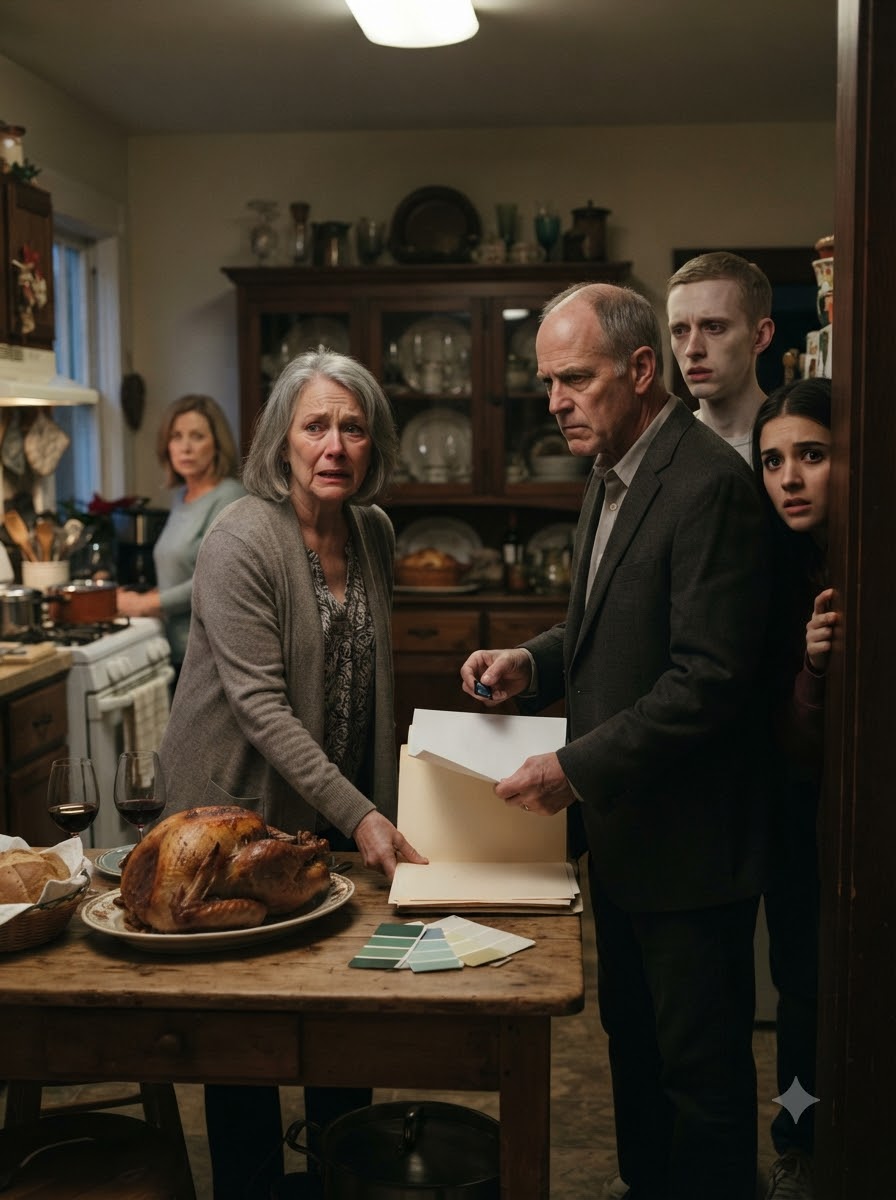
Behind her, the turkey rested on the kitchen island beneath a sheet of foil. My son, Ryan, stood beside it with a carving knife in his hand. He was studying the breastbone as though it held the answer to a difficult puzzle.
He did not look up.
I tightened my grip on the edge of the counter. “I am not moving next month.”
Tessa gave a little laugh. She was six months pregnant, and one hand rested protectively over the rounded shape of her stomach. “Helen, we’ve been through this. The apartment is perfect for you. It has elevators, activities, and emergency response buttons. We already paid the holding deposit.”
“You paid a holding deposit?”
“With the money from the sale of the guest furniture,” she said. “Which I also told you about.”
The guest furniture. My mother’s oak bedroom set. Arthur’s writing desk. Two lamps we had bought during our honeymoon in Vermont.
All of it had appeared on an online marketplace without my permission.
Ryan finally set the knife down.
“Mom,” he said, with the weary tone of a man addressing a child who refused to cooperate, “you’re sixty-seven. You don’t need four bedrooms. Brielle will be here in February. We need the space.”
The name struck me harder than the trash bag.
Brielle. Their unborn daughter.
They had already decided to take my bedroom for a nursery, my dining room for an open-concept renovation, and my husband’s belongings for whatever apartment they had selected without me.
My house had become a project they were managing.
It was the house Arthur and I had bought thirty-two years earlier. We had repaired the roof twice, replaced every pipe, refinished the floors ourselves, and paid off the mortgage eleven years before his death. For the last four years, I had paid the property taxes, bought most of the groceries, and watched their three-year-old son, Mason, five days a week.
Tessa called it “helping family.”
Ryan called it “what Mom would want.”
Now they wanted me gone before lunch.
Diane, Tessa’s mother, swept into the kitchen carrying paint samples and a tape measure. She wore a cream-colored coat despite the mild weather and smelled of expensive perfume.
“Perfect,” she said, looking around. “This is exactly the light I wanted.”
She walked to my mahogany china cabinet and tapped the glass with one manicured fingernail.
“This old thing has to go by Sunday, Helen. Tessa needs an open dining room before the baby shower.”
“That cabinet belonged to Arthur,” I said.
Diane smiled. “Then you can keep it in storage.”
“My house is not a storage facility.”
The smile disappeared.
Ryan rubbed his forehead. “Please don’t make Thanksgiving difficult.”
I looked from him to Tessa, then to Diane. Three people stood in my kitchen discussing my life as if I had already left it.
Outside, a car door slammed.
The doorbell rang.
Tessa’s expression changed so quickly that I noticed it even before she turned toward the foyer. The confident irritation vanished. For one bare second, fear crossed her face.
Then she recovered.
“I’ll get it.”
“No,” I said.
I walked through the hall, past the framed photograph of Arthur holding baby Ryan, and opened the front door.
A man in a navy suit stood on the porch. Beside him was a woman I recognized from the branch of First National Bank where Arthur and I had kept our accounts.
Behind them stood Mr. Callahan, my estate attorney.
The bank woman held a leather folder against her chest.
“Mrs. Whitaker?” she asked.
“Yes.”
“I’m Marlene Ortiz, a notary and fraud investigator with First National Bank.”
Ryan appeared behind me. I heard the knife clatter onto the cutting board.
Marlene’s eyes moved past me and settled on him.
“We need to discuss a home equity line of credit connected to this property.”
Tessa came to a stop halfway down the hall.
“What home equity line?” she asked.
Marlene opened the folder.
“One hundred eighty-five thousand dollars,” she said. “The application was submitted six weeks ago.”
The house seemed to contract around us.
I looked at Ryan. “What is she talking about?”
He lifted both hands. “I don’t know.”
Marlene continued. “The application lists Helen Whitaker as the borrower and Ryan Whitaker as her authorized agent under a power of attorney.”
“I never gave Ryan power of attorney,” I said.
“We know,” Mr. Callahan said quietly. “That’s why we’re here.”
Diane moved toward the door. “This is a family matter. You can’t just come into someone’s home and make accusations on a holiday.”
Mr. Callahan removed his hat.
“It is also a property matter,” he said. “And a criminal matter.”
Diane planted herself in the doorway.
“You should leave,” she told him.
Mr. Callahan reached into a second folder.
“Before anyone leaves,” he said, “there is something else you need to see.”
Four years earlier, after Arthur died, I had been too exhausted to think clearly. I was grieving, selling his medical equipment, sorting through papers, and trying to keep Mason from climbing onto the dining room table.
Arthur had insisted on a revocable living trust. I remembered signing it in Mr. Callahan’s office. I remembered Arthur’s careful explanation that the house would remain protected and that I would be the trustee while I lived.
But grief had made paperwork feel like a foreign language.
Ryan had offered to help.
He drove me to the county office to update the tax mailing address. He organized bills. He told me I was lucky to have a son who understood finances.
What I did not know was that he had begun asking questions about the trust.
What I did know was that I had paid everything.
Every property tax bill. Every insurance premium. Every repair.
The house remained in Arthur’s revocable living trust, with me as the sole current trustee and beneficiary. Ryan had no ownership interest, no authority to sell, borrow against, or renovate it.
Mr. Callahan explained that in his office while we stood in the foyer beneath Arthur’s wedding photograph.
“Two weeks ago, the county recorder’s office sent us a routine notice,” he said. “A lien had been filed against the property.”
I felt cold despite the heat in the house.
“A lien?”
“A deed of trust securing a home equity credit line. The lender believed you had authorized it. I requested the original documents.”
He handed the first page to me.
My name appeared beneath a signature that looked almost like mine.
Almost.

More From This Author