STORY
My Son Tried Taking Arthur’s House—Then His Forged Signature Reached My Attorney
The capital H was too narrow. The final loop in Whitaker was too sharp. Arthur used to say my signature wandered across a page like a woman late for a train. This one was stiff and deliberate.
“I didn’t sign this,” I said.
Marlene nodded. “We know.”
She showed me the notarization page. The notary stamp was dated October 14. The document claimed I had appeared in person at a branch in another county.
“I was here,” I said. “I was watching Mason. He had an ear infection.”
“And the notary who supposedly witnessed your signature has never worked for First National Bank,” Marlene said. “The seal was copied.”
Ryan took a step forward. “That doesn’t prove anything.”
“It proves the paperwork was fraudulent,” Mr. Callahan replied.
Ryan looked at me. “Mom, someone must have stolen your information.”
Tessa folded her arms. “This is ridiculous. Why would Ryan steal from you? We’re trying to help you.”
“You told me the apartment deposit came from the sale of my furniture,” I said.
Her mouth opened, then closed.
Diane snapped, “You’re confused. You’ve been under a lot of stress.”
“I am not confused.”
The words came out louder than I expected.
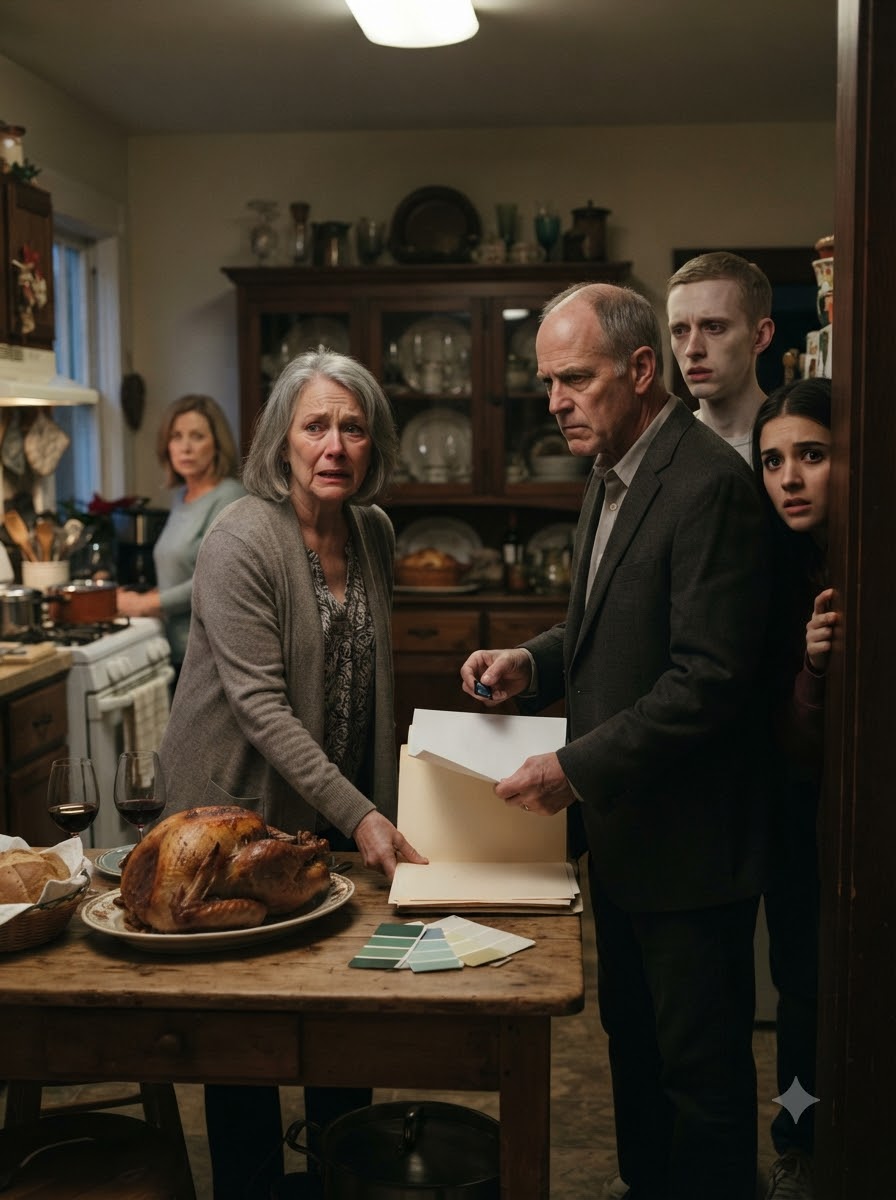
Mason appeared at the end of the hallway holding a plastic dinosaur. His cheeks were flushed. He looked from the adults to the trash bag near the kitchen.
“Grandma,” he said, “are we moving?”
No one answered.
Mr. Callahan opened the second folder.
“This is the trust,” he said. “And this is a document submitted to the bank six weeks ago.”
He placed both copies on the console table.
The first was Arthur’s original trust, dated and notarized four years earlier. The second was a purported amendment. It claimed that I had resigned as trustee and appointed Ryan in my place.
Underneath that was a limited power of attorney authorizing Ryan to borrow against the house.
My stomach turned.
The signature on the amendment was mine.
The signature on the power of attorney was mine too.
But neither was mine.
Mr. Callahan pointed to a line near the bottom of the amendment.
“The document also says the trust was amended in my office on September 29,” he said. “It was not. My office was closed that day. I was in a hospital with pneumonia.”
Ryan’s face had gone pale.
Tessa stepped toward the table. “This is some kind of clerical mistake.”
“It is not,” Mr. Callahan said. “The documents were attached to the loan application from an email address created two months ago.”
Marlene opened another sleeve and removed a printed email.
The address was a variation of mine: helen.whitaker.trustee@gmail.com.
My actual email was different.
The message had been sent to the bank by someone calling herself Helen Whitaker. Attached were scans of my driver’s license, Arthur’s death certificate, the trust, the forged amendment, and the power of attorney.
I looked at Ryan.
He shook his head before I said anything.
“I didn’t do this.”
Marlene turned another page.
“The applicant also submitted a phone number for identity verification. That number was used to contact the bank three times. It was registered to a prepaid phone purchased at a convenience store.”
“Anyone could have bought it,” Ryan said.
“Yes,” Marlene answered. “But the store has security footage.”
Silence settled over the foyer.
Tessa looked at Ryan.
Diane looked at Tessa.
I looked at the trash bag containing my husband’s sweaters.
Mr. Callahan drew out a small flash drive.
“On the morning of November second, our investigator obtained footage from that store,” he said. “The buyer is Tessa Whitaker.”
Tessa laughed.
It was a thin, unnatural sound.
“That’s impossible.”
“We also found the second phone in the glove compartment of your SUV,” Marlene said. “Your vehicle was towed last week after a parking violation. The investigator obtained a warrant to inspect it.”
Tessa’s hand went to her stomach.
Ryan stared at her.
She stared back.
“This is insane,” she said. “I bought a phone for work. My clients need privacy.”
Marlene’s voice remained calm. “The phone contained text messages to the loan officer. It also contained photographs of Mrs. Whitaker’s driver’s license and trust documents.”
Ryan turned toward Tessa. “Why did you have Mom’s documents?”
“I didn’t.”
“They were on your phone.”
“I said I didn’t!”
Diane stepped between them. “My daughter is pregnant. You’re harassing her.”
“No one is harassing anyone,” Mr. Callahan said. “We are documenting fraud.”
Ryan’s eyes had moved to the table. He picked up the forged power of attorney and studied it.
“I never saw this,” he said.
Marlene took out one final document.
“Actually, you signed the borrower acknowledgment.”
Ryan did not move.
The page showed his signature beneath a statement confirming that he had reviewed and approved the loan application.
He looked at me.
“Mom, I thought it was an authorization to manage the property.”
“You signed a loan acknowledgment without reading it?”
“Tessa handled the paperwork.”
Tessa spun toward him. “You knew exactly what we were doing.”
“No, I didn’t!”
“You said your mother would never let us get ahead unless we forced the issue.”
Ryan’s face changed.
The anger fell out of it, leaving something smaller and more frightened.
Diane whispered, “Tessa.”
But Tessa was no longer looking at her mother. She was looking at Ryan as if she had just discovered he was capable of betrayal.
He had been.
“Tell them,” she said.
“Stop.”
“Tell them what you said.”
Ryan’s voice dropped. “You wanted the house.”
“You wanted it too.”
“I wanted to refinance the back taxes.”
I stared at him. “What back taxes?”
He swallowed.
Marlene answered for him. “There were no back taxes. The property taxes are current.”
Tessa laughed again, but this time her face was wet.
“He used the money,” she said.
Ryan grabbed her arm. “Don’t.”
She pulled free. “You used the first seventy-five thousand to pay off your gambling debts.”
The room went still.
I had known Ryan liked sports. I had not known about the betting accounts, the late-night withdrawals, the credit cards hidden under his name.
Marlene opened a bank statement.
“The credit line was approved for one hundred eighty-five thousand,” she said. “A preliminary draw of seventy-five thousand was deposited into a joint account held by Ryan and Tessa. From there, thirty thousand went to a betting platform, twenty-two thousand went to a luxury furniture retailer, and the remainder was transferred to an account belonging to Diane Mercer.”
Diane’s face hardened.
“That was a loan,” she said.
“To help my real estate business,” Tessa added quickly.
“Your business had outstanding debts to three vendors,” Marlene said. “The money was not used for renovation.”
Diane lifted her chin. “This is a private family transaction.”
“No,” Mr. Callahan said. “It is a fraudulent encumbrance against trust property.”
He handed me a letter.
It was from the bank. The loan had been frozen. No further draws could be made. The bank had accepted my identity theft claim and withdrawn its demand against me personally.
But the first seventy-five thousand remained owed by the people who had taken it.
The next revelation came from an unlikely source.

More From This Author