STORY
My Son’s Lunch Went in the Trash—Another Mother Kept Cartwright’s Message
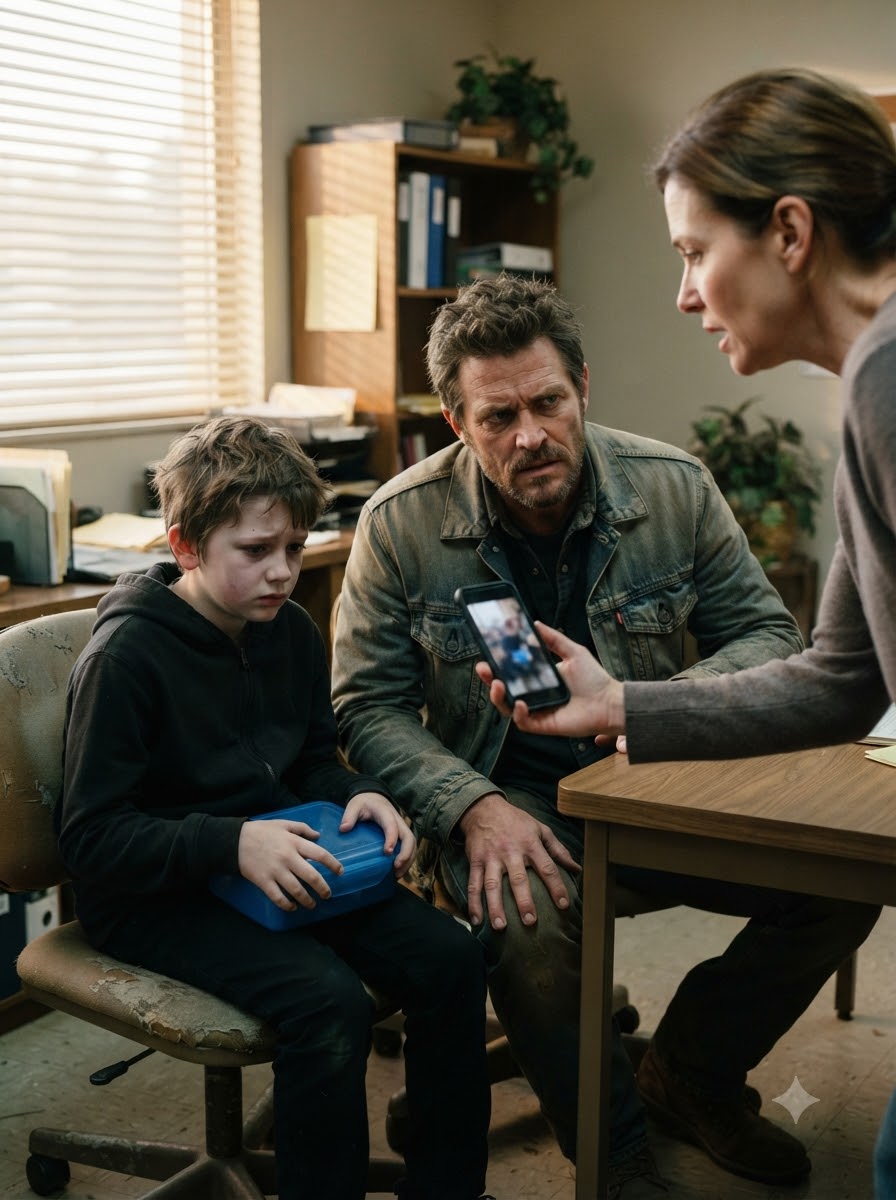
David printed the email and put it beside the notice. Friday’s welcome-home assembly had already started without Marcus. The event had been planned months before David’s deployment ended; Marcus had wanted to see the photographs on the gym wall, to be there when the other families applauded. David let him decide whether to go late.
Marcus shook his head. “I don’t want to walk in there with everybody looking.”
So David stayed home. He and Marcus made sandwiches in Dorothy’s kitchen, sitting together at the table where Marcus had prepared the chicken. David told him about the long flight and the strange relief of seeing their street from the car window. Marcus asked whether he had been afraid overseas. David said yes.
Late that afternoon, Rebecca forwarded another message. It came from a student whose older sister had graduated the year before.
The sister, Nia Carter, said Patterson had taken food from her brother’s lunch tray the previous spring. Their mother had complained. Cartwright told her there was no written report of the incident and no basis for further action.
Nia had a copy of the email her mother sent afterward. Attached was a photograph of her brother’s lunch and a written account of Patterson calling it “unsuitable.” Cartwright’s reply promised to “address the misunderstanding privately.”
David sent both emails to the district investigator assigned that morning, along with a request to meet.
The investigator, Lila Moreno, arrived at Dorothy’s apartment on Monday. She had already watched Tyler’s video. She asked Marcus to describe what happened without interrupting him, then asked about Patterson’s claim that he had been defiant.
“I said please,” Marcus answered. “I followed her to the trash can. I didn’t touch her.”
Moreno nodded and wrote it down.
She examined the blue container. Dorothy showed her Angela’s recipe card, still marked with flour from Thursday morning. David had hesitated to include it; he did not want his wife turned into evidence. Marcus had brought it to the table himself.
“She knew why it mattered,” he said of Patterson. “I told her.”
Moreno told them what she could. The school had no rule against home-cooked food. It had rules about sharing food because of allergies, but Marcus had not shared his lunch. Mr. Lewis had given her the tied bag on Friday, with a written statement. Inside were the chicken, macaroni, and greens, in the cafeteria trash just as the video showed.
“That proves she took it,” David said.
“The video already proves that,” Moreno replied. “The bag helps establish that the food wasn’t set aside over a safety concern, as Ms. Patterson now says.”
David stared at her. “That’s her explanation?”
Moreno closed her notebook. “There’s more to review.”
Over the next week, Moreno interviewed students, cafeteria staff, and teachers. Five families came forward after the district contacted them. Their children had brought food from home and been told by Patterson that it smelled, made a mess, or did not meet “school standards.” All five children were Black, Latino, or South Asian. No one could identify an instance in which she had taken or criticized a white student’s lunch.
Patterson denied singling anyone out. She described herself as strict, not prejudiced, and insisted that Marcus had been “emotionally volatile.” Cartwright supported her. Their statements used nearly the same phrases.
Then Moreno requested the original files behind Patterson’s typed complaint folder.
At the meeting with Dorothy, Patterson had laid that folder on the table as if every page represented a separate adult witness. Three pages were labeled cafeteria incident statements. One was attributed to a lunch aide who had not worked Thursday. Another bore Tyler Brooks’s name beneath a description of Marcus “shouting at staff.”
Tyler had never written it. Rebecca confirmed that neither he nor anyone in their family had been asked to sign a statement. The lunch aide confirmed that she had taken Thursday off to attend a medical appointment.
The digital files showed that all three documents had been created on Cartwright’s office computer after Patterson sent her first report. Someone had typed Tyler’s name into a signature line. No signed original existed.
When Moreno found that, she requested the previous year’s complaint files.
Cartwright had told Nia Carter’s mother there was no written report. In fact, her email and photograph had been saved, then marked “resolved—no substantiated incident” the following morning. Two other parents’ complaints had received the same notation. Their accounts had never been sent to the district.
The first revelation was that Patterson had been humiliating children for what they brought from home. The second was that Cartwright knew enough to hide the complaints. When Marcus and Tyler brought her a video she could not quietly close, her office helped build a record against Marcus instead.
The district called a formal conference the next Thursday. David attended with Dorothy and Marcus. Rebecca came with Tyler. Moreno sat at one end of a long table; the superintendent, a district lawyer, Cartwright, and Patterson sat at the other.
Patterson looked at Marcus only once.
She began by saying that the video lacked context. She had noticed a smell and believed the food might have spoiled. Students, she said, had become agitated before she reached the table.
Tyler leaned forward, but Rebecca touched his wrist.
Moreno played the recording on a screen. It began before Patterson entered the frame. Students were eating and talking. Marcus was smiling. When the clip ended, Moreno asked Patterson why she had told Marcus to bring something “appropriate” the next day if she believed the issue was spoiled food.
Patterson said she had chosen her words poorly.
“And why did you throw the food into a trash bin rather than send it to the nurse or cafeteria manager?”
“I had to make a quick decision.”
Mr. Lewis’s statement and the photograph of the recovered bag lay in front of her. She pushed the photograph away.
Cartwright said the suspension had been based on more than the lunch. She cited the three incident statements and reached for the folder.
Moreno did not stop her. Cartwright read a line about Marcus refusing to follow directions. Then Moreno asked the lunch aide, who was attending by video call, whether she had seen Marcus that Thursday.
“No,” the woman said. “I wasn’t in the building.”
Cartwright looked toward the district lawyer.
Moreno turned to Tyler. “Did you write the statement with your name on it?”
“No,” he said. His voice shook, but he kept going. “I recorded Ms. Patterson. That’s all.”
Cartwright said an employee must have misunderstood who had provided the account. She could not explain why a statement from Tyler appeared in her folder when she had watched him challenge the suspension herself.
Finally, Moreno displayed the file history. The documents had been created from Cartwright’s computer account. Cartwright said others had access to the office. Moreno asked her to identify them. She named her secretary, who had already stated that she neither drafted nor handled the statements.
Marcus watched Cartwright’s face. All week he had remembered her sitting across from Dorothy, letting him believe three adults had reported him. Now she was speaking quickly, trying to leave room for a mistake that could belong to somebody else.

More From This Author