STORY
My Twin Sister Built Her Harvard Law Story on My Disappearance—Until I Returned
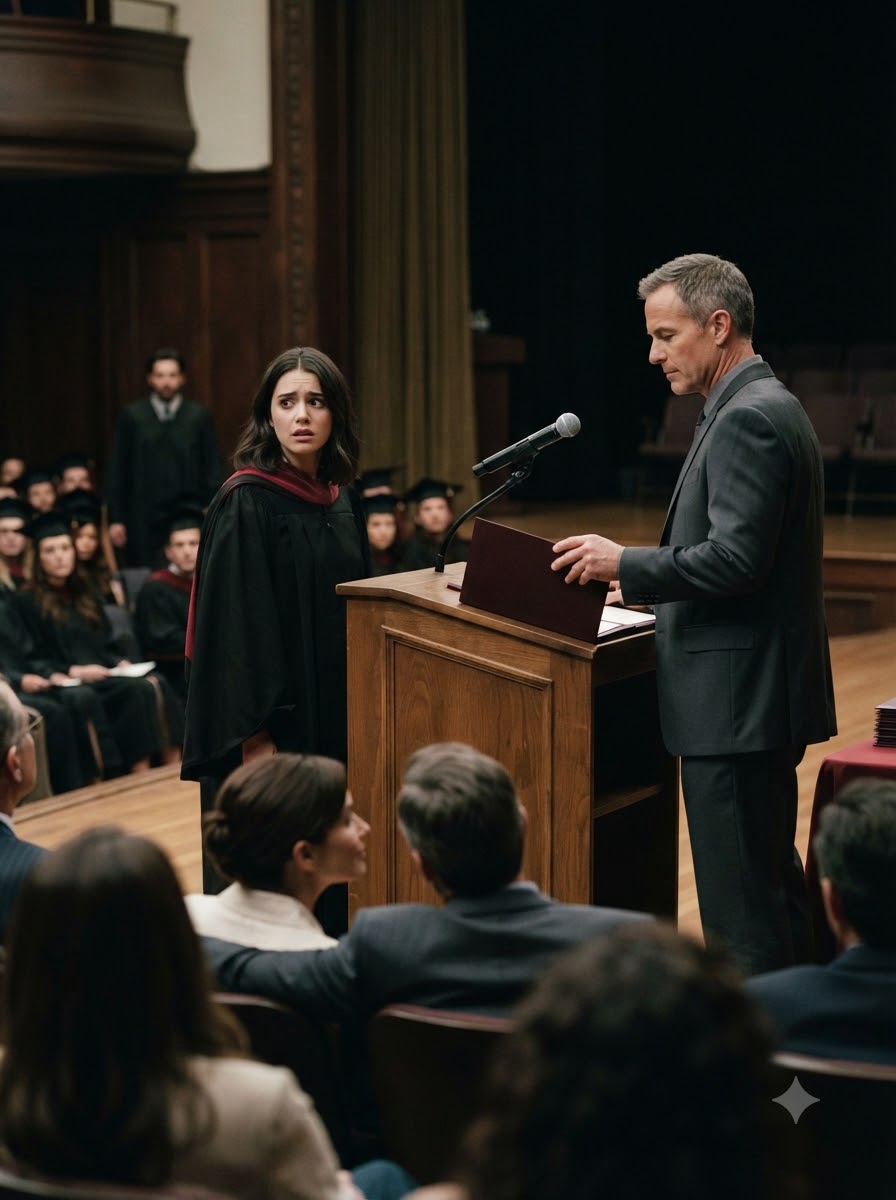
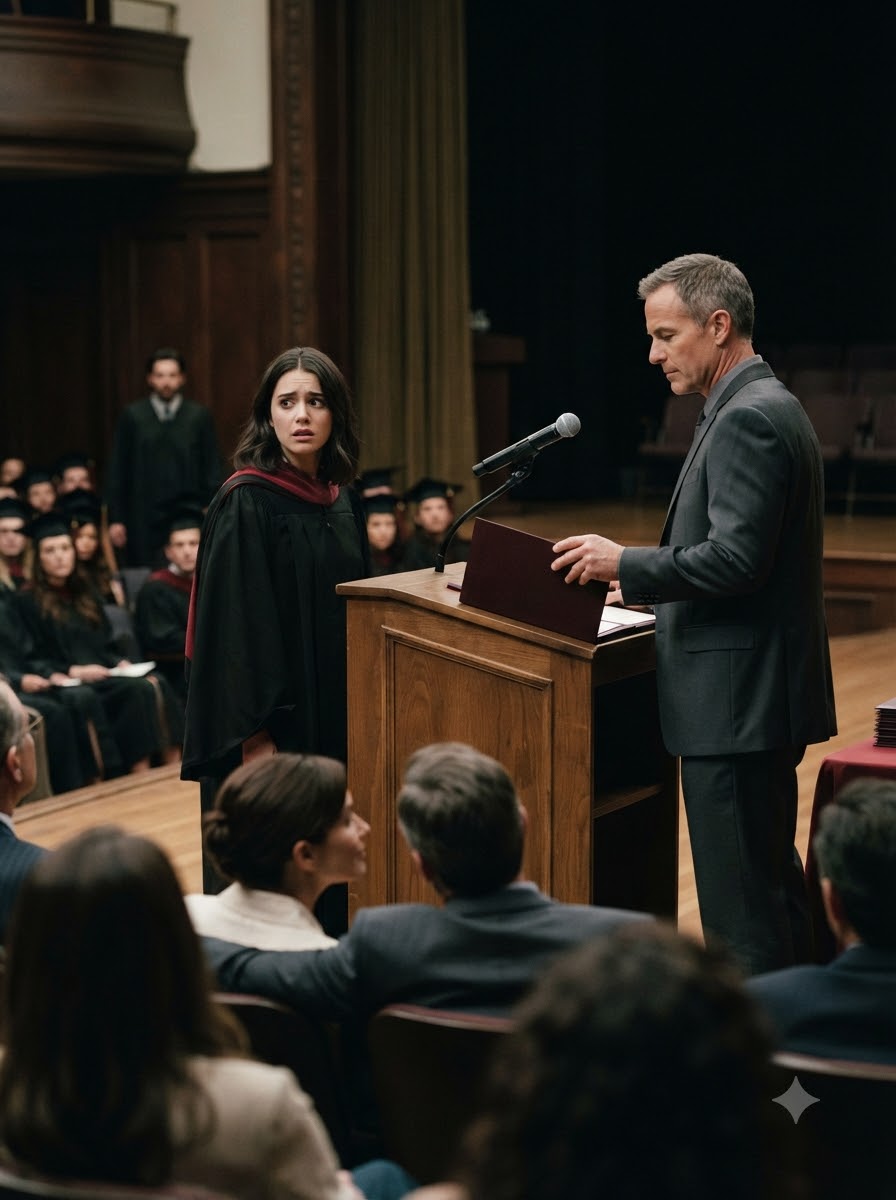
Nobody noticed me when I walked into the theater.
That was the first insult of the morning.
The second was that my mother was already crying for me.
She sat in the second row beneath a crimson Harvard banner, one hand clutching a white tissue, the other resting on my father’s knee. Her face had been arranged into the expression she wore at funerals and charity galas: sorrowful enough to attract sympathy, controlled enough to look dignified.
My father sat beside her in a dark suit, shoulders squared, chin lifted. He was proud of the room, proud of the university, proud of the people who might recognize him as the father of the graduating speaker.
Neither of them saw me take a seat.
Neither of them looked fourteen rows back.
On the stage, my twin sister adjusted the sleeve of her black robe and accepted a folder from the dean. Sloan Mortensson looked exactly as she had in every photograph I had seen over the past six years—polished, composed, impossible to catch making a mistake.
She was about to address the graduating class of Harvard Law.
She was about to tell them about me.
The first time I heard Sloan describe my disappearance, I was sitting in the break room of a Boston hospital with my shoes off and dried blood on the cuff of my scrubs.
I had just finished a twelve-hour ICU shift. My hands smelled faintly of antiseptic despite washing them twice. I was too tired to eat, but too wired to sleep, so I opened my phone and began scrolling without really seeing anything.
Then I saw my face.
It was an old photograph, taken on my grandmother’s porch when I was sixteen. I wore a red flannel shirt and had one knee pulled to my chest. Sloan had taken the picture while I was reading.
Underneath it, she had written:
Six years ago today, I lost my twin sister, Mara.
I stared at the words until they stopped making sense.
I was not lost.
I was alive.
I was in Boston, two hours away from the house where we had grown up. I had a lease, a driver’s license, a nursing job, student loans, tax records, hospital credentials, and a life Sloan had never bothered to ask about.
But on her page, I was a vanished girl.
The post continued.
Sloan wrote that my disappearance had changed the direction of her life. She said she had once wanted only success, but losing me taught her that justice mattered more than ambition. She said every exam she passed and every courtroom she entered was an attempt to honor the sister who had been taken from her.
The final line read:
I will keep fighting for the voiceless, because Mara no longer has a voice of her own.
Hundreds of people had commented.
They called her brave.
They called her inspiring.
One woman wrote that I must be looking down on Sloan with pride.
I put my phone facedown and sat in the empty break room until my supervisor found me.
“What happened?” she asked.
I told her I had seen a post about myself.
She thought I meant a photograph.
I did not correct her.
That night, I saved everything.
The post. The photographs. The interviews. The fund-raising page Sloan had created for a “justice initiative” in my name. The podcast appearance where she told a host that our family had searched everywhere for me. The alumni article that described her as “a survivor of profound personal loss.”
I saved screenshots because I had learned, slowly and painfully, that memory was not evidence.
Paper was evidence.
I had learned that in the kitchen of our childhood home.
We were seventeen when Sloan and I applied to Harvard. We had filled out the applications at the same dining table, sharing a printer and fighting over the last clean blue pen.
Sloan had always assumed she would be accepted.
I had hoped.
When her letter arrived, my parents ordered a cake. My mother bought a banner with Sloan’s name printed in gold. My father called every relative he could reach. Sloan stood in the middle of the kitchen while people applauded her, and I stood near the refrigerator holding a glass of water no one asked me to refill.
Three days later, I found my own acceptance letter.
It was not in the mailbox.
It was behind the stack of old newspapers in my mother’s bedroom closet.
The envelope had been opened.
My name was visible through a crease where someone had folded it in half.
I carried it downstairs.
My mother was at the kitchen counter sorting coupons. My father was reading the newspaper. Sloan was sitting on the island, eating strawberries from a glass bowl.
I placed the letter between them.
For several seconds, no one moved.
Then my father said, “Where did you find that?”
It was not congratulations.
It was not surprise.
It was accusation.
My mother closed her eyes. Sloan stopped chewing.
My father explained that they could not afford to send both of us. Sloan had received a better financial package, he said. Her program was more demanding. She had a clearer career path.
I pointed out that my acceptance letter included financial aid.
He said the aid would not cover everything.
I said I could work.
My mother said I was being emotional.
I asked why the letter had been hidden.
She told me she had needed time to think.
Sloan finally spoke.
“You always knew I was the one more likely to make something of it.”
I looked at her, waiting for her to take it back.
She did not.
That night, I packed a bag.
I did not leave because I was brave. I left because staying would have required me to accept that my family had made a decision about my value, and I was not ready to let them make that decision permanent.
My grandmother, Evelyn, helped me move to Boston. She gave me enough money for a room, a used car, and three months of expenses. She hugged me in the driveway while my mother stood at the front door and my father remained inside.
Sloan did not come out.
Evelyn died nine months later.
I returned for the funeral, but not for the family.
Afterward, I worked as a nursing assistant, enrolled in classes, and eventually became an ICU nurse. My life was not glamorous, but it was mine. I learned how to stand beside frightened families without making promises I could not keep. I learned how to recognize the difference between someone who was unconscious and someone who was simply refusing to wake up.
For six years, no one from home called.
Not once.
Then Sloan’s post appeared.
I tried calling my mother first.
The number went to voicemail.
I left a message saying I had seen Sloan’s story and wanted to know why she was telling people I was gone.
My mother called back eleven minutes later.
She did not say hello.
“Why are you doing this to your sister?” she asked.
I laughed once because the question was so absurd it hurt.

More From This Author