STORY
My Twin Sister Built Her Harvard Law Story on My Disappearance—Until I Returned
“What am I doing?”
“You know exactly what I mean. Sloan has worked hard to turn something painful into something meaningful.”
“She is telling people I disappeared.”
“You did disappear.”
“I moved to Boston.”
“You cut us off.”
“You stopped answering my calls.”
My mother’s voice hardened. “We were trying to protect Sloan.”
That sentence stayed with me long after she hung up.
Not because it explained anything.
Because it confirmed that there was something to protect.
I contacted an attorney in Boston, but before I could make an appointment, I received a letter from my grandmother’s estate lawyer.
The envelope had been forwarded three times before reaching me. Inside was a handwritten note from Evelyn.
Mara,
If you are reading this, then you have waited longer than I hoped you would.
There are things your parents told you that were not true. There are things Sloan believes she got away with. Do not confront them until you speak to Theodora Brennan.
Trust Theo.
Theodora Brennan had been Evelyn’s attorney for nearly twenty years. I remembered her vaguely as a tall woman with silver hair and a habit of listening without interrupting.
I found her office in a brick building near Beacon Hill.
She did not look surprised when I walked in.
“You look like your grandmother,” she said.
“I was told you had something for me.”
“I do.”
She closed the office door and removed a burgundy folder from a locked cabinet.
The folder was thick enough to make my stomach tighten.
Theo did not hand it over immediately.
“Before you open this,” she said, “understand that some of it may be difficult to read. Your grandmother wanted you to have the truth, but she also wanted you to choose what to do with it.”
I took the folder.
The first document was a copy of my Harvard acceptance letter.
The second was a certified delivery record showing that it had arrived at my parents’ house on April 4.
The third was a scan of a bank statement.
Evelyn had opened an education trust for both of us when we were children. It contained enough money to cover my tuition, housing, and books for four years.
My parents had emptied most of it two weeks before the acceptance letters arrived.
The withdrawals had been authorized by my father.
The money had gone toward Sloan’s private admissions consultant, travel, tutoring, and a deposit on an apartment near Harvard.
I turned the page.
There was a letter from Evelyn to my parents, dated one week before I left home.
It said she had discovered the withdrawals and demanded that they restore my share immediately. She wrote that if they refused, she would change her will and report the misuse to the bank.
My father had replied that I was “unstable,” “resentful,” and “unlikely to complete a degree.” He claimed the money had been used for the child with the strongest prospects.
Another page contained an email from my mother to Evelyn.
Please do not interfere. Mara needs to accept that Sloan is the one with a future.
My hands began to shake.
Theo opened a second section.
“There is more,” she said.
The documents showed that Evelyn had changed her will. She left me the house, her remaining investments, and a separate account containing $184,000. Sloan received a smaller trust that would be released only after she completed a degree or entered a profession.
My parents had known about the changes.
They had also known that Evelyn was preparing to report the withdrawals.
Then came the medical records.
Evelyn had suffered a stroke six years ago. She had been hospitalized for three days before she died. During that time, my mother told relatives that I was unreachable and had “run away again.”
But Theo had called me.
I had never received the voicemail because my mother had changed the contact information on Evelyn’s hospital file.
My mother had also told the hospital that I did not wish to be contacted.
“That is why you never knew she tried to reach you,” Theo said.
I could not speak.
The final documents were copies of social media messages and fundraising records. Sloan had created a foundation in my name while I was alive and living in Boston. Donations had exceeded $90,000. The foundation paid for scholarships, but a consulting company controlled by my father had received more than $28,000 in administrative fees.
My name was on the website.
My death was not.
That distinction mattered legally.
It mattered more emotionally than I could explain.
“They knew I was alive,” I said.
Theo nodded. “Your mother answered one of my letters two years ago. She wrote that contacting you would endanger Sloan’s career and public image.”
I looked down at the folder.
“What do you want me to do?”
“That is the wrong question,” Theo said. “What do you want to do?”
I thought of Sloan on the podcast, lowering her voice as she described my supposed disappearance. I thought of strangers telling her how proud I must be. I thought of my mother pressing a tissue to her eyes in a theater while I sat alive in the audience.
“I want her to tell the truth in the same room where she told the lie.”
Theo nodded.
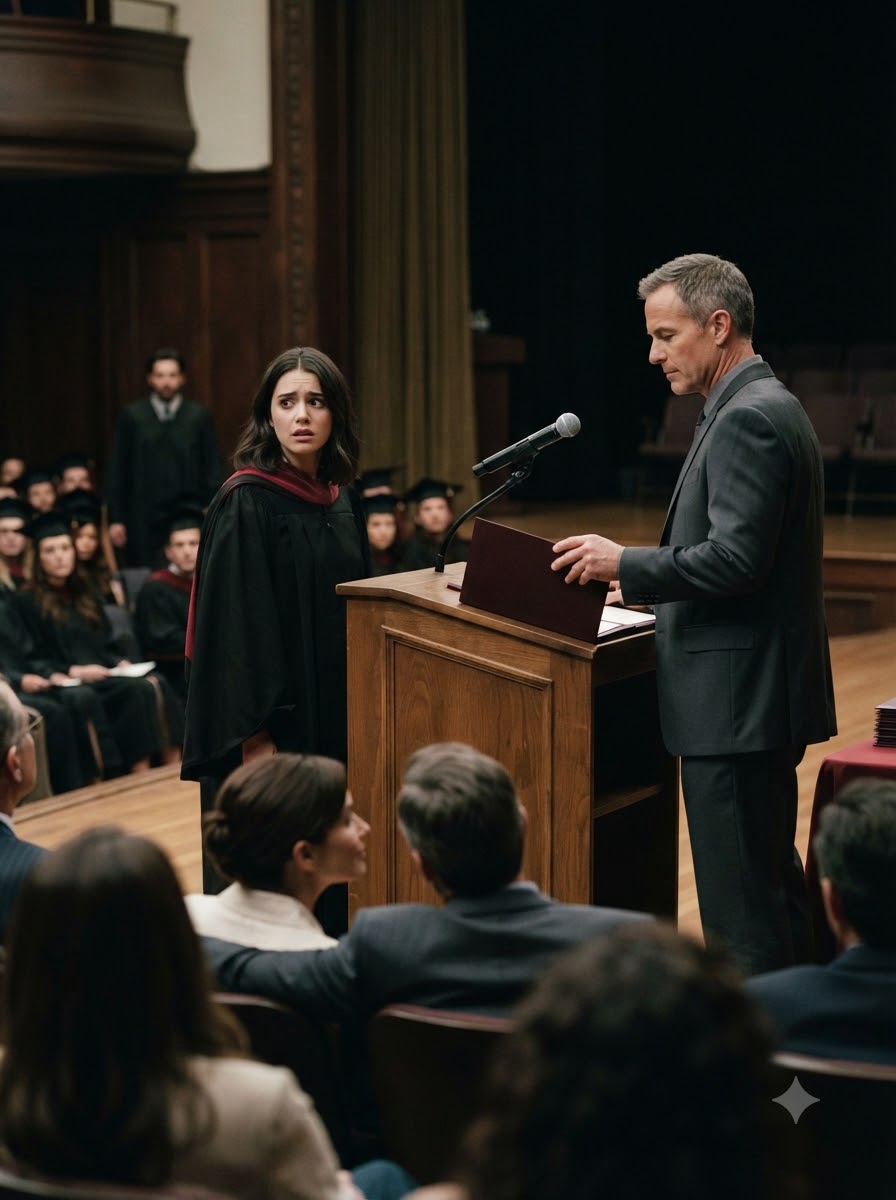
Three weeks later, I sat in Row 14 at Harvard’s commencement.
I had not told my parents I was coming. I had not contacted Sloan. Theo arranged my ticket through the university’s general counsel, who had reviewed the documents and agreed to attend.
I carried the burgundy folder in my lap.
Sloan began her speech at eleven.
She spoke beautifully.
That was the worst part.
She talked about the responsibility of lawyers to people who had been abandoned by institutions. She talked about how grief had sharpened her sense of justice. She told the graduates that no one should be reduced to a case number or forgotten because their voice was inconvenient.
Then she said my name.
“Mara taught me that silence is not the same as consent,” Sloan said.
My mother bowed her head.
My father stared at the stage.
Sloan’s voice trembled at exactly the right moment.
“My sister disappeared six years ago,” she continued. “I do not know whether she is alive, whether she will ever hear this, or whether she knows that every step I have taken has been for her.”
The audience grew still.
A woman in front of me began to cry.
I looked at Sloan’s face.
She did not look toward Row 14.
She knew I was there.
Maybe she had known for days.
Maybe Theo had warned her.
Either way, she finished the speech without stumbling.
The applause was enormous.
People stood.
My mother stood too, one hand over her heart.
Then the dean introduced the keynote speaker.
“Theodora Brennan is a distinguished attorney, advocate, and member of the Harvard Law School community,” he said. “She has spent her career defending the principle that truth must survive performance.”
Theo walked to the podium.
She carried no notes.
She placed the burgundy folder on the lectern.
Sloan’s smile disappeared.
Theo waited until the room quieted.

More From This Author