STORY
She Asked Her Husband to Forgive an $86,000 Debt—But Money Wasn’t the Only Thing They Had to Untangle


Cal wrote slowly, pressing hard enough for the words to leave grooves in the paper.
“My need for a sexual marriage is real, but it is not a bill Priya must pay.”
He put the pen down.
Beside his sentence was hers: “No repayment, affection, or physical intimacy is expected in return.”
For several seconds, neither of them spoke. The refrigerator hummed. A truck changed gears on the avenue below their apartment. On the table between them sat the remains of a dinner neither had eaten.
“Sign yours,” Priya said.
“You first.”
She signed. Then Cal did.
The page had no legal force. The document beneath it did.
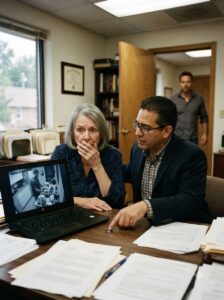
At nine the next morning, they carried both to Sonia Kline, the attorney who had helped Priya close her company.
Sonia was a compact woman with silver-framed glasses and an office full of plants that looked healthier than either of them. She reviewed the debt-release agreement, asked Cal twice if he understood that he was surrendering his claim to the remaining balance, and reminded him that the original money had come from an inheritance.
“If this marriage ended next month,” Sonia said, “you would not be able to treat this loan as an outstanding asset. Are you certain?”
Cal looked at Priya.
Her back straightened, as if she were preparing to accept whatever he decided without moving a muscle.
That posture had once impressed him. Priya could stand inside a disaster and become more precise. During the worst weeks of her company’s collapse, she had negotiated with creditors while living on crackers and two hours of sleep. She had laid off twelve people without letting her voice break until she reached the parking garage.
Now Cal understood that her stillness was not strength. It was bracing.
“I’m certain,” he said.
Sonia gave him the pen.
He signed.
She notarized the agreement, slid the official pages into a folder, then tapped the handwritten sheet.
“This part doesn’t belong in the file.”
“I know,” Cal said.
“What are you planning to do with it?”
Priya answered. “Try to live by it.”
Sonia looked from one to the other. “That will be harder than signing it.”
Neither of them argued.
***
Priya Raman was thirty-eight when Lantern House Fabrication failed.
She had started the company at twenty-nine with one assistant, a rented workshop, and an unreasonable belief that exhaustion was evidence of devotion. They built custom lighting installations for hotels, restaurants, and retail spaces—huge suspended pieces made of glass, brass, wood, and programmable LEDs.
For years, the business grew.
Then a hotel group delayed payment on three completed projects while Priya’s material costs kept coming due. She borrowed to finish work she had already financed. The hotel group entered restructuring. A lender called her loan. Her landlord enforced the personal guarantee on the workshop.
Within six months, she went from employing twelve people to selling equipment one machine at a time.
Cal, forty, worked as a water-systems engineer for the city. His salary could cover their mortgage and groceries, but not the company’s final obligations. The $86,000 came from money his father had left him.
It paid Priya’s employees their last checks. It covered the lease settlement. It hired Sonia, who stopped Priya from plugging one financial hole by opening three worse ones.
It did not save Lantern House.
Cal had transferred the money from his account while Priya sat beside him on the couch, gripping a yellow legal pad covered with names and numbers.
“I’ve got us,” he told her.
She cried then, briefly and soundlessly. The next morning, she drafted the promissory note.
Cal had resisted it.
“We’re married.”
“It was your inheritance.”
“It’s money.”
“It was your father’s money.”
“My father is dead.”
That ended the conversation, though not the argument beneath it.
Priya set a five-year repayment schedule at two percent interest. Cal signed because refusing seemed cruel. She needed to believe the rescue had limits, numbers, and an end date.
What neither of them understood was that the note would move into their bedroom with them.
At first, desire disappeared beneath exhaustion. Priya’s phone vibrated with collection calls. She woke at three in the morning convinced she had forgotten a tax filing or an employee reimbursement. She developed a twitch in her left eyelid. When Cal kissed the back of her neck, she sometimes flinched because her body registered one more thing requiring a response.
He told himself to be patient.
Then patience became waiting, and waiting became observation.
If she changed clothes in the bathroom, he noticed. If she kissed him quickly, he noticed. If she rested her head on his shoulder but went still when his arm tightened, he noticed that most of all.
Priya noticed him noticing.
Three weeks after the $86,000 transfer, Cal had tried to kiss her in bed. She turned her face away and said she couldn’t.
He rolled onto his back.
“After everything,” he said into the dark, “I just wanted one thing to feel normal.”
He apologized the next morning. He explained that “everything” meant the lost company, the creditors, and the fear. He said “normal” meant them.
Priya believed him.
Her body believed something else.
***
After leaving Sonia’s office, they sat in Cal’s car without starting the engine.
The folder containing the canceled debt lay on Priya’s lap.
“Well,” Cal said.
“Well.”
“Do you feel different?”
She considered lying. “No.”
He nodded as if he had expected that. His disappointment was visible anyway.
That was one of the things they had not yet learned: how to let disappointment exist without turning it into punishment or proof.
Priya reached across the console and placed her hand beside his, not touching.
Cal looked down.
“What is this?” he asked.
The question stung until she saw his face. He wasn’t suspicious. He was trying not to assume.
“A hand,” she said.
“Just a hand?”
“For now.”
He turned his palm upward.
Priya placed her hand in it. They stayed that way for three blocks after he began driving, their joined hands resting lightly between them.
It was the first touch in months that did not immediately become a test.
At home, Priya put the official release in the small fireproof box where they kept their passports and mortgage papers. She placed the handwritten page in the kitchen drawer beneath the takeout menus.
Cal moved into the guest room that night.
It was not a dramatic departure. He carried in his pillow, two stacks of clothes, his charger, and the novel he had been pretending to read for six weeks.
“You don’t have to do that,” Priya said from the doorway.
“I think I do.”
“Because I won’t sleep with you?”
“Because our bed has turned into an exam room.”
Her face changed.
“For both of us,” he added quickly. “I lie down wondering if tonight is the night you prove you still want me. You lie down wondering if I’m going to ask.”
“I don’t want separate rooms to become our answer.”
“Neither do I.”
“What if we get used to it?”
Cal smoothed the blanket with his palm. “We’ve already gotten used to worse.”
***

More From This Author