STORY
She Begged Me Not to Cut His Cast—Then I Found His Note
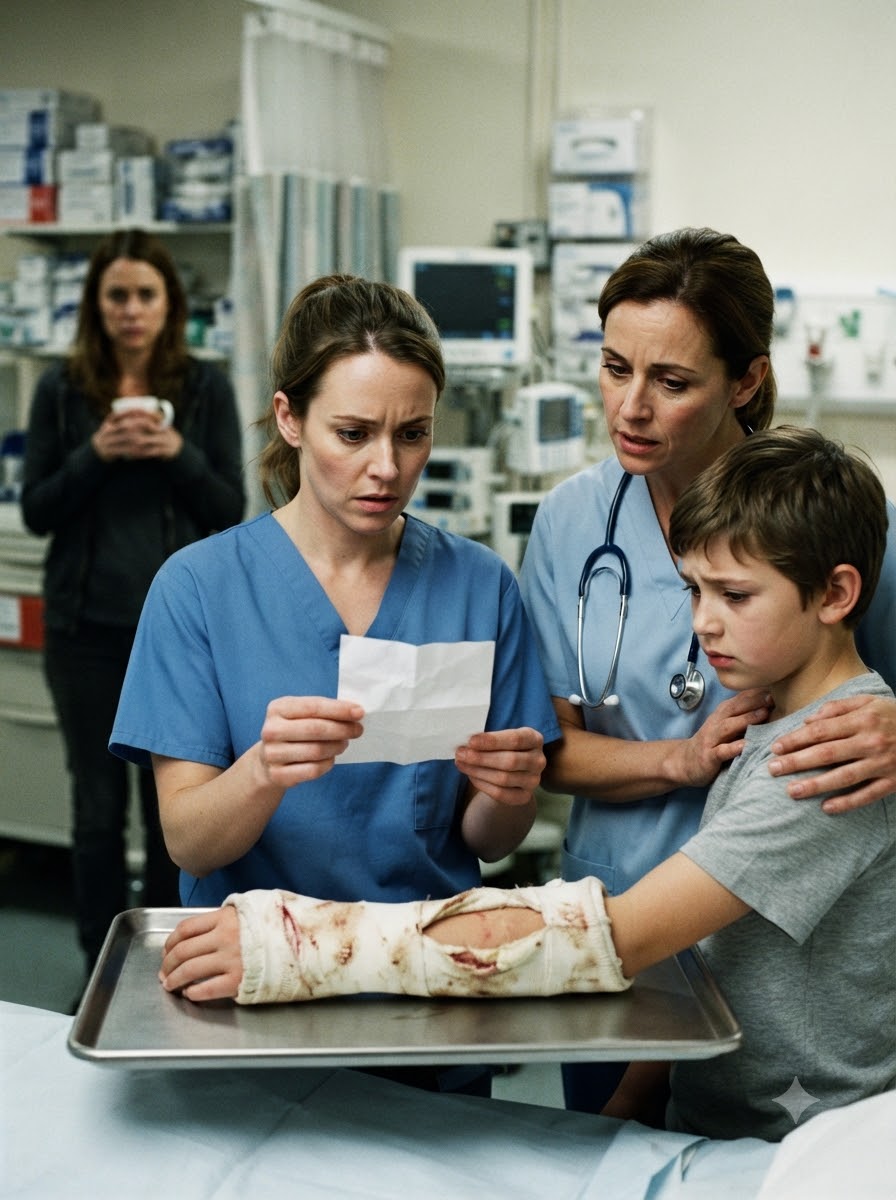
Nadia was not yet strong enough to stay with him for long, but the hospital arranged a visit that afternoon. I was there only because I needed to check his hand. I meant to slip out before she came in.
Owen saw her at the door and tried to sit up too quickly. Nadia crossed the room and stopped beside his bed, afraid to touch his injured arm.
“You tried,” she said.
He looked at her for a long moment. “You got my note?”
“We did,” I told him.
He leaned against his mother. She held him with her eyes closed while I finished checking his fingers.
Afterward, Owen told a child protection investigator what had happened at home. He spoke in short sentences and asked twice whether Martha could hear him. The investigator assured him she could not.
His account matched the physical evidence and Nadia’s description of the house. Investigators found the bedframe where the chain had been fastened. They found fiberglass dust and discarded casting supplies in a garage cabinet. A receipt showed Martha had ordered them the day after Owen’s arm was broken.
They also found a key to the wrist padlock on Martha’s car keys.
When the case reached court, Martha’s attorney argued that she had been overwhelmed by caring for a sick sister and a difficult child. He described the confinement as a desperate attempt to keep the family together. Martha herself said she had never meant for Owen to become seriously ill.
The surgeon testified about the wound beneath the padlock. Clara testified to Owen’s condition when he arrived and to Martha’s attempts to prevent us from opening the cast. Mrs. Alvarez testified about calling the ambulance. The police presented the photographs, receipts, bank transfers, and Nadia’s bedroom door.
I testified last. I described Owen’s blue fingertips and the moment the cast split open. When I was asked whether a chain and padlock could have ended up there by accident, I said no.
Martha was convicted of unlawful imprisonment, child abuse, and financial crimes connected to the trust. The judge ordered restitution, though not all the stolen money could be recovered. The company that had received the transfers was dissolved, and its remaining assets were seized. Nadia sold the house and moved with Owen to a small apartment closer to his school and his doctors.
None of that gave them back the months Martha had taken.
Owen needed another procedure on his wrist and many weeks of therapy. Nadia had her own recovery ahead of her. They both had nights when a closed door felt like a threat.
I saw them nearly a year later at Owen’s final surgical follow-up. He wore a green jacket and carried a library book so thick it barely fit under his arm. A pale scar crossed his wrist. He could bend his fingers, grip a pencil, and turn a key.
Nadia told me he had started drawing again. Owen opened the book to show me a picture tucked between its pages: their new apartment building, with every window brightly colored. In one window, he had drawn himself and his mother waving.
Before they left, he held up his right hand.
“Look,” he said, and curled it into a fist.
I looked. This time, nothing was holding it closed.

More From This Author