STORY
The Intimacy Book Told Them to Stop Talking. On Night Seven, His Deaf Husband Refused to Pretend.
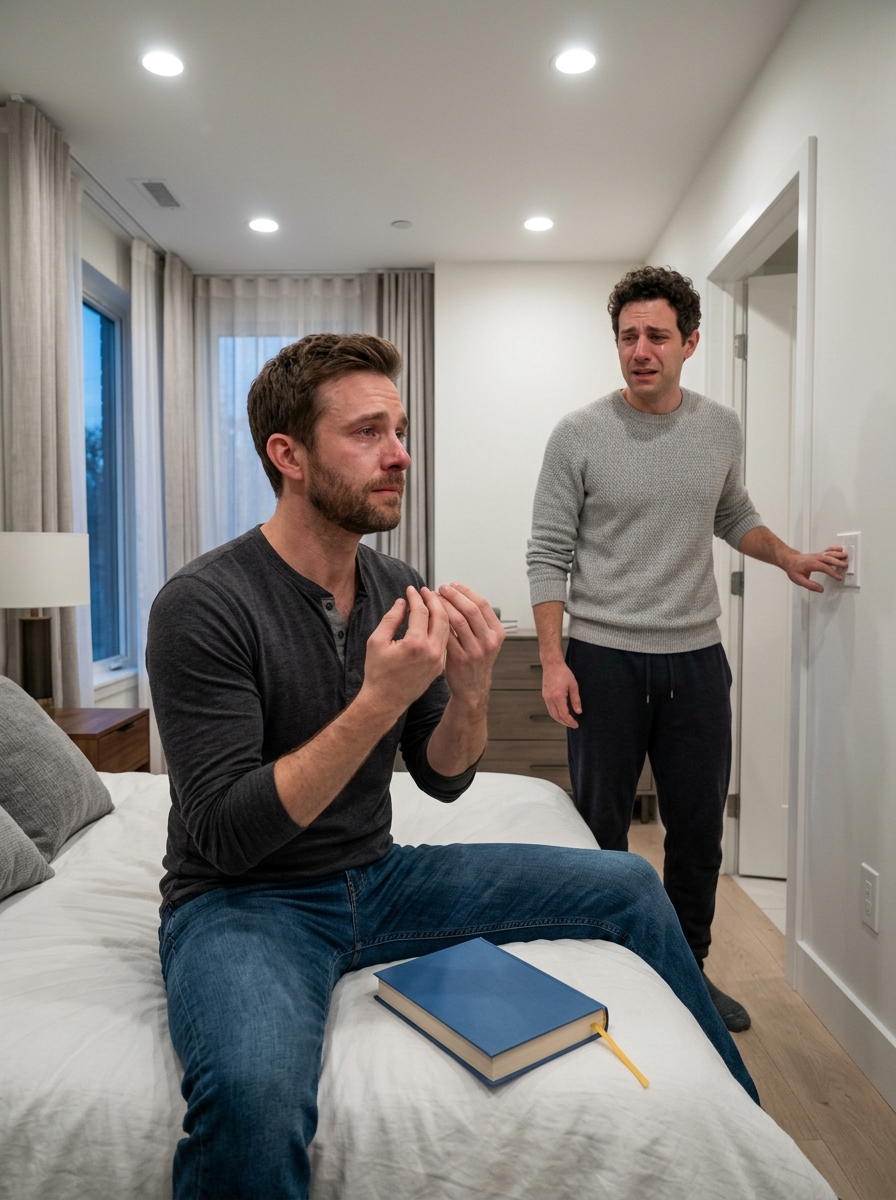
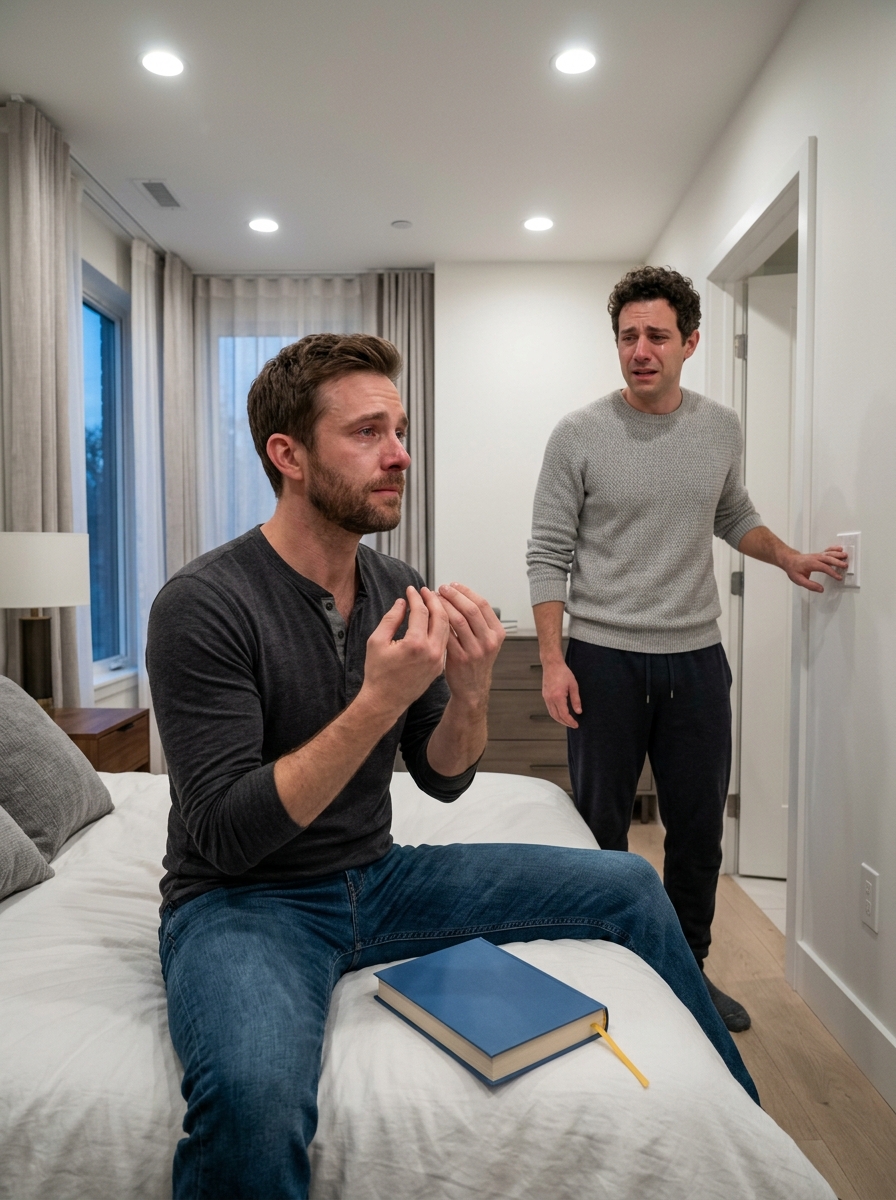
Felix’s hands stopped moving.
For a moment, neither of them did anything. The room held its careful stillness: the low lamp, the clean sheets, the book open facedown between their knees. Outside the apartment, a bus groaned at the corner and moved on.
Then Felix stood and turned on the overhead light.
Rowan flinched at the brightness, not because it hurt but because it made the room honest. It showed the laundry basket beside the dresser, the water glass with his fingerprints on it, the paperback with its blue cover and a yellow ribbon marking Day Seven.
The soft lamp had made the bedroom look like a place where a marriage could be repaired by following instructions.
The overhead light showed two men who had run out of instructions.
Felix looked at Rowan and signed, slowly, “Did I hurt you?”
Rowan hated that question. He hated how quickly it made the whole night about Felix’s hands, Felix’s intentions, Felix’s fear of being the kind of man who caused harm.
“Not tonight,” Rowan signed. “Not exactly.”
Felix waited.
“You made tonight proof of something that has been happening for a long time.”
Felix sat down on the edge of the bed. At forty-two, he still had the posture of someone who expected a supervisor to walk in and evaluate the work. His shoulders rounded. His hands rested on his thighs.
Rowan, thirty-nine, had spent most of their marriage trying not to make him feel that way.
The book had called itself *Thirty Days to Closer*. Felix had bought it at an airport bookstore after returning from a conference in Denver. He had held it up in the kitchen with an embarrassed smile and said, “This is either helpful or the beginning of a very specific kind of divorce.”
Rowan had laughed. He had been tired, but he had laughed.
Their physical relationship had been thinning for almost a year. There was still affection. Felix kissed him goodbye. Rowan leaned against him while they watched television. They still slept in the same bed, though some nights one of them stayed awake facing the wall.
What had disappeared was the sense that closeness belonged to them rather than to their history.
They had once been playful. They had known how to be curious without turning every touch into a referendum on the marriage. Lately, when one of them reached for the other, both men became watchful.
Was this enough?
Was that a rejection?
Was someone supposed to be enjoying this more?
The book promised to interrupt that watchfulness with thirty daily prompts. Small acts. No pressure. A gradual return to desire.
For the first six nights, Felix had read each page aloud and then signed the essential parts. Rowan had corrected him only twice.
He had wanted the challenge to work.
That was the humiliating part.
“Were all six nights fake?” Felix asked.
Rowan shook his head. “No.”
“Then what are you saying?”
“I’m saying that parts of them felt good. Parts felt kind. Parts felt like you were looking at my face to see whether we were winning.”
Felix’s mouth tightened. “I wasn’t keeping score.”
“You didn’t need a chart.”
“I didn’t say you had to finish every prompt.”
“You bought a book with a finish line.”
“Because we needed something.”
“No,” Rowan signed. “You needed something you could do.”
Felix looked away. The difference landed, and Rowan saw him understand it before he was ready to admit it.
***
The first time Felix had tried to learn ASL, he had arrived at Rowan’s apartment with a spiral notebook and twelve new signs.
He was twenty-nine. Rowan was twenty-six. They had met at a gallery opening where Rowan was showing a series of small porcelain houses with their roofs removed. Felix had spent most of the evening trying not to stare at Rowan’s hands while Rowan signed with a friend.
Afterward, Felix had asked the friend, through a notes app, whether Rowan was seeing anyone.
The friend had typed back: “You can ask him yourself.”
Felix had.
Not gracefully. He had written his question on his phone, held it out, and then looked so terrified of the answer that Rowan agreed to coffee.
Three dates later, Felix showed up with the notebook.
The signs were clumsy, but he had chosen them for conversations rather than charm. Where? When? Tired. Hungry. Again. Wait. I don’t understand.
Rowan had been touched by the last one.
Felix had learned in bursts. He attended an evening course. He practiced fingerspelling while driving, though Rowan told him never to do that with both eyes off the road. He learned enough to talk at dinner and make jokes with Rowan’s friends.
He learned how to say “I love you” before he learned how to argue.
For a while, that had been enough.
Then Felix took a promotion at an architectural firm, and they moved across the river to a neighborhood farther from the Deaf community Rowan had built around himself. The commute lengthened. Felix missed two classes, then three. He promised he would find another course.
Rowan said, “It’s okay.”
He meant: I don’t want to have this fight again.
Felix heard: You understand.
Neither of them corrected the translation.
In the bedroom, the gap mattered more. ASL was visual. Rowan needed to see a face, hands, shoulders, the whole shape of a response. Felix preferred low lights because he thought they made the room feel intimate. He would reach for Rowan in the dark and ask a question from somewhere behind him.
“Okay?”
“More?”
“Do you want me to stop?”
Rowan would turn enough to see his mouth, or tap Felix’s wrist, or nod.
The answers were technically available. They were not always understood.
Once, two years earlier, Rowan had tried to explain that he did not want Felix to keep touching him after he became still. He had been signing from the other side of the bed, where the lamp did not reach.
Felix had said, “I know, I know,” without looking.
Rowan had snapped the lamp on.
“No,” he signed. “You don’t.”
Felix had heard accusation. Rowan had meant alarm.
After that, Felix initiated less. Rowan, believing Felix had finally understood that he was unwanted, withdrew more.
They had both mistaken retreat for respect.
***
On the night of Day Seven, Rowan picked up the book and read the prompt again.
“For twenty minutes, use no language,” he said aloud, though he preferred to sign when he was upset. “Let the body finish the sentence.”
Felix watched his face.
“I thought we could adapt it,” Felix said. “We’ve adapted everything else.”
“You adapted it by asking me not to sign.”
“It says no talking.”
“Sign isn’t talking.”
“I know that.”
“Do you?”
The question was sharper than Rowan intended. Felix absorbed it anyway.
“I thought it meant no explaining,” he said. “No checking every second. No turning it into a conversation about whether we’re doing it right.”
“And what did you think I would do if I needed something?”
“You could stop me.”
“That is not the same as being able to tell you what I need.”

More From This Author