STORY
The Morning She Stopped Letting Convenience Decide Their Marriage
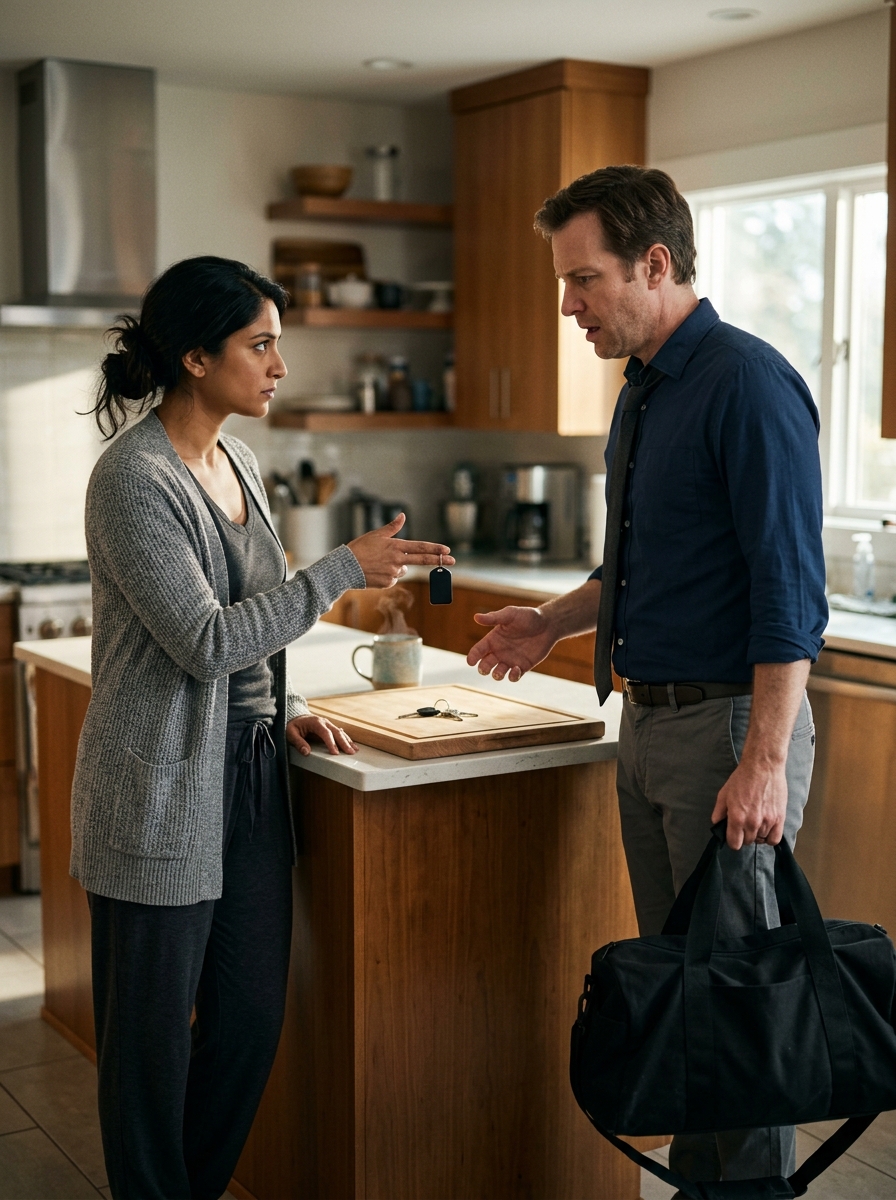
But when she sat beside him on the couch, his body subtly closed. When she kissed his cheek, he went still. At night, he turned toward his edge of the mattress and asked what time she needed the alarm set.
Reliability was not nothing. It was simply no longer enough.
On Thursday afternoon, Owen called.
“Are you still going to that appointment?” he asked.
“Our appointment?”
“The one you booked.”
“Yes.”
A pause.
“What time?”
“Six.”
“I’ll meet you there.”
Priya closed her eyes. “Okay.”
“I’m not agreeing to thirty days.”
“Okay.”
“And I’m not moving into the guest room because a counselor tells me to.”
“Okay.”
“You could say something other than okay.”
“I’m trying not to turn your coming into a promise you didn’t make.”
That silenced him.
Finally, he said, “Six, then.”
***
Dr. Alana Brooks had an office above a dental practice, with two gray chairs facing each other at angles carefully designed to discourage combat.
Owen chose the one nearest the door.
Dr. Brooks listened as Priya explained the separate bedrooms, separate errands, and counseling boundary. Then she turned to Owen.
“What did you hear when Priya said those things?”
“That my wife believes access to her practical support should depend on whether I’m physically affectionate.”
Priya’s head snapped toward him.
Dr. Brooks raised one hand. “Let him finish.”
Owen kept his eyes on the rug.
“I heard that everything I do count as roommate work,” he said. “Cooking. Repairs. Bills. Showing up for her family. Apparently none of it means love unless I touch her the way she wants.”
“That’s not what I said.”
“It’s what I heard.”
Dr. Brooks turned to Priya. “What were you trying to say?”
“That I can’t keep accepting logistics as a substitute for an intimate relationship. I don’t want favors traded for touch. I want us to stop using favors to avoid talking about why touch is gone.”
Owen rubbed his thumb along the side of his wedding band.
“What happens if we talk,” he asked, “and I still don’t want what you want?”
“Then at least I can make a decision based on the truth.”
“You mean leave.”
“I might.”
He flinched, so quickly she almost missed it.
Dr. Brooks leaned forward. “Priya, can you accept that Owen may participate honestly and still not arrive at the outcome you hope for?”
Priya swallowed. “Yes.”
“Can you accept a no without punishing him?”
“Yes.”
“Can you accept that repeated no as information about whether this marriage works for you?”
Priya looked at Owen.
“Yes,” she said again.
Dr. Brooks turned to him. “And can you accept that declining physical intimacy is a boundary, but declining to discuss the loss of all intimacy is also a choice with consequences?”
Owen’s jaw tightened.
“That makes talking sound mandatory.”
“No. Nothing in this room is mandatory. But there is no version where silence has no effect on your partner.”
He leaned back.
For the first time since the kitchen, Priya saw something beneath his anger. Not indifference. Fear.
“There was a night in Baltimore,” he said.
Priya knew immediately which one.
Ten months earlier, they had gone away for their anniversary. They had eaten crab cakes by the harbor, returned to the hotel, and tried to recover something that had already begun to feel distant.
Owen had become tense. Finally, he had asked to stop.
Priya had held his face and said, “It’s okay. We’ll figure out what’s wrong.”
She had meant it tenderly.
The next morning, while Owen showered, she had searched for specialists. By lunch, she had emailed him three names and an article about stress-related changes in desire.
“I was trying to reassure you,” she said.
“You gave me referrals before we checked out.”
“You’d been saying you were tired for months.”
“So you diagnosed me.”
“I was scared.”
“So was I.”
His voice softened on the last word, and that was worse than anger.
Owen told her about a night several weeks after Baltimore. They had been watching a movie. He had kissed her slowly for the first time in weeks, and Priya had immediately asked if he wanted to go upstairs.
“When I said no, your whole face fell,” he said. “You said it was fine, but you moved to the other end of the couch.”
“I was embarrassed.”
“I felt like I’d handed you a check that bounced.”
“So you stopped kissing me.”
“I stopped starting something I couldn’t finish.”
“A kiss wasn’t a contract.”
“It felt like one.”
Dr. Brooks let the silence sit.
Priya stared at the seam in Owen’s trouser leg. She wanted to tell him he had misunderstood. She wanted to defend the hope on her face, the doctor list, every anxious attempt to close the distance.
Instead, she asked, “Why didn’t you tell me?”
“I didn’t know how to say it without making it worse.”
“You could have said exactly what you just said.”
“And you could have let a kiss be a kiss.”
Both statements landed. Neither canceled the other.
Owen looked toward the darkening window.
“The worst part,” he said, “is that I don’t miss sex the way you do. I miss wanting it. I miss being the person I was when it was easy. But the actual absence doesn’t hurt me every day.”
Priya pressed her lips together.
“Does affection hurt?” she asked.
“No.”
“Then why did all of that disappear, too?”
“Because I didn’t trust it to remain affection.”
His honesty felt cruel only because the silence had lasted so long.
Dr. Brooks asked whether Owen would consider returning home under temporary conditions they negotiated together. He said he would think about it.
They left without touching.
In the parking lot, Priya said, “Thank you for coming.”
Owen gave a tired laugh. “You sound like the dentist.”
“I don’t know what tone is safe anymore.”
His face softened.
“Neither do I,” he said.
***
Owen returned Sunday afternoon and put his overnight bag in the guest room.
They agreed that common household work would remain common. Owen would not stop buying toilet paper to make a point. Priya would not refuse to let in the plumber because she had not caused the leak.
Personal errands would be requested rather than assumed. Either person could say no without it becoming evidence in the larger argument.
Affection would also be requested, with no presumption that one form of touch had to lead to another.
The arrangement made their lives less efficient almost immediately.
On Monday, Owen discovered he had forgotten to pick up his blue suit. He stood in the entryway at 5:42, staring at the claim ticket on the table.
Priya knew the cleaner closed at six. She knew she could get there faster because her coat and shoes were already on.
She said nothing.
Owen looked at her, then at the ticket.
“This feels ridiculous,” he said.
“You can ask.”
He exhaled. “Would you pick it up? I need to finish preparing for tomorrow.”
Priya considered whether she actually wanted to.
“Yes,” she said. “I can do that.”
His eyes narrowed. “Is this going to come up in counseling?”
“No. It’s a favor you asked for, and I said yes.”

More From This Author