STORY
The Morning She Stopped Letting Convenience Decide Their Marriage
He nodded slowly. “Thank you.”
The difference was microscopic. It was also real.
The following night, Priya made lentil soup and nearly placed a bowl at his usual seat. Instead, she found him in the living room.
“I made extra,” she said. “I wanted to offer you some.”
Owen closed his laptop. “Are you eating at the table?”
“Yes.”
“Can I eat with you?”
“Yes.”
They talked about things that did not require action. A stonemason on Priya’s restoration project who sang opera while he worked. A judge who had called Owen’s thirty-page brief “energetic,” which he believed was judicial code for exhausting.
Priya laughed. Owen smiled at her as if he had forgotten that he could cause that sound.
After dinner, he carried both bowls to the sink.
“Do you want to take a walk?” he asked.
“Is this exercise or time together?”
“Time together. Probably some exercise by accident.”
Outside, the air smelled like wet pavement. They walked three blocks with space between their coats.
At the corner, Owen stopped.
“Can I hold your hand?” he asked. “Just that.”
Priya’s heart surged so sharply she had to steady her breathing.
“Yes.”
His fingers closed around hers.
She did not lean against him. She did not ask what it meant. She did not guide them toward home faster.
They walked two more blocks, hand in hand, and nothing followed.
For Owen, that nothing was the first safe thing.
For Priya, it was the first proof that restraint did not have to mean rejection.
***
At their second counseling session, Dr. Brooks asked each of them to define romantic intimacy without using the word sex.
Priya answered first.
“Being sought,” she said. “Being looked at like I’m not only useful. Touch. Curiosity. Saying things that aren’t about what needs to happen next.”
Owen stared at the floor.
“Reliability,” he said. “Private jokes. Knowing someone’s worst days and not leaving. Making their life easier.”
“Those are both reasonable definitions,” Dr. Brooks said. “But you’ve each been treating your own definition as complete.”
Owen’s father had been charming and unreliable. He disappeared for days, then returned with flowers and dramatic apologies. Owen’s mother had called those reunions romantic.
At sixteen, Owen had decided love should look like a stocked refrigerator and a paid electric bill.
Priya’s parents had stayed married for twenty-nine years. During the last ten, they occupied separate rooms, took separate vacations, and coordinated household maintenance with perfect civility. When they finally divorced, Priya’s mother admitted she had been lonely for a decade.
Priya had decided that stability could become a hiding place.
“You see practical care and think safety,” she told Owen.
“You see it and think abandonment,” he replied.
“Eventually, yes.”
“And when you push for physical reassurance, I feel like my father walking in with flowers. Like I’m making a gesture I may not be able to sustain.”
Priya looked at him. “I never knew that.”
“I never put it together before.”
Dr. Brooks asked Owen whether he wanted to understand the change in his desire for his own sake—not to meet a deadline or secure the marriage.
He said he did.
“I made a doctor’s appointment,” he added.
Priya opened her mouth to ask when, with whom, and whether he had written down the symptoms they had once discussed.
She stopped.
Owen noticed.
“Thank you,” he said.
“I was going to give you a list.”
“I know.”
“I’m trying.”
“So am I.”
They were, but trying did not create steady progress.
Some nights Owen sat beside her on the couch. Other nights he shut himself in the guest room, depleted by work and by the effort of examining instincts that had once seemed virtuous.
Sometimes Priya accepted a hug cleanly. Sometimes she lay awake afterward, furious that an ordinary embrace required negotiation.
Once, after Owen declined to sit with her, she snapped, “Don’t worry, I wasn’t going to demand a performance.”
He went pale and left the room.
She apologized the next morning without explaining away the remark.
He accepted the apology without pretending it had not hurt.
Their old marriage had been smoother. Their new one was clumsy, explicit, and occasionally exhausting.
It was also the first time in months that either of them knew what the other was feeling.
***
During the third week, Priya’s mother needed outpatient surgery.
Owen appeared in the kitchen at 5:30 that morning holding two travel mugs.
“I can drive,” he said.
Priya studied him. “You don’t have to.”
“I know.”
“Is this shared-family responsibility?”
“No. This is me wanting to come.”
She took the coffee.
At the hospital, Owen carried Priya’s mother’s bag, asked the nurse precise questions, and found crackers when she became nauseated afterward. He did everything he had always done well.
But this time, Priya did not let competence answer every emotional question.
That evening, after her mother was settled at home, Priya and Owen stood on the front porch beneath the yellow light.
“Can I have a hug?” she asked.
“Yes.”
He opened his arms. Priya stepped into them.
For a few seconds, she felt his cheek against her hair and his hand warm between her shoulder blades. Her body remembered him faster than trust did. Hope rushed in, bright and undisciplined.
When they separated, she asked, “Do you think you could want me again?”
Owen’s face closed.
Priya knew immediately.
“I did it again,” she said.
“You turned it into a test.”
“I know.”
“One hug, and suddenly I have to predict our future.”
“I’m sorry.”
He stepped away, then stopped at the porch stairs.
“I use that, too,” he said.
“Use what?”
“Your questions. Your hope. I use them as proof that I can’t say anything until I’m certain. Then I stay silent and call it caution.”
Priya wrapped her arms around herself.
“I don’t need certainty,” she said. “I need you not to disappear.”
Owen looked back at her.
“I don’t know what my desire will look like,” he said. “The doctor thinks stress and sleep may be part of it. Maybe medication. Maybe not. I don’t want you waiting for a medical solution that turns me back into who I was five years ago.”
“Neither do I.”
“But I miss you.”
“I miss you, too.”
He came back up one step.
“Can I kiss you?”
Priya’s throat tightened. “What do you want it to mean?”
“That I want to kiss you now. Nothing about later.”
She nodded. “Yes.”
The kiss was tentative, warm, and shorter than she wanted.
When Owen drew back, she let him.
He searched her face. “Are you okay?”
“I’m disappointed it’s over,” she said. “And I’m glad it happened. Both are true.”
A small, startled smile appeared on his face.
“Both are true,” he repeated.
He did not come into her room that night.
The kiss remained a kiss.
That was why they were able to have another one three days later.
***
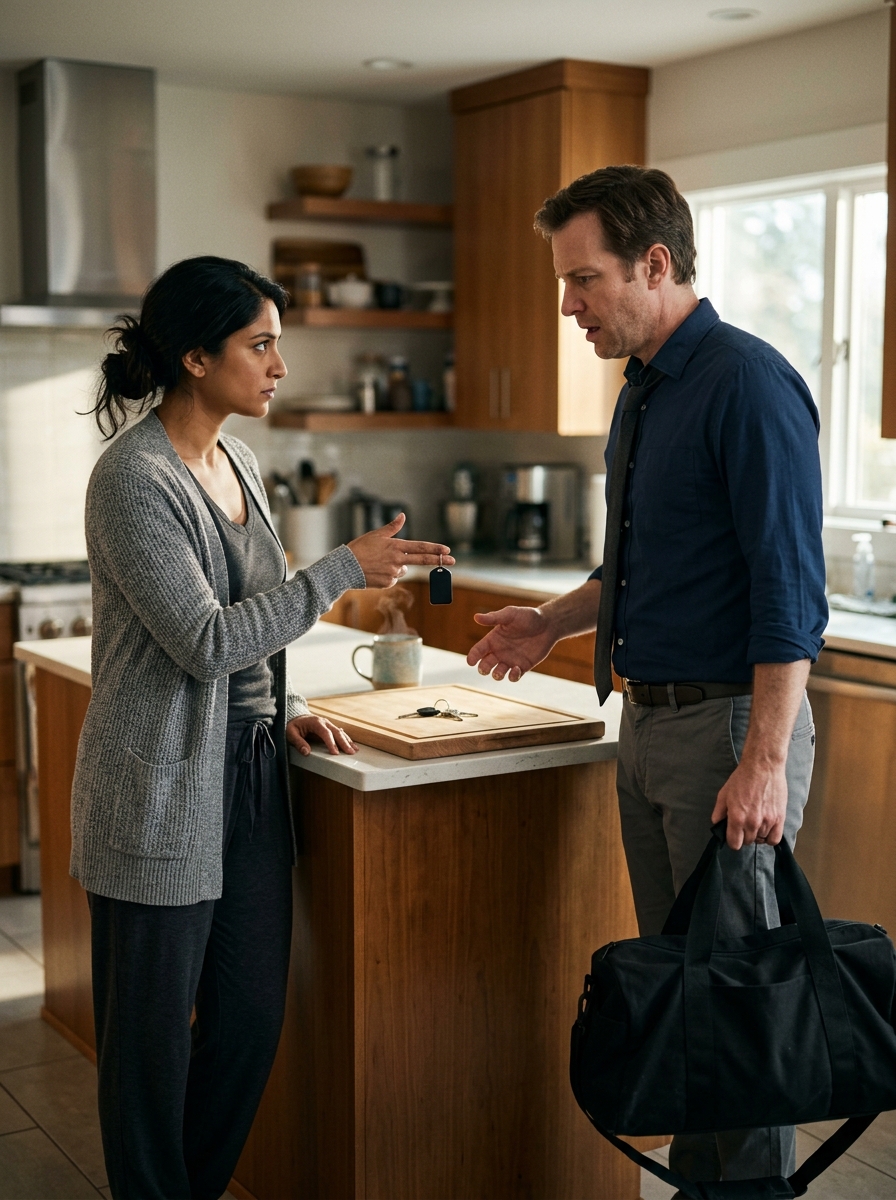
On the thirtieth day, they sat at the kitchen table where their confrontation had begun.
Owen placed his car keys between them, then seemed to notice the symbolism and moved them aside.
Priya almost laughed.

More From This Author