STORY
He Called Their Bedroom Dead—Then He Told His Wife What He Could Still Hear in Her Podcast
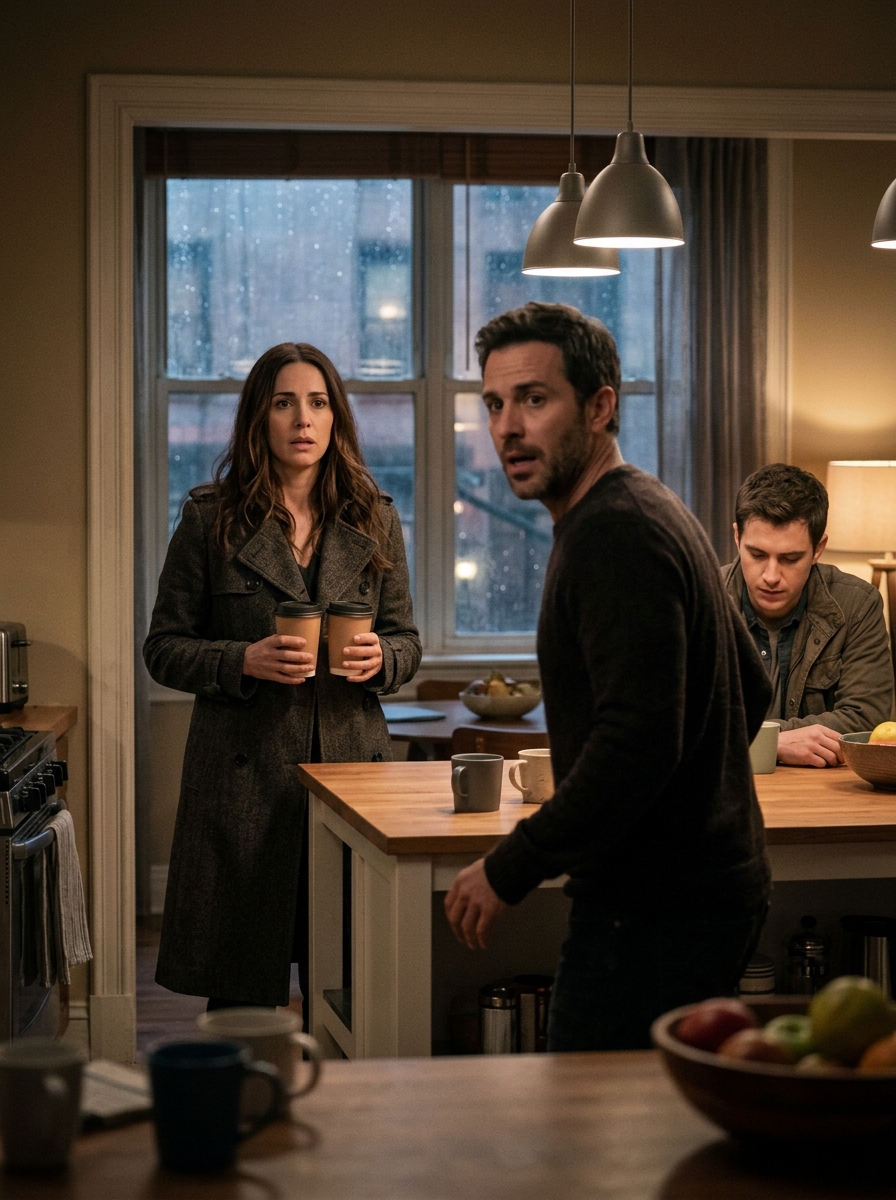
Celia Ortiz heard the sentence before she saw either man.
“Our bedroom’s been dead for two years,” Elias said.
She stood just outside the kitchen with two cold coffees in her hands, her coat still buttoned, the rain ticking against the windows behind her. She had come home early from the studio because the producer had canceled their last interview. She had expected to find Elias making pasta or arguing with the dog about a stolen dish towel.
Instead, she heard her husband describe their marriage to his closest friend.
Theo Mercer was sitting at their kitchen island, one ankle hooked over the other. He had known Elias since college. He had been in their wedding. He was the person Elias called when the water heater broke, when his father went into the hospital, when he needed someone to help carry a sofa up three flights of stairs.
Theo said, “Have you told her that?”
“I’ve tried.”
Celia’s fingers tightened around the cardboard cups.
Elias continued, quieter now. “Not in a way she could hear.”
The sentence landed harder than the first one.
She pushed open the door.
Theo looked up. Elias turned so fast his knee struck the underside of the island.
“Celia,” he said.
She put the coffees down. One tipped over, brown liquid spreading toward the edge of the counter. Neither man moved to catch it.
“Dead?” she asked.
Theo rose immediately. “I should go.”
“No,” Celia said. “Stay. Apparently, this is the part where everyone else gets to know what’s happening.”
“Celia,” Elias said again, but this time her name sounded like a warning.
She looked at Theo. “Did he say there was someone else?”
“No.”
“Did he say he wanted to leave?”
Theo glanced at Elias.
“That’s a yes-or-no question,” Celia said.
“No,” Theo answered.
“Then what exactly did he say?”
Theo’s face tightened with discomfort. “I think you should talk to him.”
“Interesting,” she said. “That seems to be the general strategy around here.”
Elias stood. He was forty, broad-shouldered, usually calm in a way that sometimes made her feel like the only person in the marriage who was allowed to be visibly affected. Tonight, his composure looked less like calm and more like fatigue.
“Theo,” he said, “give us a minute.”
Theo took his jacket from the back of the chair. At the door, he stopped beside Celia.
“I’m sorry,” he said.
She turned toward him. “For what?”
He looked at Elias, then back at her. “For being the person he told.”
The door closed.
Rain filled the silence.
Celia folded her arms. “Start again.”
Elias stared at the spilled coffee. “I wasn’t saying I don’t love you.”
“You said our bedroom is dead.”
“I said the bedroom is dead.”
“Do you hear how much worse that sounds?”
He pulled a dish towel from the oven handle and placed it over the coffee. “I didn’t mean that I don’t want you.”
“Then what did you mean?”
Elias looked at her.
“I stopped feeling private,” he said.
Celia blinked.
It was not the answer she had prepared to hear. She had spent two years building explanations for the distance between them. He was tired. She was tired. They had both gotten older. Her body had changed. His work had become more demanding. Maybe he had developed a private attraction to someone at the construction office. Maybe he had stopped finding her interesting. Maybe he still loved her but had moved into the part of marriage where love became maintenance.
She had never imagined privacy.
“What does that even mean?” she asked.
“It means that when I think about being close to you, I don’t just think about you anymore. I think about your microphone. Your listeners. The way you shape a moment until it has a beginning, a turn, and a line people can quote.”
Her throat tightened. “This is about the podcast?”
“It’s about Episode Sixty-Two.”
For a moment, she didn’t recognize the number. Then she did.
The Question on the Edge of the Bed.
The episode had been released two years and three months earlier. At the time, her podcast, *Small Honest Things*, had been struggling. She interviewed therapists, divorced couples, newlyweds, and sometimes people who had never been in a relationship at all but had strong opinions about them. The show was about the things people avoided saying until avoidance became a second language.
Episode Sixty-Two had been a solo essay.
It began with a story about a married couple who had stopped recognizing each other as desirable. Celia had described the husband sitting on the edge of the bed in the blue-gray light before dawn. He had asked his wife whether she still wanted him or whether she only wanted the life they had built together.
She had changed the names. She had changed the city. She had removed the details about his workplace and the brand of whiskey he drank.
She had left the sentence exactly as he had spoken it.
At the time, she had believed that was what made the episode honest.
“Elias,” she said, “I changed everything.”
“You changed the parts a stranger could use to identify me.”
“That’s the point.”
“No.” His voice remained quiet, which somehow made it worse. “The point is that you changed my name and kept my voice.”
Celia leaned against the counter. “I didn’t use your name.”
“You used the sentence I said to you in our bedroom.”
“You said it to me. It was part of my life too.”
“I know.”
“And you never told me not to publish it.”
“I told you I didn’t want to hear our private conversations coming out of your mouth to strangers.”
“When?”
“The night you recorded it.”
Her mind went back.
She had been sitting at the desk in their bedroom, cutting tape on her laptop. Elias had come in from the shower. She remembered the way he had stopped in the doorway, looking at the microphone beside her notebook.
“What are you doing?” he had asked.
“Working.”
“On what?”
She had told him about the episode. She had said she wanted to talk about the question he asked her.
He had stood there for a long time.
“I don’t know if I want to be part of that,” he had said.
She remembered her response with awful clarity.
“You’re not part of it. You’re an example.”
At the time, the distinction had seemed obvious.
Now it sounded cruel.
“You said I was an example,” Elias said, as though he had read the memory from her face. “You laughed and said I should be flattered because the episode might finally get people to talk about desire without making it ridiculous.”
“I was nervous.”
“You were excited.”
“I was both.”
“I know.”
The episode had become her most downloaded piece. A short clip of the sentence had been shared thousands of times. Listeners had written to her about the courage of the fictional husband. One woman had called him “the first emotionally intelligent man on the internet.” Another had said the story made her realize her own husband had never once asked whether she wanted him.
Celia had read every message.

More From This Author