STORY
My Son’s Lunch Went in the Trash—Another Mother Kept Cartwright’s Message
The suspension notice was waiting on the kitchen table when Colonel David Williams came home.
Beside it sat a blue plastic container with tiny white flowers on the lid. One corner was cracked. A streak of yellow grease clung to its rim.
David had spent eight months in Afghanistan imagining his son running toward him. Instead, at eleven on Thursday night, he found Marcus asleep on the couch in his grandmother’s apartment, still wearing his school clothes. Dorothy stood in the kitchen doorway, holding her phone.
“Your flight wasn’t supposed to land until tomorrow,” she whispered.
“It got moved up.” David set down his bag. “What happened?”
Dorothy handed him the notice. Three days’ suspension for disruptive conduct, beginning Friday. Marcus would miss the school’s welcome-home assembly for local service members, the one he had talked about for weeks.
David read the attached teacher’s report. It said Marcus had brought food that violated cafeteria standards, refused an instruction, and caused a scene.
Then he looked again at the container.
Angela’s container.
His wife had packed his lunches in it before she died. Marcus had insisted on keeping it when they moved in with Dorothy. David knew his son used it only when what went inside mattered.
“What did he bring?” he asked.
“Chicken,” Dorothy said. “He made her recipe.”
Marcus had been awake before dawn that morning, standing on a stool in Dorothy’s narrow kitchen. He had copied Angela’s handwriting with one finger as he measured paprika and garlic. He’d fried the chicken in small batches while Dorothy hovered near the stove, ready to help and trying not to take over.
David was supposed to arrive Friday afternoon. Marcus had planned to have the food waiting after school, a welcome-home meal made by his own hands. He’d packed one serving to take for lunch Thursday because he couldn’t bear not to taste it.
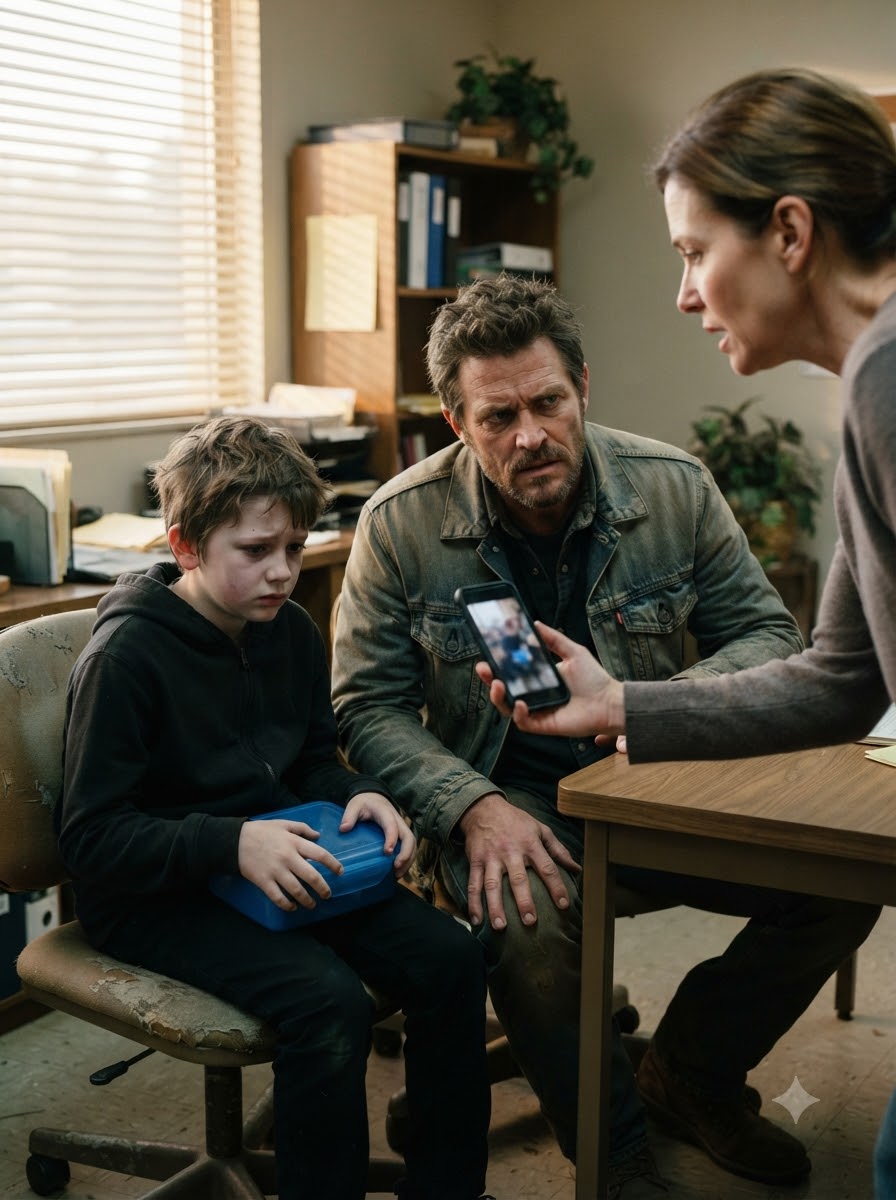
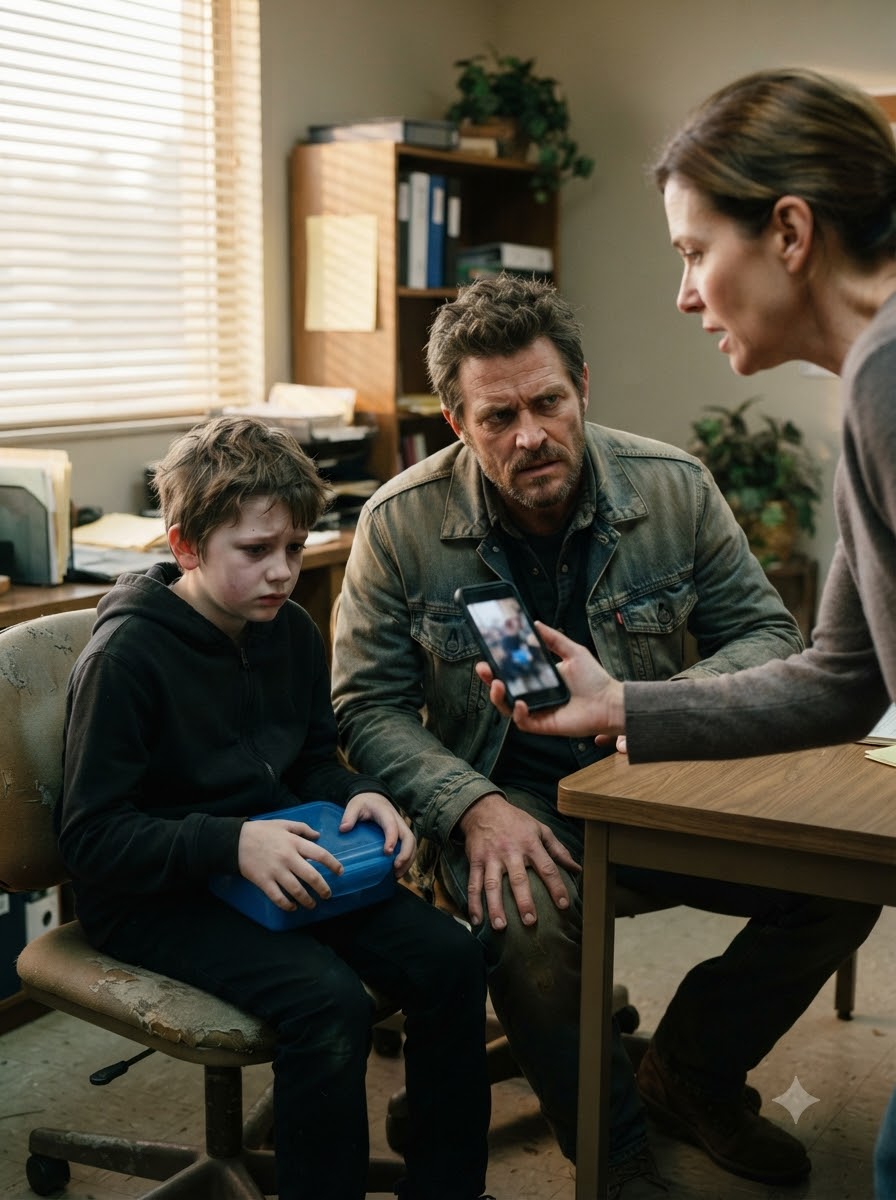
Dorothy pressed play on her phone.
In the video, the school cafeteria hummed with voices. Marcus sat beside his friend Tyler Brooks, smiling down at the open container. A woman in a navy blazer strode toward him.
“What is that smell?” Jennifer Patterson demanded. “This is a school cafeteria, not a street corner cookout.”
The sound in the video changed. Students stopped talking. Marcus explained that he had made the food himself. Patterson took the container.
“Please,” Marcus said, following her. “That was my mom’s container.”
David watched the chicken fall into the trash. The macaroni followed. Patterson tossed the empty plastic onto the table.
“Bring something appropriate tomorrow,” she said.
The video ended before anyone moved.
David did not speak for a long moment. He watched it a second time, then read Patterson’s report again. There was no mention of her taking the lunch. There was no mention of the trash can.
“Principal Cartwright saw this?” he asked.
“She watched it with the boys,” Dorothy said. “Then she called it professional discretion.”
From the couch came Marcus’s voice. “Dad?”
David turned. Marcus was sitting upright, looking less startled than ashamed.
“I was going to make you a new batch,” he said. “Grandma said we have enough chicken.”
David crossed the room and knelt in front of him. “You don’t owe me dinner.”
“I wanted to.” Marcus’s eyes filled. “She threw it away in front of everybody.”
“I saw.”
For one terrible second, David saw Angela at that same age in a photograph she’d kept: chin lifted, refusing to cry after someone had told her the food her mother made smelled wrong. She had laughed when she told him the story years later. He had never understood how much work the laugh must have taken.
He rested a hand on Marcus’s shoulder. “Tell me everything from the beginning.”
Marcus did. He described the laughter, then the silence. He described Tyler standing up and the children at the next table looking down. He described Principal Helen Cartwright watching the recording without once asking whether he had eaten anything afterward.
By the time Marcus finished, David understood that Patterson had thrown away more than a lunch. Cartwright had watched her do it and made sure Marcus carried the blame home.
At seven the next morning, David called the school. Cartwright’s secretary said the principal was unavailable and offered him a meeting the following Tuesday.
David asked for the district superintendent’s office instead.
While he waited for a return call, he photographed the suspension notice, the container, and the teacher’s report. Dorothy helped Marcus write down what he remembered, in his own words, before the details could be argued out of him.
Tyler’s mother, Rebecca Brooks, arrived at nine with Tyler and the original video file. She had refused to let him post it online the night before.
“I wanted to,” Tyler admitted. “I thought if everybody saw it, they’d have to fix it.”
“You did the right thing recording,” David told him. “And your mother did the right thing keeping the original.”
Tyler looked at Marcus. “I should’ve stopped her.”
“You stood up,” Marcus said. “Nobody else did.”
Rebecca had something else. Tyler had spent the evening texting classmates. Two had replied that they had seen Patterson do similar things before. Neither wanted their names given to the school.
One girl said Patterson had called her grandmother’s tamales “messy food” and made her put them away. Another student remembered being told that his father’s curry was “too strong for a shared space.” Both had been embarrassed. Neither had filed a complaint.
Dorothy read the messages twice. “Marcus wasn’t the first.”
“That’s what we need to find out,” David said.
The superintendent’s office returned his call just before ten. An assistant said the district would review the matter and asked him not to contact other students. David asked that the cafeteria recording, discipline records, staff emails, and any written food policy be preserved.
The assistant went quiet. Then she said she would forward the request.
At the school, meanwhile, Tyler heard something he hadn’t expected. On his way to math, he passed the cafeteria and saw the same gray trash bin. Its liner was gone. Mr. Lewis, the custodian, was wiping the lid.
Tyler stopped. “Did they throw out the bag from yesterday?”
Mr. Lewis glanced down the hall. “Why?”
“Because my friend’s lunch was in it.”
Mr. Lewis’s face changed. He opened the supply closet and pulled out a black bag tied at the top.
“I took it out after lunch,” he said. “When I heard what happened, I didn’t put it in the compactor.”
Tyler called his mother. Rebecca called David.
Mr. Lewis did not open the bag. He agreed to keep it locked in the closet until district staff could collect it, and he wrote down when he had removed it and where he had stored it. He had worked at Lincoln Heights for seventeen years. He knew how quickly people could decide they had never seen what he had seen.
By noon, the district had lifted Marcus’s suspension pending review. Cartwright sent Dorothy a short email stating that Marcus could return immediately.
There was no apology.

More From This Author