STORY
My Father Broke My Jaw Over Mom’s Memorial Money—Until Her Sealed File Opened
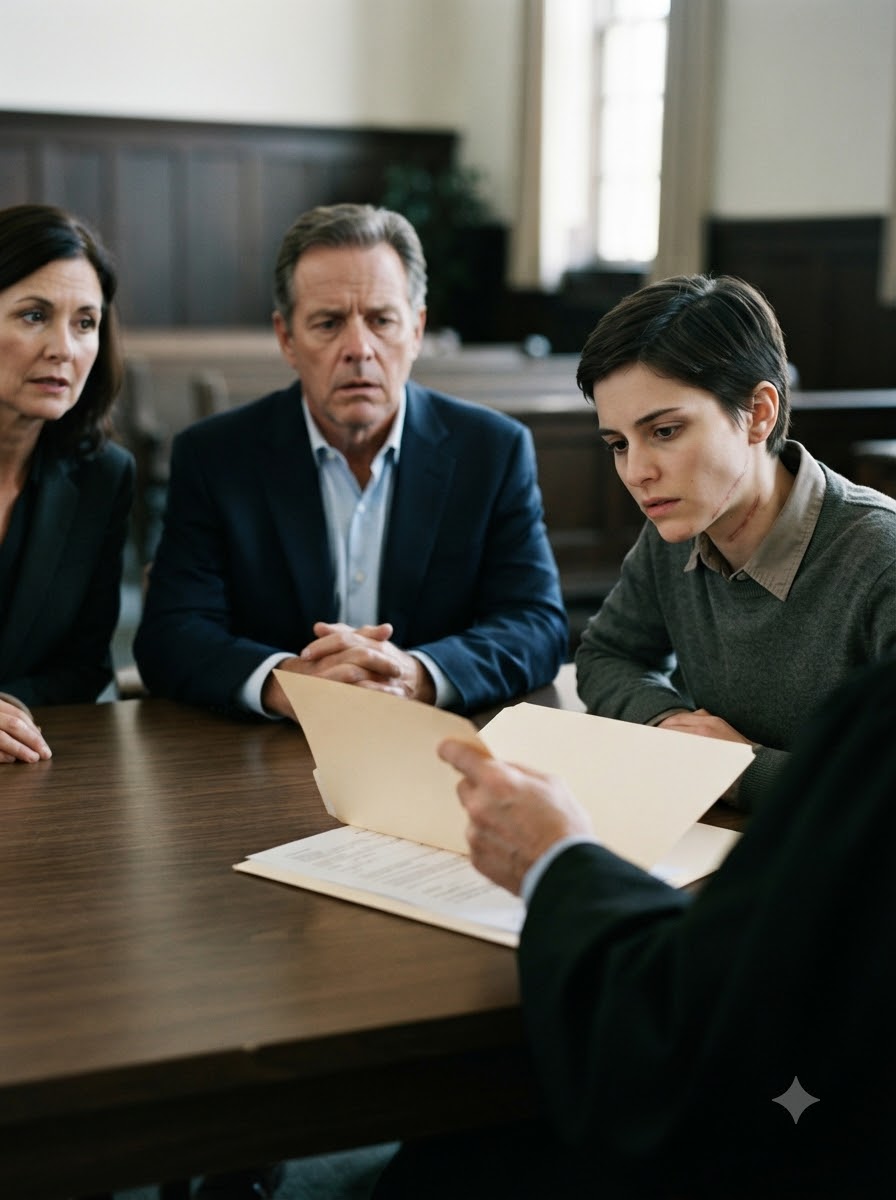
The wrench was still in my father’s hand when I understood that the money had never been the real reason he came.
He had come because, for the first time in my life, I had told him no.
Blood ran into my mouth as I sat against the garage wall. My jaw felt loose, detached from the rest of my face. One of my teeth lay on the driveway beside a crushed receipt. Another had landed in the dirt where my mother used to plant marigolds every spring.
Dad stood over me, breathing hard.
“You really think you can take something from me?” he said.
The gray metal lockbox sat three feet away, its lid still closed. Inside were $1,847 from the garage sale I had organized after Mom’s death. Every dollar was meant for the memorial stone she had chosen before she died.
My father knew that.
He also knew I had spent twenty-three days sorting through my mother’s house alone while he, my sister, and my brother found excuses to stay away.
Yet he still looked at that money as if it were his.
I had spent the entire weekend turning Mom’s life into price tags. Her blue casserole dishes. Her winter coats. A box of costume jewelry she had worn to church dinners. Her gardening tools. The hand-painted birdhouses she had made during the year she retired.
I had marked everything carefully, sometimes crying over an object so ordinary that a stranger would never understand why it mattered.
My sister had promised to help but left after two hours, saying she was too overwhelmed. My brother had arrived long enough to remove Mom’s cordless drill, two power tools, and a box of fishing gear. He said he would come back for the rest.
He never did.
Dad had not asked how I was coping. He had called twice to ask whether Mom owned any “real valuables.”
The house still smelled like her. Vanilla hand cream. Lemon polish. The faint floral perfume she saved for Sundays. Every room seemed to hold the shape of her absence.
Six months before she died, Mom and I had driven to a doctor’s appointment together. She had been unusually quiet on the way home. At a red light, she turned toward me and said, “If I go first, don’t let your father cheap out on the stone.”
I laughed because I thought she was joking.
She didn’t laugh.
“He’ll say it’s too expensive,” she continued. “He’ll say a marker is a waste. Promise me.”
“I promise.”
She looked out the window. “And don’t let him tell you what belongs to the family. He has used that phrase for forty years.”
I did not understand what she meant then.
I understood it when Dad arrived at the house on the final afternoon of the sale.
He walked past the folding tables and empty shelves, surveying the garage as if he were inspecting an estate he had inherited. He wore his old brown work jacket and the expression he used whenever he believed the outcome was already decided.
“How much?” he asked.
I was taping shut a box of unsold linens. “How much what?”
“The money.”
I glanced at the lockbox. “It’s for Mom’s memorial stone.”
His mouth tightened. “How much is in there?”
“Dad.”
“How much?”
“$1,847.”
His eyes moved directly to the box.
“That money comes to me,” he said.
I thought he was testing me. “No. It’s for the marker.”
He gave a short, humorless laugh. “It came from this house. That means it belongs to the family.”
“She was the family,” I said.
The air changed.
Our neighbors knew that change. Anyone who had lived near us long enough knew the silence that came before my father lost control. Across the street, a woman stopped loading grocery bags into her car. A delivery driver slowed beside the mailbox. One of the sale customers remained near the sidewalk, holding a lamp she had just purchased.
Dad stepped closer.
“Give me the box.”
“No.”
His face turned red. “You’re confused about how this works.”
“I’m not giving you money Mom specifically wanted used for her marker.”
He shoved me backward.
My shoulder struck the garage frame. The ledger slipped from my hand, scattering pages across the driveway. Receipts fluttered over Mom’s gardening gloves. I heard a neighbor gasp.
Dad looked down at the workbench.
The wrench was there, heavy and silver, the one he had used to repair the lawn mower.
His expression changed.
There was no sudden explosion. No blind impulse. He looked at the wrench, then at me, and made a decision.
He picked it up.
I raised my hands. “Dad, put that down.”
“You think you can take something from me?”
The wrench struck the left side of my face.
There was a flash of white. Then the ground tilted.
I remember the sound more than the pain: metal against bone, a horrible, wet crack that seemed to come from somewhere outside my body. I remember the taste of blood. I remember seeing the lockbox beside my chair.
And I remember using my phone.
Before I blacked out, I took three pictures.
The first showed my face and the blood on my shirt. The second showed Dad standing over me with the wrench in his hand. The third showed the lockbox, the scattered receipts, and the page of my ledger listing “memorial marker deposit.”
Then everything went dark.
I woke beneath bright hospital lights with my sister crying near the door and a surgeon explaining that my jaw was fractured in multiple places.
I could not speak clearly. My mouth was wired shut. Two teeth were gone, and several others were damaged. The fracture extended from my cheekbone down toward the joint. The surgeon said reconstruction would require plates, screws, and months of recovery.
The police came before I was taken to surgery.
A detective named Alvarez stood beside my bed while an officer photographed my injuries. They collected my phone, the wrench, the receipts, and the lockbox. The gray box had been recovered from the driveway. The money was still inside.
Dad had not taken a single dollar.
That fact mattered later.
At the time, all I could think about was the way he had looked at the tool before he lifted it.
The case moved quickly at first. The neighbors gave statements. The woman across the street had seen Dad shove me. The delivery driver had captured part of the attack on his dash camera after slowing near the mailbox. The customer holding the lamp saw the blow and called 911.
The footage did not show the first shove clearly, but it showed my father raising the wrench and striking me. It showed him stepping over me afterward. It showed him turning toward the street and saying, “She came at me.”
That became his story.
He told relatives I had attacked him because I was “emotionally unstable.” He said he had only defended himself. He claimed the blood in the driveway came from a fall. He said the money had been found in the house and that I had stolen it from Mom.
My sister repeated parts of his version.

More From This Author