STORY
Valentina Couldn’t Sit in Class—Her Drawing Exposed an Earlier Report
Daniel Carter had spent twelve years teaching children how to name the world.
A house.
A dog.
A thunderstorm.
A feeling.
That morning, Valentina Reyes could name only one thing.
Pain.
She stood in the middle of Room 12 with her backpack still hanging from her shoulders. Around her, twenty first-graders were opening folders and arguing over blue crayons. The ordinary noise of the classroom made her stillness look even more frightening.
“I can’t sit down, teacher,” she whispered.
Daniel rose from beside his desk.
Valentina gripped the front of her uniform with both hands. Her face had gone pale, but her eyes were dry.
“It hurts.”
Daniel did not rush toward her. He had learned that frightened children sometimes retreated when adults moved too quickly.
“Okay,” he said softly. “You don’t have to sit. You can stand right there.”
Her chin trembled.
“Did you fall?”
She shook her head.
“Did someone hurt you?”
Valentina looked toward the classroom door.
The movement lasted less than a second, but Daniel saw it.
He also saw the apology in her expression.
Not fear of being disbelieved.
Fear of causing trouble.
Daniel walked into the hallway and called 911.
By the time two officers arrived, Principal Elaine Brooks was waiting near the main office. She had put on her professional smile, the one she used for district visitors and parents who complained about cafeteria food.
“I’m sure this has been exaggerated,” Brooks told the officers. “Children sometimes say things for attention. Valentina has had a difficult week.”
Daniel stood several feet away, his hands clenched at his sides.
“What difficult week?” he asked.
Brooks glanced at him with a warning that would have silenced a less stubborn person.
The officers spoke with Valentina in a small conference room. A female officer named Maya Patel crouched to her level and left the door open. She did not demand answers. She offered water. She waited.
After several minutes, Valentina whispered that she did not want to talk.
Then she said, “It doesn’t hurt anymore.”
Officer Patel looked at Daniel.
He understood immediately.
Valentina was not saying she had been helped.
She was saying she had decided it was safer to say nothing.
The officers documented the report. They asked whether Valentina had visible injuries, whether she had identified a person, and whether there was an immediate medical emergency.
There was no clear statement.
There was no obvious injury.
There was only the child, the pain she had mentioned, and the silence that followed.
Before leaving, Officer Patel gave Daniel instructions to call again if Valentina disclosed anything further.
Principal Brooks waited until the patrol car disappeared.
Then she pulled Daniel into the teachers’ lounge and shut the door.
“You had no right to create a scene like that,” she said.
“I called because a six-year-old said she was hurting.”
“You called the police into a school without consulting me.”
“I was not required to consult you.”
Brooks’s jaw tightened.
“You need to understand what accusations like this do. Parents panic. The district investigates. People assume the worst. One careless report can destroy this school’s reputation.”
Daniel stared at her.
“And what happens if we ignore a child who is asking for help?”
Brooks folded her arms.
“Do not turn this into a crusade.”
He left without answering.
The next morning, he gave his class an ordinary assignment.
“Draw a place you know well.”
The children bent over their papers. Some drew kitchens. Others drew bedrooms, backyards, grandparents’ houses, and the school playground.
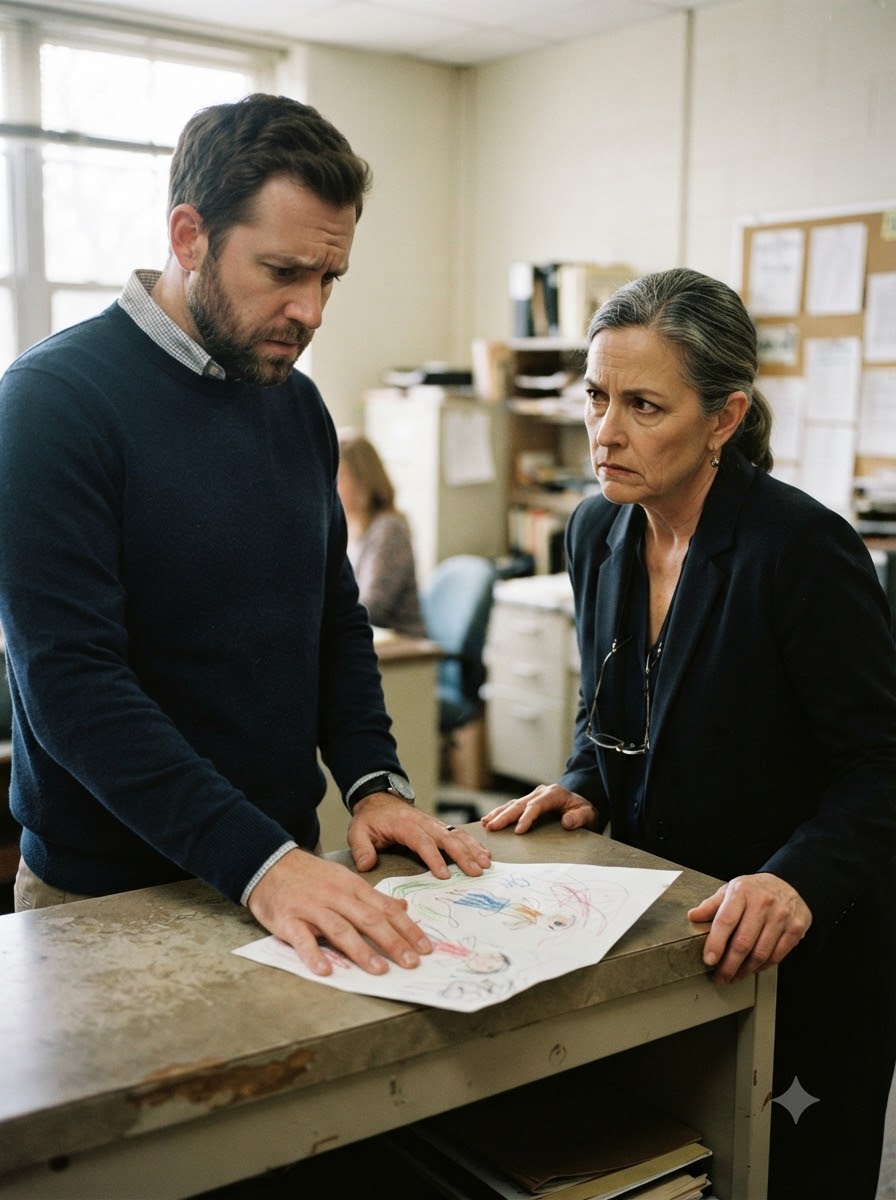
Valentina drew a chair.
It was a small wooden chair placed in the center of the page.
There was nothing around it.
No table.
No room.
No person.
Only violent red crayon marks circling it.
Daniel sat beside her.
“Would you like to tell me about your picture?”
Valentina pressed the crayon so hard it snapped.
“I like how you talk to me, Mr. Carter.”
Daniel felt his chest tighten.
He did not ask what she meant. He did not ask who had made her sit in the chair. He did not ask why the red marks were there.
He knew enough not to turn her trust into an interrogation.
“Thank you for telling me,” he said.
He placed the drawing in a folder and wrote the date, time, assignment, and Valentina’s exact words on a separate page.
On Friday afternoon, Daniel saw another piece of the truth at the front gate.
Valentina had been walking toward a tall man waiting beside a dented pickup truck. She stopped so abruptly that another child nearly collided with her.
The man wore a wrinkled work shirt. Dried paint covered his fingers. He had a cigarette tucked behind one ear.
“Hurry up,” he snapped. “I don’t have all day.”
Valentina lowered her head.
Daniel stepped outside.
“Are you Valentina’s father?”
The man turned.
“Stepfather.”
“I’m her teacher, Daniel Carter. I’m concerned about her. She told me earlier this week that she was in pain when she tried to sit.”
The man’s face changed.
The irritation vanished. What replaced it was colder.
He walked close enough for Daniel to smell cigarettes and paint thinner.
“You teach her letters, Mr. Teacher,” he said. “Don’t stick your nose where it doesn’t belong.”
Valentina stared at the pavement.
“Her name is Valentina,” Daniel said.
The man’s hand closed around her upper arm.
“Come on.”
Daniel saw Valentina flinch.
He also saw the man notice that he had seen it.
Then they walked away.
That evening, Daniel sat at his kitchen table with the police report, Valentina’s drawing, and a blank sheet of paper.
He wrote down everything he remembered about the man’s words.
He wrote the exact time he had seen Valentina at the gate.
He wrote the names of the children who had been nearby.
He called Officer Patel and made a supplemental report.
He also contacted the county child-protection hotline.
The intake worker asked whether he had evidence.
Daniel looked at the drawing.
“I have a child who said she was hurting,” he replied. “I have a drawing that concerns me. I have a witness to the stepfather’s behavior. And I have a principal who told me to keep quiet.”
“Do you have anything in writing from the principal?”
“Not yet.”
That changed on Monday morning.
Brooks arrived before the first bell. She did not knock before entering Room 12.
“Daniel. Office. Now.”
He picked up his folder.
Her eyes dropped to it.
“What is that?”
“Documentation.”
“We are not discussing this in front of children.”
“Then we can discuss it in the office.”
She turned sharply and started down the hall.
They had taken only a few steps when the front-office door opened.
Officer Patel stood inside with a county child-protection investigator named Rosa Martinez. Behind them was a uniformed detective Daniel had not seen before.
Principal Brooks stopped.
For the first time since Daniel had known her, her expression contained no performance.
Officer Patel looked at him.
“Mr. Carter, may we see the records you mentioned?”
Daniel placed the folder on the counter.
Brooks reached for it.
Patel moved between them.
“Please don’t touch that.”
“It’s school property,” Brooks said.
“No,” Daniel replied. “It is my documentation of a child-safety concern.”

More From This Author