STORY
Alicia Wanted My Bedroom for Her Parents—My Lawyer Found Another Plan
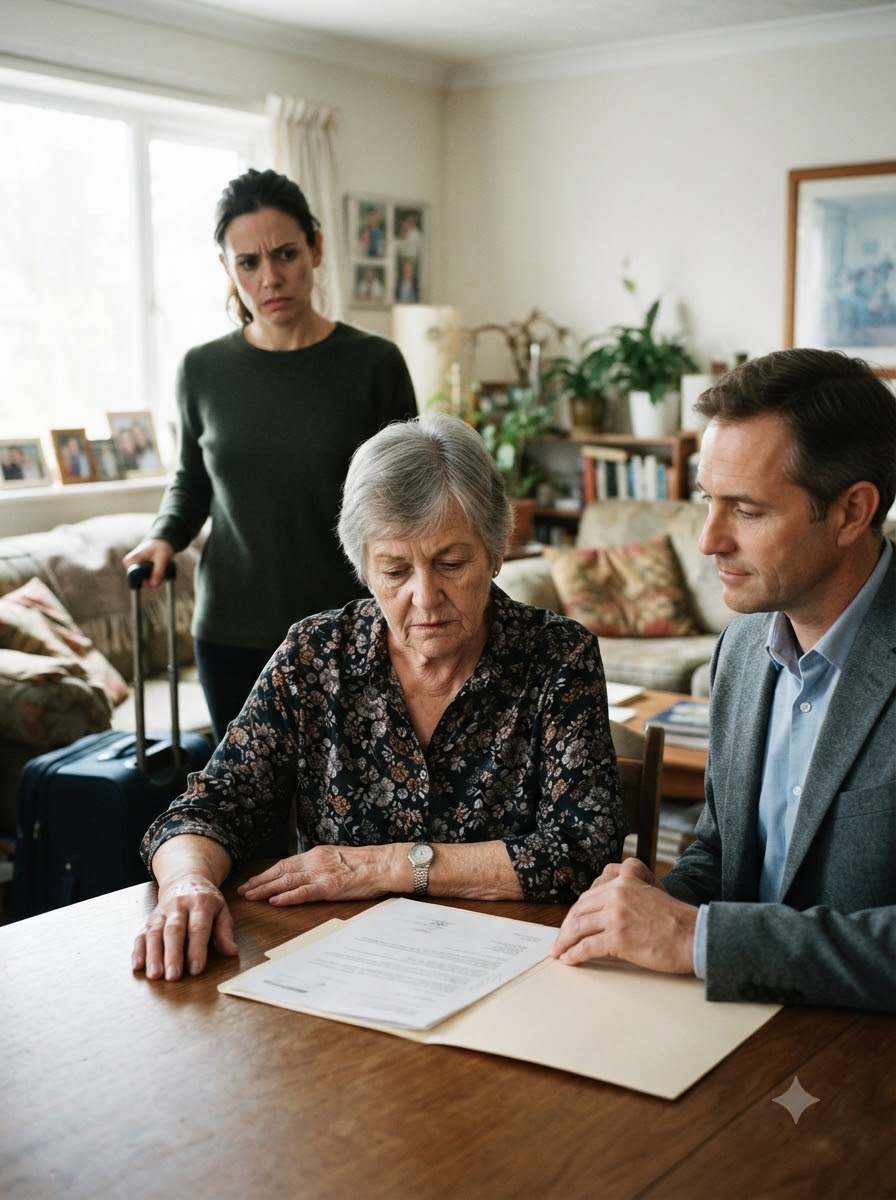
Alicia’s expression shifted.
It was the first time I saw fear.
She turned to him. “I said we would inherit it eventually. That is normal.”
“Not if your mother is alive,” I said.
“That’s not what this is about,” Alicia said. “This is about helping my parents.”
“Then why did you ask Mr. Harris how to transfer the house?”
Silence filled the room.
Fernando looked at me. “What?”
Mr. Harris opened the folder and removed a written record of the call from his office.
“Alicia contacted my staff on March ninth,” he said. “She asked whether she could obtain Consuelo’s property documents and arrange a transfer on her behalf.”
Alicia shook her head violently. “That is not true.”
“It is recorded in our office log. We also have the employee’s statement.”
“She misunderstood me.”
“She asked whether a daughter-in-law could sign for an elderly homeowner,” Mr. Harris continued. “The answer was no.”
Fernando’s face had gone pale.
Alicia pointed at me. “She is twisting everything. She has always hated me.”
I placed my phone on the table.
“Then explain these.”
I played the first recording.
Alicia’s voice filled the room.
She was speaking to her mother in the hallway.
Everything is going according to plan. She’s easy to manage. If she gets uncomfortable, she can go to a nursing home. That house is worth too much to waste on her.
Maribel’s face turned gray.
“That is edited,” Alicia whispered.
I played the second recording, captured after I had set my phone to record while working in the kitchen.
And the master bedroom is just the beginning. Once she signs, we can refinance it and pay off the credit cards. Fernando doesn’t need to know everything yet.
Fernando slowly turned toward her.
“What credit cards?”
Alicia’s lips parted.
For the first time, she had no prepared answer.
Mr. Harris removed another document from the folder.
“I also obtained a copy of a credit application submitted last month. It lists this property as collateral and gives a projected home-equity amount of two hundred and eighty thousand dollars.”
Fernando stared at the page.
“I never signed that.”
“No,” Mr. Harris said. “You did not.”
Alicia backed toward the staircase.
“Everyone is misunderstanding. I was trying to help us.”
“With money you did not own?” Fernando asked.
“You said your mother would help us.”
“I said nothing like that.”
“You don’t remember because you never pay attention!”
Her anger came out so quickly that even Maribel flinched.
I looked at Fernando, not Alicia.
“You told me you were saving for a house,” I said. “But your bank statements, which arrived here by mistake last month, showed nearly eleven thousand dollars in credit-card debt.”
Fernando closed his eyes.
Alicia had told him I had opened his mail. She had accused me of spying. I had apologized, though I had only seen the envelope on the floor and placed it beside his briefcase.
Now I understood why she had panicked.
Mr. Harris continued. “There is also the issue of the forged signature.”
He laid a copy of a draft quitclaim deed on the table.
My name was printed across the bottom. Underneath it was a signature that resembled mine from a distance, but not close up.
The final curve was wrong. Arthur had taught me to sign my name with a long upward stroke. Whoever had written it had stopped halfway.
I felt cold.
“Where did you get that?” I asked.
“From a title company,” Mr. Harris said. “They contacted my office after finding my name in the old file. Someone submitted it as a preliminary document.”
Alicia began to cry.
Not softly. Loudly, dramatically, as though tears could erase ink.
“I didn’t forge anything,” she said. “A broker prepared it. I never signed it.”
“Did you give them my information?” I asked.
She looked toward Fernando.
“Your mother was going to die and leave the house to you anyway. I was trying to protect our future.”
“That is not an answer.”
“You were going to put everything in a nursing home and leave us with nothing!”
“I was going to live in my own house.”
Maribel suddenly slapped Alicia across the arm.
“You told us the house was already promised.”
“I said she would give it to us!”
“You said the papers were almost done!”
Raul dropped into a chair, breathing heavily. “We packed everything.”
“I know,” I said. “But you cannot move in.”
Alicia wiped her face and turned on me again.
“You want to throw out your own son?”
“I am asking you and Fernando to leave.”
Fernando looked stunned. “Mom—”
“You have thirty days,” Mr. Harris said, handing him a formal notice. “During that period, you may remain as occupants under the terms listed here, provided there is no harassment, damage, unauthorized borrowing, or attempt to access Consuelo’s records. Alicia’s parents must leave today.”
Maribel opened her mouth.
Mr. Harris raised one finger. “If they remain after today, they will be trespassing. If anyone attempts to transfer, mortgage, or encumber this property again, Consuelo will pursue civil and criminal remedies.”
Alicia stared at him.
“You’re threatening me?”
“No,” he said. “I am explaining the consequences of what you have already done.”
The house fell silent.
Then Fernando walked upstairs.
A few minutes later, he came down carrying a small box. He set it on the table and removed several envelopes.
“What are these?” I asked.
“Mom’s property tax bills,” he said. “Alicia told me she was paying them.”
I opened the box.
The bills were unopened. Some were months old.
Mr. Harris checked the county account online. Two payments had been missed. A late notice had been issued.
Alicia had been telling me the taxes were current.
She had also been using the household account to pay her own phone, a furniture installment plan, and a collection agency.
Fernando found the statements in the desk drawer while looking for his birth certificate.
The final layer of the betrayal came from a place I had not expected: money meant for me.
After Arthur died, I received a small survivor’s pension. Alicia had convinced me to let her “organize” the automatic payments because she said I was forgetting bills.
For nearly two years, she had transferred money from that account to a payment app linked to her personal credit card.
The total was more than eighteen thousand dollars.
When confronted, she said it had been repayment for groceries, repairs, and “the privilege of having a roof over my head.”
Mr. Harris told her that argument would not survive an audit.
Alicia tried one last defense.
“I cared for her,” she said. “I cooked. I cleaned. I made sure she wasn’t alone.”
“You controlled who visited me,” I replied.
“You needed help.”
“You threw away Arthur’s things.”
“They were clutter.”
“You destroyed his roses.”
Her expression flickered.
“I didn’t touch those.”
Olivia spoke from the fireplace.
“I saw you with the bleach bottle.”
Alicia spun around. “You were spying on me?”
“No,” Olivia said. “I was standing at the side gate because you had locked Consuelo out of the house again. I saw exactly what you did.”

More From This Author