STORY
He Called Their Bedroom Dead—Then His Wife Learned What He Had Been Pretending to Feel
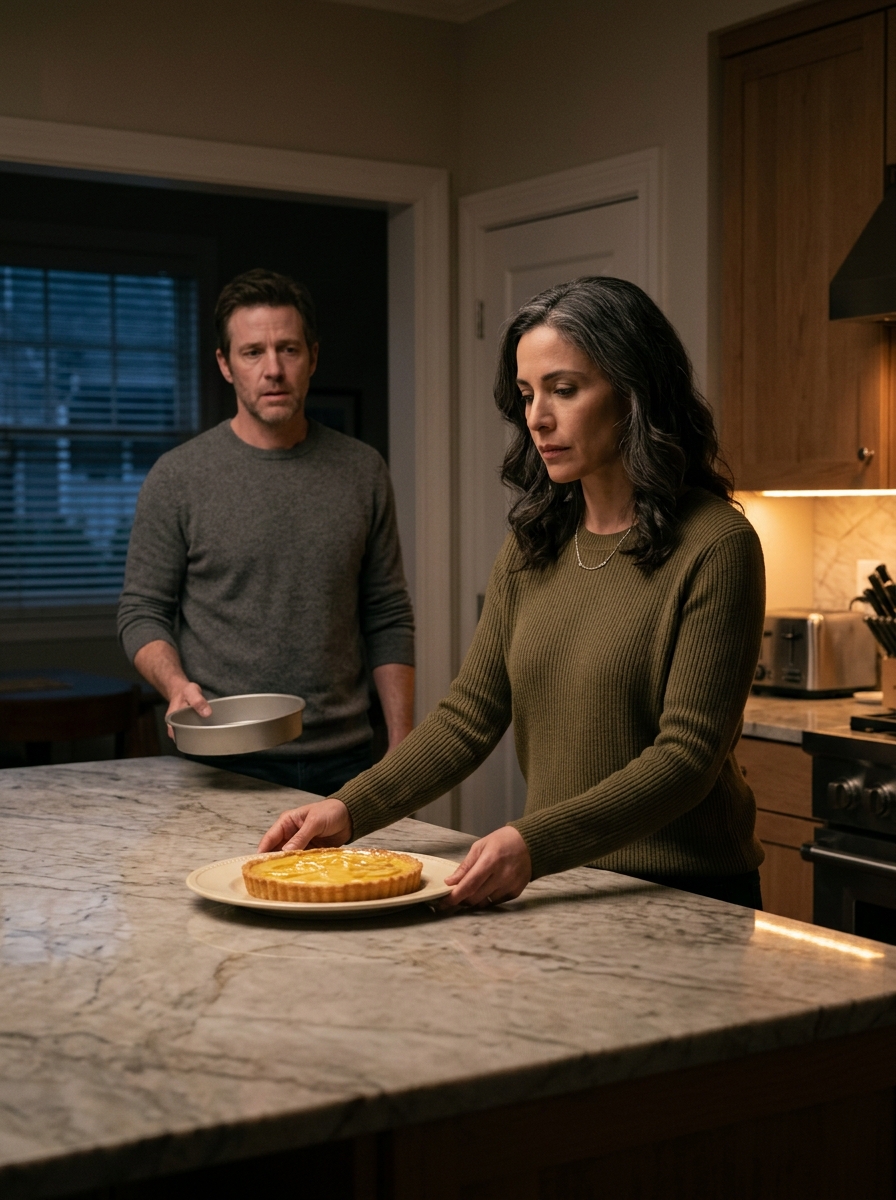
“How many times?” she asked.
“What?”
“How many times did you have sex with me because you thought I expected it?”
Bennett closed his eyes.
Mara felt the answer before he gave it.
“Most of the time,” he said.
The kitchen seemed to tilt.
She grabbed the edge of the counter. “Most?”
“Not because I was afraid of you.”
“I didn’t say you were.”
“Not because you pressured me. You didn’t. You were always clear when you wanted something, and you always stopped when I asked you to. But I thought wanting you was part of the job of loving you. And sometimes I thought if I began, the wanting would arrive.”
“And did it?”
“Sometimes I enjoyed being close to you. Sometimes I enjoyed making you happy. But I was always waiting for the feeling everyone described.”
Mara looked at him. “You made me the place where you went looking for it.”
“Yes.”
That was the first answer he had given that felt like the whole truth.
She sat down.
For a moment neither of them moved. The refrigerator hummed. A car passed on the street. Somewhere upstairs, the pipes clicked as they cooled.
Finally Mara said, “I don’t know what to do with this.”
“I don’t either.”
“You want to stay married?”
“Yes.”
“Do you want to have sex with me?”
Bennett looked devastated by the question, but he answered it.
“I don’t know if I can want sex the way you need a spouse to want it.”
“That wasn’t what I asked.”
“No.”
The word sat between them, plain and terrible.
Mara nodded as if he had confirmed a delivery time.
“Tomorrow,” she said, “we find a therapist. Tonight, you tell me the whole truth.”
He looked at the floor.
“If I tell you all of it,” he said, “you may find out you married a story I started telling before I knew it was fiction.”
***
They did not sleep in the same room that night.
Mara took the guest room, which contained a desk, two half-finished canvases, and a stack of old museum catalogs Bennett had promised to recycle. She shut the door but did not lock it.
Bennett remained in their bedroom.
At two in the morning, Mara woke to the sound of him walking through the hall. She could see his shadow beneath the door.
He stopped.
For one suspended second, she thought he might knock.
Then he continued toward the kitchen.
In the morning, she found him sitting at the table with a mug of coffee he hadn’t touched. He had changed into the same gray shirt he had worn the day before.
“Did you sleep?” he asked.
“No.”
“Me neither.”
She poured coffee and sat across from him.
He had written something on a sheet of paper. It was covered in crossed-out sentences.
“What’s that?”
“I tried to make a list.”
“Of what?”
“The truth.”
“Did you succeed?”
“No.”
Despite herself, she almost smiled. It disappeared quickly.
He turned the page around.
The first line read: I love Mara.
The second read: I may not experience sexual desire in the way she does.
The third read: I knew something was different before I admitted it.
The fourth read: I let her believe the difference was about her.
Mara read the list twice.
“You went to a doctor?” she asked.
“Yes.”
“When?”
“Last year.”
“And you didn’t tell me.”
“I thought it might be medical.”
“What did they say?”
“That my labs were normal. That stress could affect desire. That I should sleep more and exercise.”
Mara stared at him. “You went to a doctor, got told to sleep more, and decided to keep me in the dark?”
“I didn’t decide it all at once.”
“You decided it every day.”
“Yes.”
The agreement made her angrier than an argument would have.
He rubbed his palms over his face. “After the appointment, I started reading. At first I searched for things like ‘why don’t I want sex with my wife but still love her.’ Most of what I found was about affairs, pornography, hormones, depression, resentment. Then I found people talking about asexuality.”
“And you thought that was you?”
“I thought it might be.”
“Why didn’t you tell me?”
“Because I was afraid you would look back at everything and decide none of it had been real.”
Mara’s voice went quiet. “You were so afraid I would decide that you made sure I had to.”
Bennett nodded.
That was the worst part. He did not defend himself. He did not say he had been confused, or scared, or trying his best, though all of those things were true. He accepted the shape of the harm without trying to make it smaller.
Mara pushed the paper back toward him.
“I need to know what you mean when you say asexual.”
“I don’t have a perfect definition.”
“I’m not asking for a pamphlet.”
“I know.” He looked at the page. “I think it means I don’t experience sexual attraction often, or maybe at all. I experience romantic love. I experience affection. I can find someone beautiful. I can want closeness. But the pull toward sex that you describe—that urgency, that sense of looking at someone and wanting to cross a particular distance—I don’t think I have that.”
“Have you ever?”
“I don’t know.”
“You don’t know if you’ve ever wanted me?”
“I know I wanted you in my life. I know I wanted to marry you. I know I wanted your attention and your trust and the feeling of being the person you came home to. I don’t know whether I ever understood the other word correctly.”
Mara looked down at her coffee.
She had spent years assuming the opposite of rejection was desire. She had not known there were so many kinds of wanting, or that two people could use the same word while standing on different sides of it.
“Do you want me to stay?” she asked.
“Yes.”
“Why?”
“Because I love you.”
“That answer used to be enough.”
“I know.”
“No, you don’t.” She pushed back from the table. “Love is not the only thing I built my life around. I wanted to be married to someone who desired me. I wanted to be touched by someone who was choosing that touch, not completing a task.”
“I know.”
“If we stay together, I can’t become grateful for your honesty and then pretend the rest doesn’t matter.”
“I don’t want you to.”
“And I can’t promise I’ll be willing to live without sex just because you finally found a word that explains why you don’t want it.”
“You shouldn’t promise that.”
They sat in the kitchen until the coffee went cold.
***
Dr. Inez Park had an office above a bakery on the east side of town. Her waiting room held three chairs, a ficus tree, and a shelf of books about relationships that Mara distrusted on sight.
The first appointment was on a Wednesday afternoon.
Mara sat with her coat folded over her lap. Bennett sat beside her but did not touch her.
Dr. Park was in her forties, with close-cropped hair and a notebook balanced on one knee.

More From This Author