STORY
He Called Their Bedroom Dead—Then His Wife Learned What He Had Been Pretending to Feel
“What brought you here?” she asked.
Mara laughed softly. “He called our bedroom dead to his best friend.”
Dr. Park looked at Bennett.
“I did,” he said.
“And what did you mean?”
Bennett took a breath. “I may be asexual.”
Dr. Park nodded, not with surprise but with attention. “May be?”
“I’m still figuring it out.”
“That’s allowed.”
Mara glanced at her. “Is it?”
“It is not a diagnosis you have to prove to anyone. It is also not a word you get to use to avoid talking about the impact of your choices.”
Bennett nodded.
Dr. Park turned to Mara. “What do you need from this process?”
“I need to know whether our marriage was honest enough for me to consent to it.”
Bennett flinched.
Mara continued. “I’m not saying he forced me into anything. He didn’t. I’m saying I made decisions based on what I believed he felt. I believed he desired me. I believed the difference between us was temporary, or ordinary, or something we could talk about when life got less busy. I need to know what was true.”
Dr. Park looked at Bennett.
“What was true?”
“I loved her,” he said.
“That is not the only question.”
“I know.”
“What else?”
Bennett’s hands tightened around each other. “I enjoyed being close to her. I enjoyed making her happy. I sometimes wanted sex. I sometimes did not. I didn’t know that the difference mattered if I could still participate.”
Mara’s eyes burned.
Dr. Park said, “Participation and desire are not the same thing.”
“I know that now,” Bennett said.
“Does Mara?”
“I’m learning.”
Mara looked at him. “I know it now. That’s the problem.”
Dr. Park let the silence sit.
She did not rush to fill it with advice. That made Mara trust her more than she wanted to.
“What happened two years ago?” Dr. Park asked.
Mara looked down at her hands.
“We were at a hotel,” she said. “It was our anniversary. I tried to start something. He didn’t respond.”
Bennett stared at the floor.
“I asked him if he was attracted to me,” Mara continued. “He said yes. But he said it like he was reading the answer off a card.”
“I was terrified,” Bennett said.
“Of me?”
“Of what the question meant.”
Mara turned to him. “What did it mean?”
“That you were asking me for proof.”
“I was asking you for the truth.”
“I know that now.”
She faced Dr. Park again. “After that night, I stopped asking. He stopped initiating. We didn’t have a fight. There was no dramatic betrayal. We just walked around the missing thing as if it were furniture.”
Bennett said, “I thought I was giving her space.”
“She thought you were rejecting her,” Dr. Park said.
“Yes.”
“And you thought she no longer wanted you to initiate?”
“I thought she had stopped because I had made her feel unwanted.”
Mara let out a breath. “We both called it respect.”
Dr. Park leaned back. “You both treated ambiguity as a boundary.”
The sentence landed hard.
For the next hour, they talked about what Bennett could honestly offer and what Mara could honestly accept.
He could offer affection without promising it would lead anywhere. He could offer closeness, hand-holding, sleeping beside her, kissing when he wanted to kiss. He could not promise that desire would appear if they tried hard enough. He could not agree to sex as a marital duty.
Mara could offer patience while he explored his identity. She could agree not to measure his love by how often he initiated. She could not agree to erase her own sexual needs, and she could not promise that understanding his orientation would make those needs disappear.
At the end of the session, Dr. Park said, “Some couples find a way to build a marriage with little or no sex. Some negotiate outside relationships. Some separate. The goal here is not to make one option look more loving than the others.”
Mara looked at Bennett.
He looked back at her.
Neither of them said anything.
***
Three days later, Mara met Cal at a coffee shop without Bennett.
Cal arrived early. He stood when he saw her, then seemed unsure whether a hug would be welcome.
“Don’t,” Mara said.
He sat.
“I’m sorry you heard that way,” he said.
“That way?”
“You know what I mean.”
“I heard my husband say our bedroom was dead. You heard him say he was confused about his sexuality. Those are not the same thing.”
Cal nodded. “No. They aren’t.”
“Why did he tell you?”
“Because I asked him what was wrong.”
“Why?”
“He’s been disappearing from conversations for months. I’d ask how you were, and he’d say fine. I’d ask how he was, and he’d change the subject. Last week I told him he couldn’t keep making you live inside a mystery.”
Mara looked at the foam gathering around the edge of her coffee.
“He said he was practicing.”
“He did.”
“Practicing on you.”
“He didn’t tell me everything. He said he thought he might be asexual. He said he was scared you would think your whole marriage had been fake.”
“Was it?”
Cal’s face tightened. “That’s not mine to answer.”
“No. It isn’t.”
He took a sip of coffee. “For what it’s worth, I never heard him talk about another woman. I never heard him say he was bored with you or angry at you. He talked about you like you were the person he was most afraid of disappointing.”
“That does not make him honest.”
“No.”
Mara appreciated that he didn’t try.
“He had a witness,” she said. “I had a verdict.”
Cal looked down.
After a moment, he said, “I should have told him to go home and talk to you.”
“Yes.”
“I know that now.”
“No,” Mara said. “You know it because I’m sitting here.”
He accepted that, too.
When she left, Cal called after her. “Mara.”
She turned.
“He loves you.”
She held his gaze.
“Then he should learn that love is not a substitute for information.”
***
For two weeks, Mara and Bennett lived like careful tenants in the same apartment.
They texted each other about groceries. They discussed the mail. They slept in separate rooms. They avoided touching because every touch seemed to arrive with a question attached.
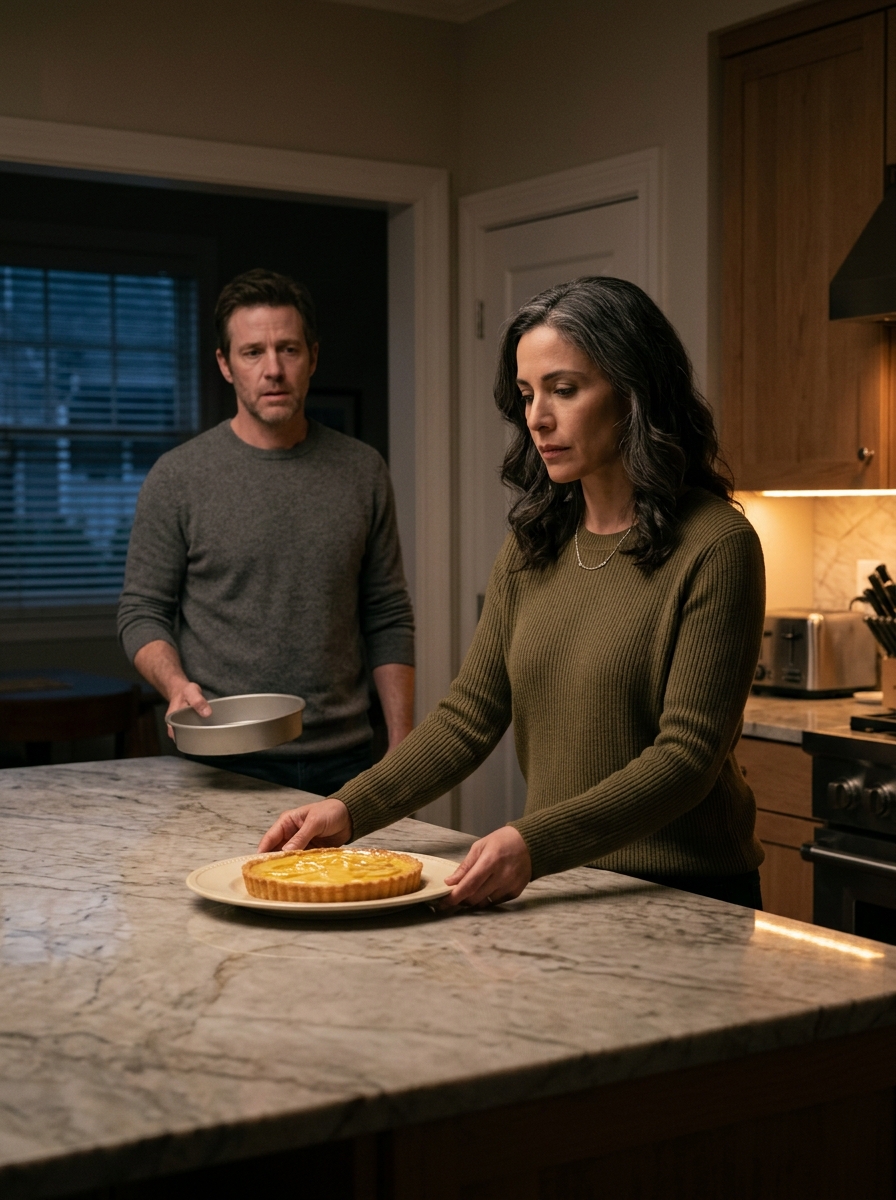
One evening, Bennett stood behind her while she washed a plate.
“Can I hug you?” he asked.
Mara kept her hands under the water.
“Why?”
“Because I want to.”
“Do you want to hug me, or do you want to demonstrate that you can still be affectionate?”
He went still.
The faucet ran between them.
“I don’t know how to answer that without making it worse,” he said.
“Try.”
“I want to hold you. I don’t know if that feeling is romantic, sexual, or simply familiar. But I want to hold you.”
Mara shut off the water.
“Then you can ask. I can decide.”
He waited.
She turned around. “Yes.”
He stepped close and put his arms around her.
The embrace was not dramatic. It did not unlock anything. It did not lead to a kiss or a confession or the sudden return of a marriage they had lost.

More From This Author