STORY
He Told His Best Friend Their Bedroom Was Dead—But His Reason for Stopping Wasn’t What His Wife Expected
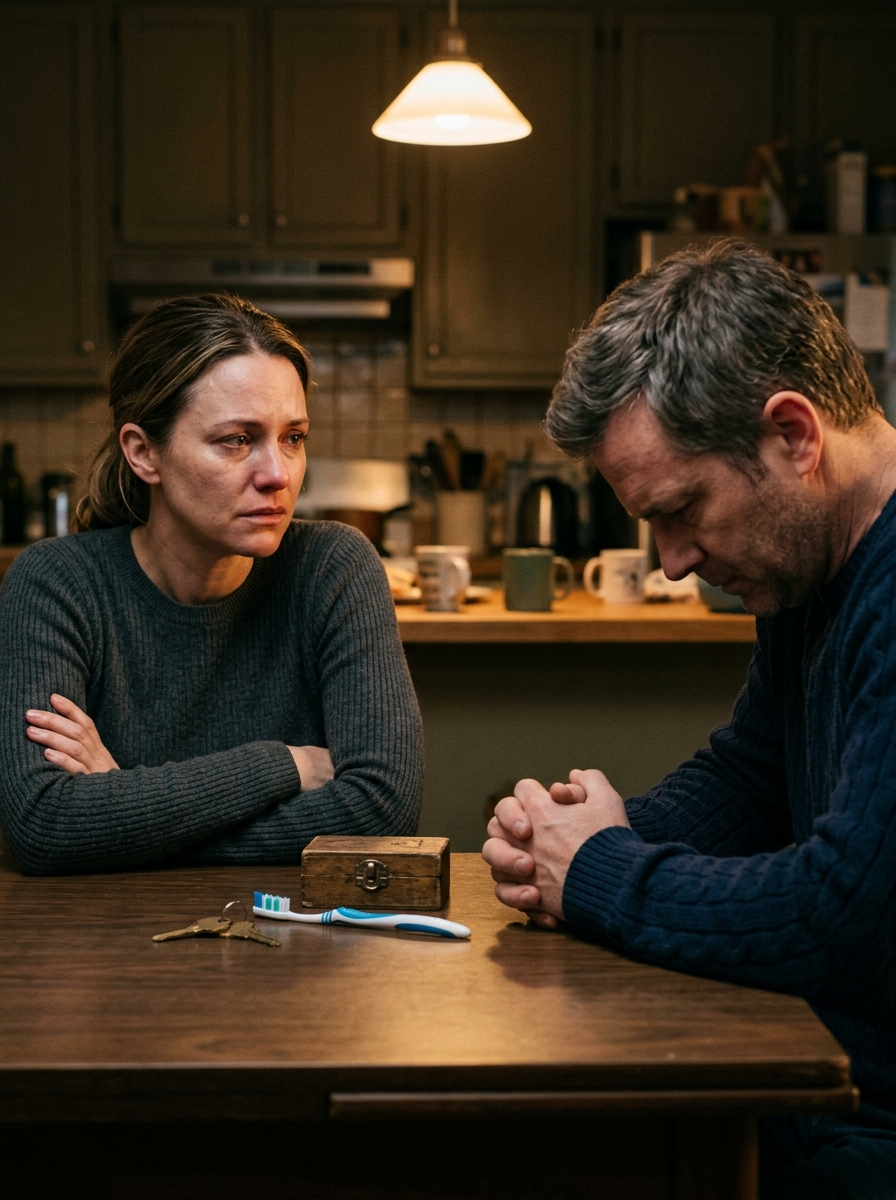
“That’s not an answer.”
“No. It isn’t.”
He looked toward the dark hallway.
“I can stay at Rafi’s.”
“For how long?”
“Two weeks.”
“Thirty days.”
He nodded.
They agreed to keep seeing Dr. Marin once a week. They would discuss bills and the house by text. They would not use the separation to provoke longing or punish each other. They would not date anyone else. At the end of thirty days, they would decide whether to return to the marriage deliberately or begin ending it deliberately.
It sounded clinical.
It also sounded more honest than anything they had done in two years.
***
Owen moved into the small apartment above Rafi’s catering kitchen.
Nora expected the house to feel relieved when he left. Instead, it felt badly balanced.
His boots remained by the door for three days before she realized they were there. She moved them to the closet, then moved them back. The empty side of the bed looked less like freedom than a missing tooth.
Owen texted about practical things.
The insurance payment is due Friday.
Your mother called the landline.
The garage window is sticking. Don’t force it.
The messages were so restrained that Nora began to miss his ordinary interruptions. She missed his habit of sending her pictures of badly repaired furniture. She missed the way he muttered at the kettle when it took too long to boil.
On the ninth day, she texted him first.
How is the table?
His answer came several minutes later.
The left leg is worse than I thought.
She stared at the message.
Is that about the table?
He replied with a photograph. The table had been turned upside down, its joints exposed. One leg was split near the base.
Nora laughed aloud in the empty kitchen.
The next therapy session was the first time they talked about missing each other without treating it as evidence that the separation had failed.
“I miss your actual self,” Nora told him. “Not the version of you I was trying to provoke.”
Owen nodded. “I miss you, not the version of you I kept waiting to come back.”
She looked at him. “I can’t promise that sex will become easy.”
“I don’t need easy.”
“I can’t promise it will happen soon.”
“I don’t need soon.”
“But I can’t stay in a marriage where we never talk about it.”
“I don’t want that either.”
She took a breath. “I can participate. I can tell you when I’m afraid. I can seek help instead of expecting you to guess. But I can’t perform recovery for you.”
“I can tolerate disappointment,” Owen said. “I can hear no without disappearing. But I need you to let me be a person who wants things, not a threat you have to keep neutralizing.”
Nora looked down at her hands.
“That’s fair.”
“It may not always feel fair.”
“No.”
They sat quietly.
Dr. Marin did not interrupt. She let them hear the shape of the agreement themselves.
After thirty days, Owen returned home.
Not permanently, they agreed. They were trying the house again for three months, with no promise beyond that. His clothes went back into the dresser. His toothbrush returned to the cup. The objects looked familiar but not innocent.
The first night, they slept in separate rooms.
The second night, Nora woke at two in the morning and found Owen sitting on the hallway floor, his back against the wall.
“What are you doing?” she asked.
“Trying to decide whether knocking would be asking too much.”
She leaned against the doorframe.
“You can knock.”
He did.
“Come in,” she said.
He entered the guest room and sat in the chair. He did not touch her.
Nora looked at him in the dim light.
“Do you want to kiss me?”
Owen’s breath caught. “Yes.”
The directness of his answer frightened her less than she expected.
“May I?” he asked.
“Yes.”
He crossed the room slowly. The kiss was brief, then awkward. Nora’s nose bumped his. Owen laughed under his breath, and she laughed too. The sound loosened something in her chest.
When he began to pull away, she caught his sleeve.
“Again,” she said.
He looked at her. “Are you sure?”
“Yes.”
The second kiss was softer. Still careful, but not ceremonial.
Afterward, Nora rested her forehead against his.
“I might want to stop,” she said.
“Then we stop.”
“I know.”
“No, I mean it.”
“I know,” she said again. “I needed to hear you say it without leaving.”
He stayed.
They did not have sex that night. They did not need to turn the kiss into a milestone. They went to sleep in separate rooms and spoke about it at breakfast, where Owen burned the toast and Nora accused him of using domestic incompetence as a coping strategy.
He said it was a hereditary condition.
For a while, progress looked like that.
A kiss that didn’t lead anywhere.
A question answered honestly.
A no that did not produce a silence lasting three days.
A yes that did not become proof that everything was repaired.
There were setbacks. Once, Nora stopped a kiss and Owen became so still that she had to remind him she had only changed her mind about that moment, not about him. Another time, Owen admitted he was lonely, and Nora heard accusation in the word. They argued in the laundry room until the dryer buzzed between them.
But they returned to the conversation.
Not gracefully.
Not every time.
They returned anyway.
***
The first time they were intimate again, it was nearly five months after Nora had heard Owen in the garage.
There was no plan. No anniversary. No carefully selected music or clean sheets.
They had spent the afternoon at a hardware store arguing over cabinet handles. Owen had bought the wrong ones. Nora had called them “aggressively ugly.” He had said she lacked vision.
That evening, they cooked soup and stood shoulder to shoulder at the counter.
At some point, Nora reached for his hand.
Owen looked down at their fingers, then at her.
“Do you want to go upstairs?” he asked.
The old fear moved through her, but it was no longer an order. It was information.
“I think so.”
“Okay.”
“And if I change my mind?”
“We stop.”
“And if you feel disappointed?”
“I’ll tell you. I won’t make it your punishment.”
She nodded.
Upstairs, they moved slowly. They talked more than either of them had expected. They paused. They laughed once because Owen’s elbow caught the lamp cord.
Later, Nora began to cry.
Owen went still.
She took his hand.
“Not hurt,” she said. “Just grief.”
“Do you want me here?”
“Yes.”
He stayed beside her without trying to turn the tears into a lesson or a crisis. Eventually, she fell asleep with her hand closed around his.
The next morning, nothing was magically different.
Nora still woke with uncertainty in her chest. Owen still had to fight the instinct to interpret every pause. The bedroom did not become a symbol of healing simply because they had crossed one threshold.
But they had crossed it together.

More From This Author