STORY
He Told His Best Friend Their Bedroom Was Dead—But His Reason for Stopping Wasn’t What His Wife Expected
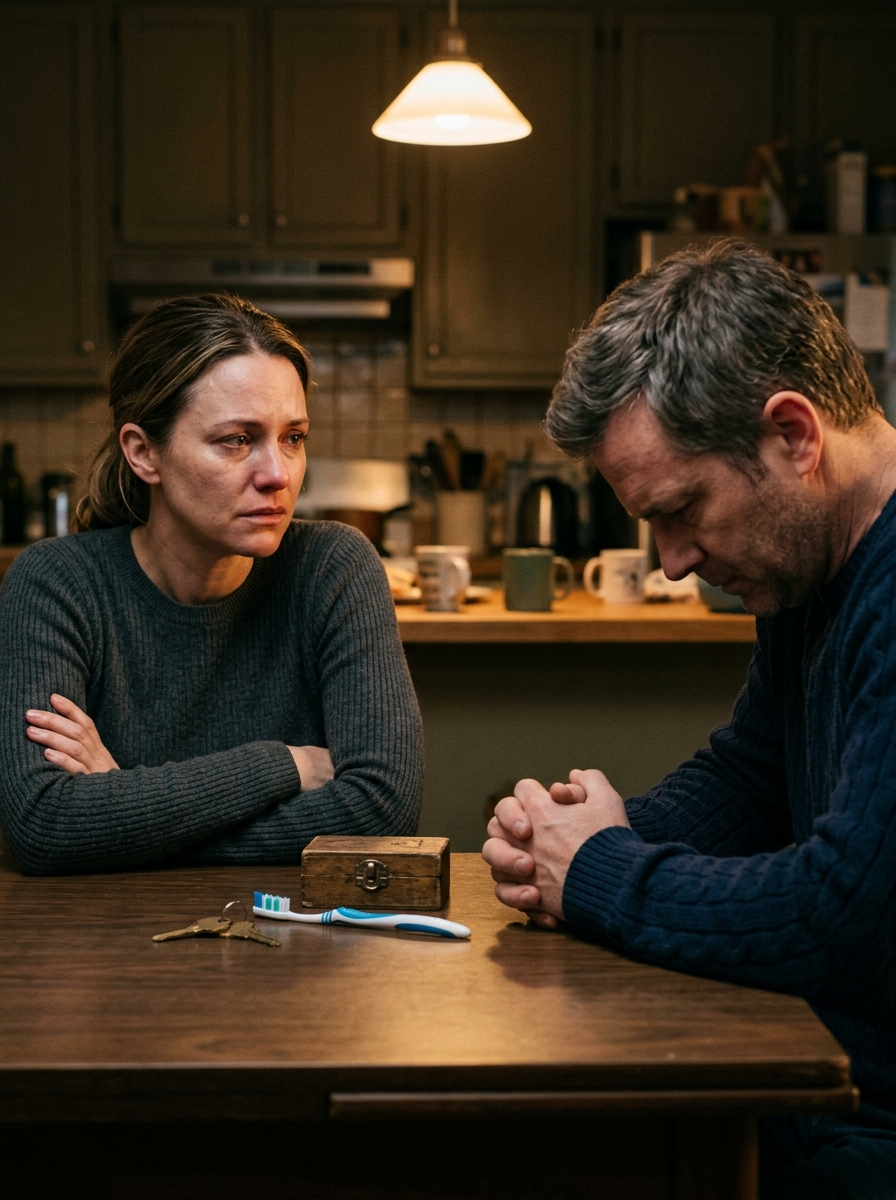
Nora opened the door.
“Before you say anything,” Rafi said, “I’m sorry.”
“You should be.”
“I know.”
He was forty-two, short where Owen was tall, with a shaved head and an exuberant mustache that made his serious expressions look slightly theatrical. He ran a catering company and had the blunt, practical manner of someone who believed most emotional crises could be improved by feeding people.
Nora crossed her arms. “Did he tell you I was the problem?”
Rafi’s face hardened.
“No.”
“Did he call me frigid?”
“No.”
“Did he say he wanted to leave?”
“He said he didn’t know how to keep living the way he was living.”
“That’s not an answer.”
“It’s the only one I’ve got.”
She let him in. Rafi placed the coffee on the entry table but didn’t drink it.
“Owen has been saying ‘fine’ for two years,” he said. “Not fine like a person who is fine. Fine like a man trying to make a door out of one syllable.”
“That sounds poetic for someone who once described his divorce as ‘a bad group project.’”
“I contain multitudes.”
“You also contain gossip.”
“I didn’t ask for details. He didn’t give me details. He said the bedroom was dead because he didn’t know what else to call the distance.”
“And you gave him advice?”
“I told him he was lonely.”
Nora’s throat tightened.
Rafi looked toward the garage. “Then I told him loneliness doesn’t become noble just because you suffer quietly. He got mad.”
“Did he say he wanted someone else?”
“No.”
“Did you suggest it?”
“I suggested he stop hiding behind the word respectful if what he meant was terrified.”
That sounded enough like Owen’s private shame that Nora had to sit down.
Rafi took the chair opposite her.
“He loves you,” he said. “I’m not saying that fixes anything. It doesn’t. But he has never talked about you like you’re defective or withholding or some villain in a story where he’s the patient husband. He talks about you like he’s afraid to touch a bruise.”
“That isn’t love if he leaves me alone with it.”
“No argument.”
“Why did he talk to you before me?”
“Because I asked him.”
“Why didn’t he tell me?”
Rafi gave her a tired look. “Because he’s Owen.”
“That is not a diagnosis.”
“No, it’s a recurring condition.”
Despite herself, Nora almost smiled.
Rafi went on. “He doesn’t know how to bring you a problem without also bringing a solution. When he couldn’t solve this, he decided silence was the closest thing to competence.”
She looked toward the hallway. The bedroom door was open. Owen had left it open since she woke.
“Did he tell you he was going to leave?”
“He told me he was thinking about moving out for a while.”
The room seemed to tilt.
“When?”
“Last night. Before you came home.”
Nora stood. “He was planning to leave?”
“He was thinking about it.”
“Did he tell you why?”
Rafi held her gaze. “He said he didn’t want to spend the rest of his life waiting for you to read his mind. Then he said he didn’t want to punish you for not reading it.”
That was the problem, Nora thought. Both of them had been asking the other person to perform an impossible kindness.
She wanted Owen to desire her without requiring anything from her.
He wanted Nora to invite him without making him feel that her invitation was a response to pressure.
They had built a marriage around two wishes that could not coexist unless somebody spoke plainly.
***
They talked again that night, this time in the bedroom.
Nora sat on the edge of the mattress. Owen remained by the door.
“You can come in,” she said.
He entered but didn’t close the door.
“Do you want it closed?”
“I don’t know.”
“Okay.”
The room looked exactly as it had for years. Their books crowded the nightstands. A blue sweater hung from the back of Owen’s chair. The quilt was folded at the foot of the bed because Nora was always cold and Owen was always warm.
There was nothing visibly wrong with the room.
That almost made it worse.
“Tell me what happened from your side,” Nora said.
Owen looked at the floor. “After you told me not to ask, I stopped.”
“I know that part.”
“I didn’t stop wanting you.”
She said nothing.
“I stopped trusting my wanting,” he continued. “Every time I thought about touching you, I imagined you saying yes because you didn’t want to hurt me. Then I imagined you resenting me for believing you. So I convinced myself that any desire I had was a kind of pressure.”
“You could have asked what kind of touch felt safe.”
“I should have.”
“You could have kissed me without assuming it had to become sex.”
“I know.”
“You could have told me you missed me.”
“I thought that would be cruel.”
“Why?”
“Because I did miss you. And I thought if I said it, you’d hear an assignment.”
Nora looked away.
She had hated his carefulness. She had also relied on it. His silence meant she did not have to say no. His distance meant she did not have to admit she still wanted to be wanted.
“I thought you didn’t find me attractive anymore,” she said.
Owen’s expression changed. “Nora.”
“I know what you’re going to say.”
“No, you don’t.”
She waited.
“I found you attractive all the time,” he said. “That was part of what scared me. I would look at you and want to close the distance, and then I’d see you get tired or quiet and decide that wanting you was something I had to manage privately.”
“You managed it so privately I thought it was gone.”
“I know.”
She pressed her thumb into the seam of the quilt.
“I thought you were waiting for me to become the woman I was before.”
“I was waiting for you to tell me who you were now.”
“Without asking?”
He nodded once.
Nora laughed, but there was no humor in it. “You made me responsible for reviving the whole thing.”
“Yes.”
“Did you know you were doing that?”
“Not at first.”
“When did you know?”
“About a year ago.”
“And you still didn’t say anything.”
“I was ashamed.”
“You were ashamed that you wanted your wife?”
“I was ashamed that I had made myself so helpless.”
She looked at him. He seemed older than he had the night before, not in his face but in the way he held his shoulders.
“I started seeing someone,” he said.
Nora went still.
“A therapist?”
“Yes.”
“For how long?”
“Six months.”
“You didn’t tell me.”
“I didn’t want you to think I was fixing you.”
“You thought I’d think that?”
“I thought you might think I was fixing us without asking whether you wanted to be fixed.”
She stood from the bed.
“So you kept therapy secret because you were respecting my autonomy?”
“That sounds worse when you say it like that.”
“It should.”
“I know.”
Nora walked to the window. Outside, the backyard was wet from overnight rain. The walnut table sat beneath the garage awning, its top sanded smooth and pale.

More From This Author