STORY
He Took a Six-Week Residency to Escape Their Silence—Then Told His Wife Why He’d Stopped Touching Her
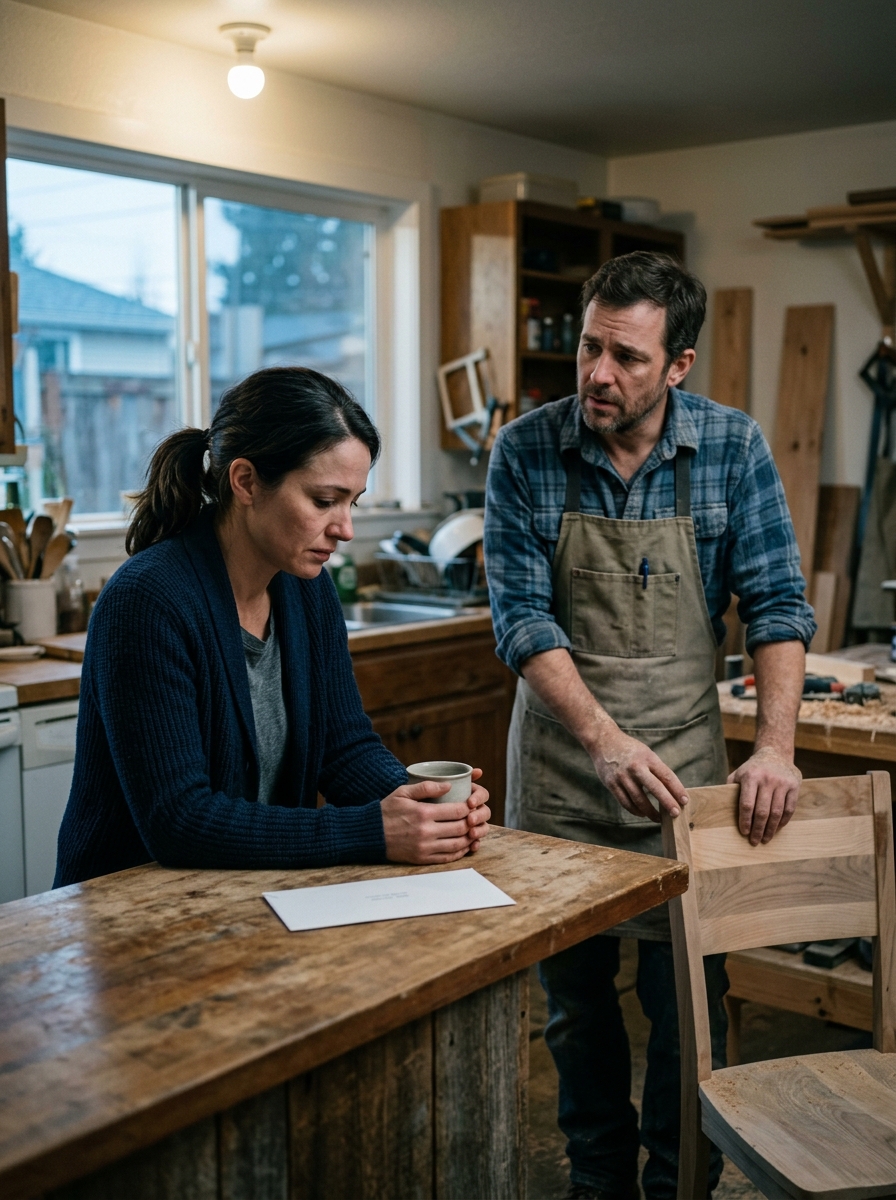
At the furniture shop, Tomas was sanding the curved arm of a walnut chair when Bren found him staring at the same section for five minutes.
“You’re going to sand through the joint,” Bren said.
Tomas set down the paper.
Bren was twenty-seven, impatient, gifted, and incapable of letting a question remain decorative.
“Rhea knows about Marlowe?” he asked.
“She does now.”
“You told her?”
“She found the acceptance.”
“Ah.”
Tomas gave him a look.
Bren raised both hands. “I’m not judging. I once accepted a job in Denver and told my girlfriend through a photo of a moving truck.”
“What happened?”
“She moved to Denver with someone else.”
“That’s not helpful.”
“It wasn’t meant to be.”
Tomas returned to the chair.
Bren leaned against the workbench. “Are you leaving because you want to leave, or because you want her to miss you?”
“I don’t want her to miss me as proof of anything.”
“That wasn’t my question.”
Tomas stopped sanding.
He thought of the residency: six weeks in a converted mill, working with a team to repair tables and beams salvaged from a demolished hotel. He had wanted it for years. He had also imagined the clean simplicity of being somewhere Rhea could not look at him with worry and he could not watch her disappear.
“I want to go,” he said.
“Then go.”
“It’s not that simple.”
“It usually is. The consequences aren’t.”
Tomas looked around the shop. The shelves, the clamps, the familiar scent of wood dust. He had built most of this place himself. He had built a life out of things that could be repaired if he paid enough attention.
Rhea was not a chair.
He had known that. He had still treated the problem like one.
That evening, he told her the truth.
“I want to go to Marlowe,” he said. “And I’m afraid that means I’m choosing myself in a way that leaves you behind.”
Rhea sat on the back steps with a blanket around her shoulders.
“You are choosing yourself,” she said.
He sat beside her.
“That doesn’t automatically mean you’re leaving me,” she continued. “But it does mean I can’t pretend your staying is proof that you love me.”
He looked at her. “Would you rather I cancel?”
“I would rather you want to stay.”
“That’s not the same question.”
“No.”
She pulled the blanket tighter.
“I want you here,” she said. “I don’t want you to cancel because I’m frightened. I want you here because you choose this life.”
Tomas took that in.
“I choose this life,” he said. “I also want the residency.”
Rhea nodded. “Both can be true.”
The sentence sounded like something Dr. Khatri would say, but it did not feel borrowed.
***
They made rules without calling them rules.
If Rhea said “pause,” Tomas would stop touching her. He would not ask whether she was sure, would not make his face neutral, and would not ask her to reassure him.
If Tomas wanted closeness, he would say what he wanted instead of circling it with casual contact and hoping she understood.
If Rhea wanted closeness but not sex, she would say that plainly.
Neither of them would keep a tally.
“No codes,” Rhea said. “I don’t want us to become air traffic controllers.”
“Plain words, then.”
“Plain words.”
“What if you go quiet?”
“I’ll try to tell you what’s happening.”
“And if you can’t?”
“Then you stop.”
Tomas nodded.
“What if you’re disappointed?” she asked.
“I’ll manage it.”
“You say that like it’s easy.”
“I didn’t say easy.”
“What if I’m disappointed?”
“You tell me.”
She gave him a sideways look. “You’re going to hate this.”
“Probably.”
That night, they sat on the porch without touching. The neighborhood moved around them: a dog barking two houses away, a teenager dragging a trash bin, the hiss of tires over wet pavement.
After twenty minutes, Rhea held out her hand.
Tomas took it.
A siren passed on the main road.
Rhea’s attention shifted. Her face emptied. Not dramatically. No sudden collapse. Just the small inward turn Tomas had learned to fear.
He released her hand.
She blinked.
“I’m at the desk,” she said.
“Do you want me to stay?”
“Not touching.”
He nodded and moved to the other end of the step.
Rhea breathed slowly. She watched the streetlight flicker against the wet sidewalk.
After a minute, she said, “You can come closer.”
“Do you want my hand?”
“Not yet.”
He stayed where he was.
She felt tears gather, which annoyed her. Everything seemed to produce tears lately: his patience, her exhaustion, the unbearable fact that he could stop without punishing her.
“You look relieved,” she said.
Tomas turned toward her. “I’m not.”
“You look like you’re trying not to be hurt.”
“I am trying not to make my hurt your job.”
The tears spilled over.
“I can’t tell the difference,” she said.
“Between what?”
“Your disappointment and my failure.”
Tomas’s face changed.
“Rhea, if we stop, I may be disappointed. That doesn’t make you a failure. It means I wanted something that didn’t happen.”
“Those are not separate things in my head.”
“Then we’ll keep separating them.”
She wiped her cheek with the heel of her hand.
“I’m sorry.”
“Don’t apologize for telling me the truth.”
“I’m not apologizing for that. I’m apologizing because I wanted to be different already.”
He looked at her for a long moment.
“You don’t have to perform progress for me.”
She almost laughed. “You really know how to make a woman feel seductive.”
“I’m working on my timing.”
This time, her laugh was real.
Later, in bed, Rhea told him what she had never said clearly.
“When I said, ‘I can do this,’ I thought I was being reassuring.”
“I know.”
“I wasn’t asking you to stop.”
“I know.”
“But I also wasn’t telling you I wanted to continue.”
Tomas stared at the ceiling.
“I should have stopped anyway.”
“Yes.”
He nodded.
“I should have asked differently,” he said.
“Yes.”
“I should have noticed the answer wasn’t actually an answer.”
“Yes.”
She turned toward him. “And I should have stopped offering a performance and calling it generosity.”
They lay in the dark with the truth between them.
It was not forgiveness. Not yet.
But it was more solid than the stories they had been telling.
***
Three days before the residency, Rhea asked Tomas if he could cancel.
She asked in the kitchen while he packed work shirts into a duffel bag.
“Can you?” she said.
He folded a shirt.
“Yes.”
“Will you?”
He stopped.
Rhea hated the pressure that entered the room. She had placed it there herself.
“I don’t know,” she said.
“You asked me to.”
“I asked whether you could.”
“That isn’t the same.”
“No.”
He sat on the edge of the bed.
Rhea remained by the dresser.
“I’m scared,” she said.
“I know.”
“I don’t want you gone.”
“I know.”
“I’m afraid you’ll discover you’re happier when I’m not there.”
Tomas looked at her. “That’s possible.”
She went very still.
He continued before she could disappear behind the desk.
“It’s also possible I’ll miss you and come home more honest. I don’t know. I can’t promise you an outcome just because you’re afraid.”

More From This Author