STORY
He Took a Six-Week Residency to Escape Their Silence—Then Told His Wife Why He’d Stopped Touching Her
“I didn’t know what would be honest.”
“What did you decide?”
“That I didn’t want the room to become a message.”
He nodded.
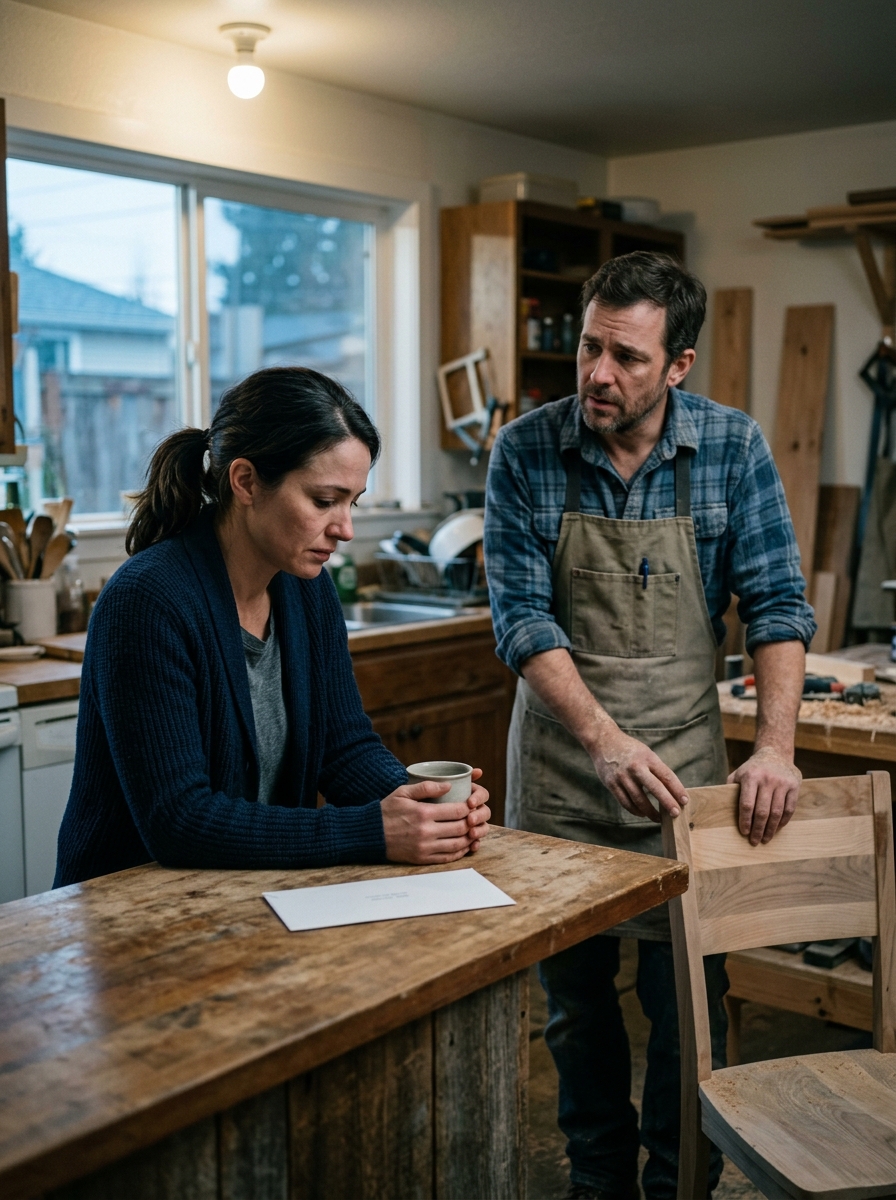
They made tea. They talked about the mill. Tomas described the staircase, the rot hidden beneath the surface, the way a beautiful structure could hold damage for years before anyone noticed.
Rhea listened.
Then she said, “I missed you.”
His eyes lifted.
“I missed being able to tell what you wanted,” she added. “I missed not having to guess whether wanting you was safe for you.”
“That’s not your job.”
“I know. But I missed it.”
He came around the counter but stopped a few feet away.
“Do you want me to kiss you?” he asked.
Rhea’s breath caught.
“Do you want to?”
“Yes.”
“Then yes.”
He crossed the space between them.
The kiss was not effortless. It was cautious in places and hungry in others, though neither of them used hunger as an argument. When Rhea pulled away, Tomas did not follow.
She touched his face.
“I’m here,” she said.
He nodded.
“And if I stop being here?”
“I’ll believe you.”
She kissed him again.
They did not return to the old marriage. There was no sudden restoration, no week when Rhea woke cured of the instinct to disappear. Tomas still occasionally mistook her quiet for rejection. Rhea still sometimes offered more than she wanted and had to take it back.
They continued seeing Dr. Khatri twice a month.
They slept separately when either of them needed space. They touched more often, but less automatically. Tomas learned that asking did not make desire less romantic. Rhea learned that saying no did not make her cruel.
Sometimes they stopped.
Sometimes they continued.
Neither outcome was allowed to become a verdict.
***
Three months after Tomas returned, a storm knocked out the power just after dinner.
They sat on the living-room floor with candles between them. Rain pressed against the windows. The house sounded unfamiliar without its appliances.
Rhea turned toward him.
“I want you to kiss me,” she said.
Tomas looked at her. “Now?”
“Now.”
“Do you want me to start?”
“Yes.”
He kissed her.
She stayed present through the first minutes. She felt his hand at her shoulder, the warmth of his breath, the rain ticking against the glass.
Then her attention began to drift.
Not vanish. Drift.
Tomas noticed.
“Pause?” he asked.
Rhea took a breath.
“No. Slower.”
He slowed.
A minute later, she placed her hand against his chest.
“Stop.”
He stopped.
The old panic rose in her: his disappointment, the closing door, the proof that she had failed again.
Tomas sat back.
Rhea looked at him. “Are you disappointed?”
“Yes.”
Her throat tightened.
“And glad,” he added. “I’m glad you wanted some of it. I’m glad you told me when you didn’t want more.”
She let out a shaky laugh.
“Those can live together?”
“They have to.”
Rhea rested her forehead against his.
“I can live with that too.”
They stayed on the floor while the storm moved over the neighborhood.
She was not in the room every second. Neither was he. But when she left it, she did not have to pretend she was still there. When she returned, she did not have to prove anything.
Tomas reached for her hand.
Rhea took it because she wanted to.
And when she let go, he let the truth remain exactly what it was: not rejection, not punishment, not the end of love.
Just information.
The kind they had finally learned how to receive.

More From This Author