STORY
I Sent Ethan Away After Amara Died—Priya Found the Report
The night I put Ethan’s backpack on the porch, he asked me one question.
“Did Mom know you felt this way?”
He was twelve. His mother had been dead for twenty-nine days. I had spent that afternoon taking her scarves out of the hall closet, and his backpack had been wedged beneath them. One strap was held together with gray tape. I set it beside him as if I were returning something he had left behind.
“No,” I said.
That was the first lie. Then I told him the truth I believed would set me free.
“You’re not my son. Your mother is gone, and I have no obligation to you.”
Ethan looked past me into the house. His shoes were still lined up beside the stairs. There was milk in the refrigerator he had put away that morning. He seemed to be waiting for me to say where he should go.
Instead, I stood in the doorway until he picked up his bag.
“Okay, Daniel,” he said.
He walked down our Columbus street without a coat. The porch light followed him as far as the corner.
When I shut the door, I felt relief. I have spent years looking for a kinder word for it, but there isn’t one.
Amara and I had been married six years. I had met Ethan when he was in kindergarten, a solemn boy who studied the instructions before opening a box of cereal. I taught him to ride a bicycle without training wheels. I paid for school trips and knew which library books were overdue. Yet in the private account I kept of my life, every one of those things was a favor.
Amara had told me Ethan’s father left before he was born. She had raised him alone. I never asked many questions about the man. Years before our marriage, Amara and I had dated briefly, then split after a stupid argument neither of us cared to remember when we found each other again. By then Ethan was six, and I accepted the story she gave me because it asked nothing further of me.
Her stroke came on a Tuesday morning. By Thursday, she was gone.
The house filled with people who brought food and told me to be strong. Ethan thanked each of them. At night, I heard him moving around his room, careful not to make noise. He made his own breakfast and left me the last clean spoon.
I mistook his care for proof that he did not need mine.
After he walked away, I called no one. I did not go looking for him. I told myself a neighbor would see him, then went upstairs and slept in the bed he had watched his mother die in less than a month before.
The next morning, there was a knock at the door. Our neighbor Rosa Alvarez stood on the step.
“Ethan is with me,” she said. “My sister works with a family-services agency. We’re calling them today.”
I remember being annoyed that she had come over, as though she wanted me to change my mind.
“Thank you for taking him in,” I said.
Her face hardened. “That isn’t what I came to hear.”
I closed the door. It was the last time anyone asked me to do right by Ethan while I still could.
Within months, I sold the house and moved to Cincinnati. I used the money to expand the small commercial lighting business I had started with a friend. Later I bought him out. I remarried. My second wife, Claire, knew Amara had died and knew I had once had a stepson. I told her he had gone to live with relatives.
I grew practiced at saying it without pausing.
Ten years passed. Then my office phone rang, and a woman invited me to the opening of the T.E.K. Gallery in Chicago.
“I don’t go to gallery openings,” I told her.
“Mr. Kapoor,” she said, “someone there wants you to see what became of Ethan.”
She gave me an address and said he knew I had been invited. I almost deleted the message she sent afterward. Instead, three days later, I stood outside a converted brick warehouse, telling myself I had come only to look.
Inside, people held paper cups of wine and spoke softly in front of large canvases. On the nearest wall was a painting of a boy seen from behind. A yellow porch light cut across the pavement. His backpack hung from one shoulder, its torn strap wrapped in gray.
The card beneath it read, “The Night I Learned What Leaving Meant.”
“He painted that from memory,” someone said.
I turned. My older sister Priya stood behind me with a slim folder against her chest.
I had seen her only twice since Amara’s funeral. She had called after I left Columbus, asking where Ethan had gone. I gave her the same answer I later gave Claire. Priya had never believed it.
“Where is he?” I asked.
“Here. He wanted me to speak to you first.”
She led me into a small office off the gallery floor. Through the glass wall, I could see visitors moving from painting to painting.
Priya put the folder on the desk but kept her hand over it.
“Ethan found me last year,” she said. “He was looking for people who knew Amara before she married you.”
“Why?”
“He had questions about his father.”
I sat down. For an instant, I thought she was about to name a man Amara had kept from him. Priya opened the folder and slid out a photograph.
It showed Amara and me outside a movie theater. I was wearing a green jacket I had lost years ago. She had her arm around my waist. We looked young and foolish and happy.
“This was taken in February,” Priya said. “You broke up in March. Ethan was born that November.”
I stared at the picture. “Amara told me she was seeing somebody else.”
“She was. Later. But Ethan wanted to know for certain.”
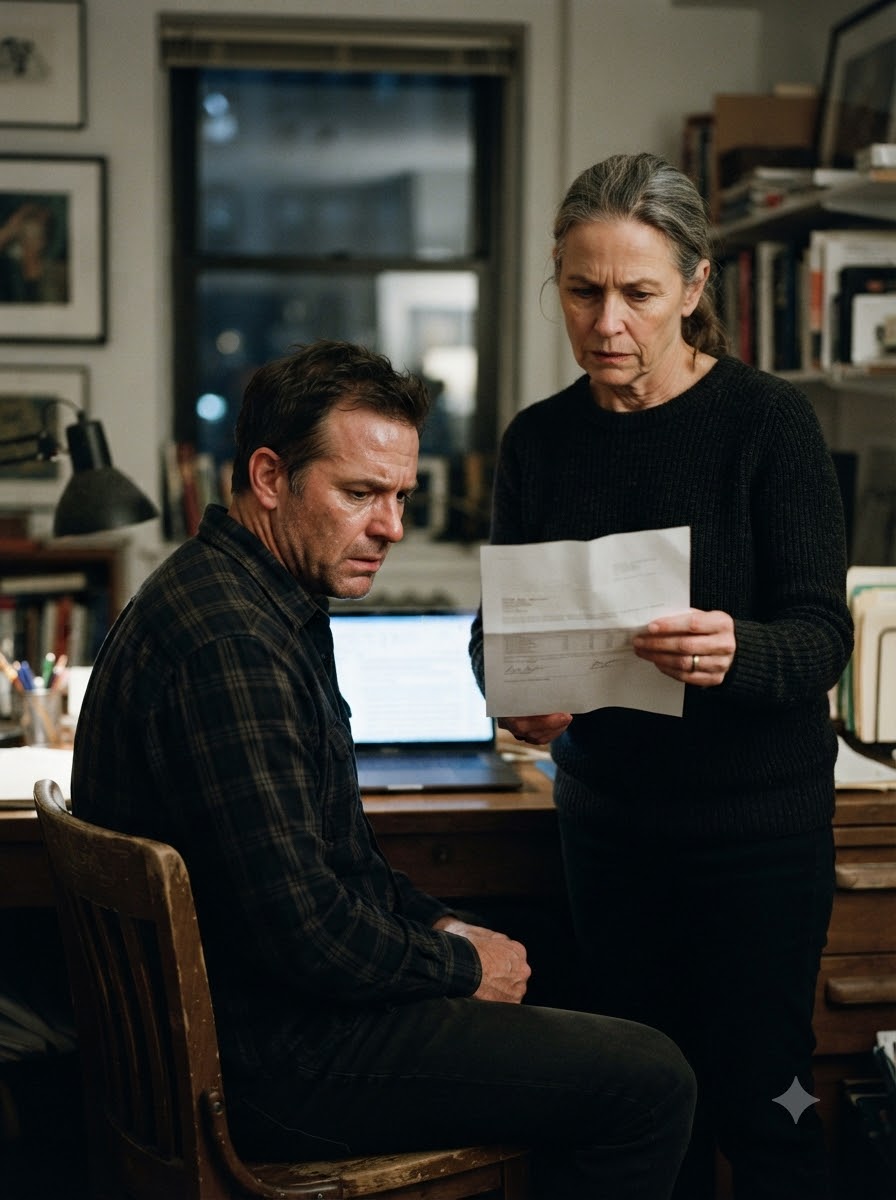
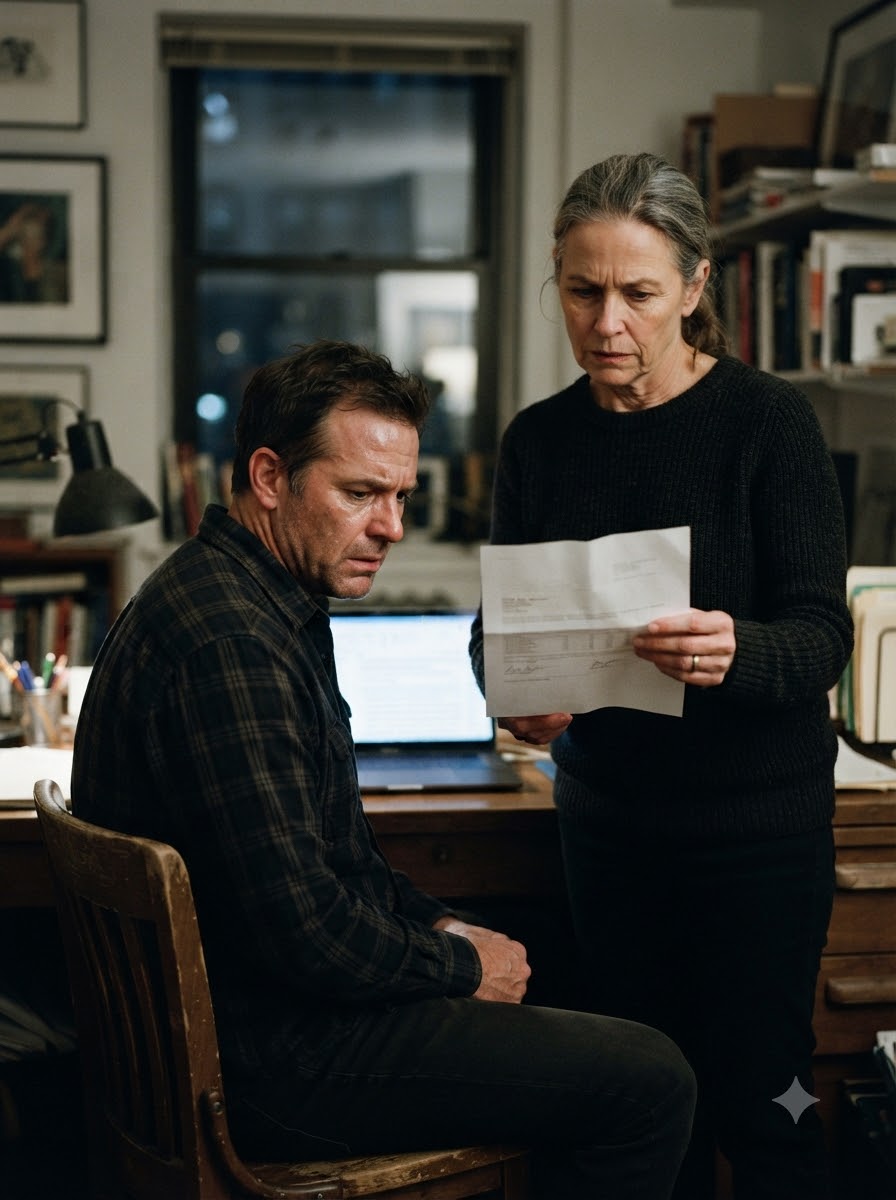
Priya laid a laboratory report beside the photograph. I read my name, then Ethan’s. Last week, at her request, I had mailed in a cheek swab. She had told me it was needed to settle a question about Amara’s estate. I had assumed it was a formality involving the sale of the house.
Now I saw what I had agreed to test.
The report gave the probability of paternity as greater than 99.99 percent.
“He’s my son,” I said.
Priya nodded.
I picked up the report, then set it down again. Ethan was my son. He had stood on my porch and asked if his mother knew I wanted him gone. I had told him he was not mine.
“Did Amara know?” I asked.
“That’s the question I hoped you’d answer.”
I shook my head. “She told me his father disappeared. Why would she lie?”
“I don’t know what she believed when he was born. She never told me she was sure.”
That answer should have made me think about how little I had wanted to know. Instead, I reached for anger.
“If she had any doubt, she should have told me.”

More From This Author