STORY
My Son Left the Steakhouse Bill—Then a Forged Deed Surfaced
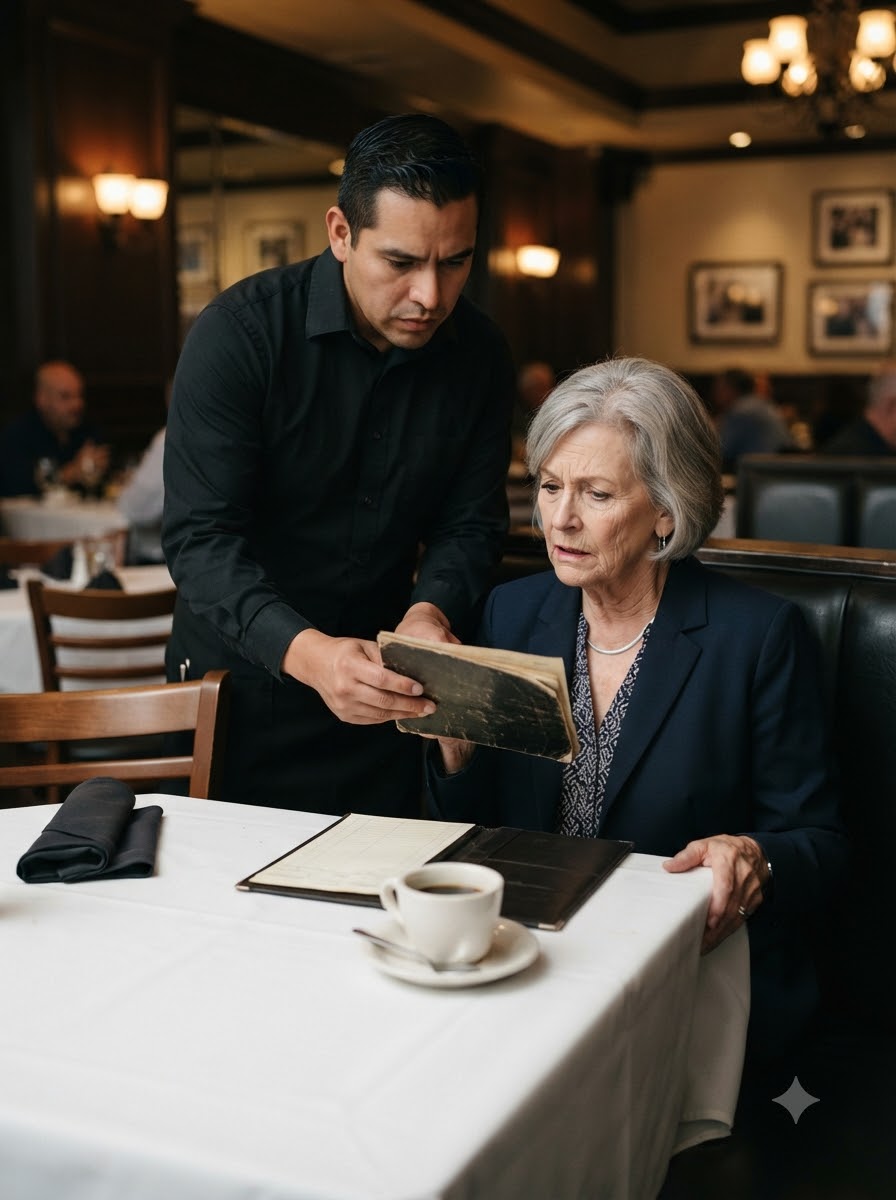
Adrian set the black leather folder beside my untouched wine and kept his fingers on it half a second too long.
“Will anyone be returning, ma’am?”
Behind him, the Sacramento steakhouse glittered with brass lamps, white tablecloths, and people celebrating things they could afford.
Across from me sat two empty chairs.
Fourteen minutes earlier, my daughter-in-law, Phaedra, had pressed manicured fingers to her temple and announced that a migraine was coming on. My son, Donovan, had gathered the children with astonishing speed.
“Take your time, Mom,” he’d said, kissing the top of my head. “Finish your wine.”
Then all six of them had disappeared through the front doors.
I opened the folder.
$942.16.
My filet had cost forty-eight dollars. The asparagus was twelve. My single glass of wine was seventeen.
I had not ordered the seafood tower, the bottle of 2014 Brunello, the Wagyu tasting flight, four specialty lemonades, or the parade of desserts Phaedra had encouraged the children to sample.
“Grandma loves spoiling everybody,” she had told them.
Apparently Grandma also loved tax and gratuity.
I looked at Phaedra’s chair. Her napkin lay crumpled on her plate, lipstick pressed around the rim of her water glass.
Donovan’s linen napkin was neatly folded beside his plate.
That was what settled it for me.
People flee emergencies. They do not fold their napkins first.
“Would you like a moment?” Adrian asked.
“Bring me a fresh black coffee,” I said. “And the dessert menu.”
He glanced toward the entrance, then back at me. His polished expression softened.
“Of course.”
For years, I had smiled because smiling was the fee I paid to remain welcome in my son’s life.
I smiled when Phaedra corrected how I spoke to the children.
I smiled when Donovan forgot my birthday but remembered to ask whether I still had the Tahoe sale records.
I smiled when they invited me to dinner, then let me discover that I was paying.
But sitting beneath that brass lamp, looking at my son’s carefully folded napkin, I felt something inside me become very quiet.
My husband, Roland, had been dead eight years.
He had been a patient man, but patience was not the same as weakness. I had spent too long confusing the two.
Adrian returned with my coffee. I photographed the empty chairs, the table, and the check. Then I called Roland’s oldest friend, Marshall Bell.
Marshall had spent forty-one years in corporate banking. Six months earlier, over lunch, he had shown me a photocopy of a document I had signed in 2021.
I had dismissed his concern.
“It was only Donovan’s home equity line,” I had said.
Marshall had studied me over his glasses.
“You know who you signed for, Camille. You don’t know what you signed.”
Now he answered on the third ring.
“Camille?”
“I’m ready,” I said. “Tell me what the line next to my signature means.”
There was a pause.
Then he said, “It means you’re not the borrower. You’re the beneficiary.”
The word seemed to ring against the wineglasses.
“Beneficiary of what?”
“The deed of trust on Donovan’s house. Your three hundred twelve thousand dollars was never recorded as a gift. Roland made sure of that.”
I closed my eyes.
In 2017, Donovan’s first business had collapsed. He and Phaedra found a large stucco house in the foothills, with six bedrooms, a pool, and a view of the valley.
The bank wanted a larger down payment.
I sold the Tahoe cabin Roland and I had owned for twenty-six summers.
Donovan had learned to swim off that dock. Roland had built the stone fireplace and cursed every rock in it. A blue enamel coffee pot had sat on the stove even after its handle loosened.
The sale gave me enough to wire Donovan $312,000.
He promised to repay me someday.
I told him not to worry.
What I had forgotten was that Roland, already ill, had asked our attorney to protect me. At closing, Donovan and Phaedra signed a promissory note. Their house secured the debt. My signature accepted the deed of trust as its beneficiary.
Four years later, Donovan came to me with another stack of papers.
He called it a formality for a $168,000 home equity line.
I signed where he pointed.
According to Marshall, I had not guaranteed that loan. I had agreed to move my lien behind the bank’s new one.
“And there’s more,” he said.
I stared at the dark surface of my coffee.
“Of course there is.”
“The note matured last year. They owe you the principal, plus interest. And I pulled an updated title report this morning.”
“This morning?”
“I’ve been worried since our lunch. Camille, your deed of trust was reconveyed three months ago.”
I knew enough to understand the word.
A reconveyance meant the debt had been declared paid and my lien released.
“But they haven’t paid me.”
“I know.”
“Then who released it?”
“The county record contains a request for full reconveyance bearing your signature.”
I placed my left hand flat on the table to stop it shaking.
“I didn’t sign anything.”
“I didn’t think you did.”
Adrian approached carefully.
“Is everything all right?”
“No,” I said. “But it will be.”
I showed him the bill and asked for an itemized breakdown by seat. He told me the restaurant’s ordering system recorded each item according to the guest who ordered it.
My meal, wine, tax, and proportional gratuity came to $103.84.
I paid that amount.
Then I asked for the manager.
Phaedra had reserved the table under her own name and left a card on file. The manager called her. She did not answer. He called Donovan. No answer.
I gave the manager their address and declined his offer to remove the remaining charges.
“They consumed it,” I said. “They can pay for it.”
Outside, I found three messages from Donovan.
The first said, Made it home. Phaedra’s resting. Thanks for understanding.
The second arrived nine minutes later.
Hope dinner wasn’t too crazy lol.
The third came after the restaurant manager reached him.
Mom, what the hell? Why did you refuse the bill? You embarrassed us.
For once, I did not reply.
The next morning, Marshall drove me to the county recorder’s office. We met Elena Ruiz, an attorney who specialized in real estate fraud and elder financial abuse.
Elena was fifty, direct, and so composed that panic seemed embarrassed in her presence.
She spread the documents across a conference table.
The first was the 2017 promissory note. Donovan and Phaedra had borrowed $312,000 from me at three percent interest, with payments deferred for five years. The entire balance had come due in 2022.
The second was my recorded deed of trust.
The third was the 2021 subordination agreement bearing my genuine signature.
“That signature proves you still considered the debt active in 2021,” Elena said. “It also proves Donovan knew the lien existed.”
Then she placed the reconveyance beside it.
Even before she explained, I saw the differences.
My real signature leaned slightly forward. The capital C in Camille had a narrow upper loop. The false one sat upright, its letters drawn with painful care.
The notary acknowledgment claimed I had appeared in person before a notary named Serena Pike.

More From This Author