STORY
She Hid Their Thursday Nights Inside “B-12 Preservation.” Her Husband Wanted to Know What, Exactly, They Were Preserving.
The assisted-living facility called to say she had become convinced someone had stolen a box of photographs. Sloane drove over after work and spent two hours searching through drawers while her mother followed her from room to room, frightened and angry.
When Sloane came home, she did not take off her coat.
Milo was at the table, repairing a small gear shifter. He looked up.
“Do you want help?” he asked.
“No.”
He set the tool down.
Sloane stared at the floor. “I don’t want solutions.”
“Okay.”
“I don’t want to talk about whether we’re okay.”
“Okay.”
“I want you to sit near me without trying to make me feel better.”
Milo pulled out the chair beside him.
She sat. For several minutes, neither of them spoke.
Then Sloane said, “She thought I had taken the photographs.”
“That sounds hard.”
“It was. And I knew she was confused, but I still felt accused.”
Milo listened.
Sloane told him about the box, the search, the photograph they eventually found tucked inside a cookbook. She told him her mother had looked at the picture and not recognized the people in it.
Milo did not reach for her until she leaned against his shoulder.
When she did, he placed his arm around her.
No one asked what the touch meant.
Later, Sloane said, “This is the first time in a long time I’ve wanted to be close to you without feeling like the closeness has to go somewhere.”
Milo rested his cheek against her hair.
“I’m glad,” he said.
He did not say, This is progress.
He did not say, We’re back.
He let the moment remain what it was.
***
At the end of the sixth week, they went to dinner at a small restaurant near the river.
The table was too narrow for distance, which made the conversation feel more intimate than either of them expected.
Sloane had ordered soup. Milo had ordered pasta and barely touched it.
“I love you,” she said.
He looked up.
“I’m not saying that as a conclusion.”
“I know.”
“I’m saying it because I need you to know that love is still here. But I can’t promise that love will always become desire on the schedule you want, or in the form you recognize.”
Milo looked out the window at the river lights. “I don’t know if I can promise I’ll never struggle with that.”
“I don’t need you to promise that.”
“I might feel rejected.”
“You probably will.”
“I might need to talk about it.”
“You can talk about it.”
“I might not be able to stay if we become roommates who occasionally try to convince each other we’re fine.”
Sloane absorbed that without flinching. “I don’t want that either.”
He reached across the table. His hand stopped halfway.
She turned her palm upward.
He took it.
“I don’t need predictable sex,” he said. “I thought I did because I thought predictability would keep me from feeling afraid. But what I actually need is to know that when you say yes, you’re not trying to prevent me from leaving.”
“And what do you need from me when you say no?”
“The truth. Not an explanation designed to make it easier.”
“That’s difficult.”
“I know.”
“I may not always know the truth immediately.”
“Then tell me that.”
She looked down at their joined hands. “I can do that.”
“And I need you to let me have a feeling without turning it into a consequence.”
“I can try.”
“I’ll try too.”
It was not a vow. It did not have the clean emotional shape of one.
But it was the first agreement they had made in years that did not require either of them to become less complicated.
They stayed married that night by choosing to stay—not because the calendar had been restored, not because intimacy had returned to a certain frequency, but because both of them accepted the marriage would have to contain uncertainty without disguising it as duty.
***
They moved back into the same bedroom the following week.
The first night, they slept on opposite sides of the bed.
The second night, Milo woke from a dream and found Sloane sitting upright beside him. She was staring at the window.
“What’s wrong?” he asked.
“Nothing specific.”
“Do you want company?”
She looked at him. “Yes.”
He sat up.
She took his hand and placed it between them. “I want to be near you.”
“Okay.”
“I don’t know what else I want.”
“Okay.”
The words no longer felt like a negotiation.
They talked quietly until nearly two in the morning. About work. About her mother. About the shop. About a house they had once considered buying and the reasons they had not. They laughed about the dog’s habit of stealing socks and hiding them beneath the couch.
At some point, Sloane leaned over and kissed him.
Milo returned the kiss, then waited.
She smiled against his mouth. “You can participate.”
“I’m trying not to assume.”
“You can want me without assuming what I want next.”
He nodded.
That distinction was not easy. It would not become easy just because they had finally named it.
But when Sloane drew him closer, he did not search her face for evidence. When she paused, he did not turn the pause into a verdict. When she said she wanted to stop, they stopped. When she reached for him again, the moment belonged to both of them—not to the calendar, not to the history of their refusals, not to the future they were afraid of losing.
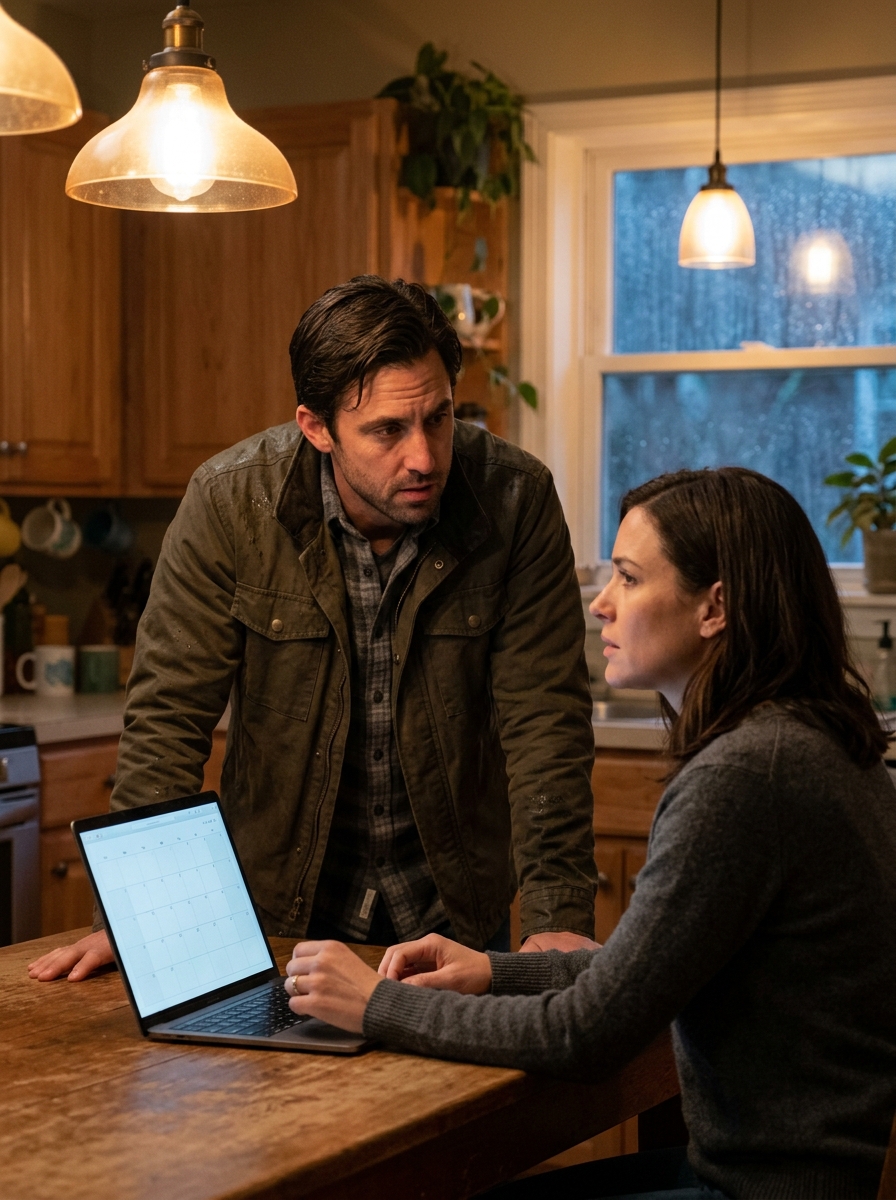
The following morning, Sloane opened the shared calendar.
The B-12 entries were still gone.
She created a new block for the next Thursday evening. The title was not romantic. It was not coded.
**Keep the evening open.**
Milo read it over her shoulder.
“What does that mean?” he asked.
“It means I want us to protect some time together.”
“For what?”
Sloane looked at him.
“I don’t know yet.”
He smiled.
She added one line to the notes: **No assignment. Either person can change their mind.**
Then she showed it to him.
Milo considered the words, then took the laptop and changed “Either person can change their mind” to “We tell the truth if we do.”
Sloane read the revision.
“That’s better,” she said.
On Thursday, he came home at six.
She came home at seven.
They ate leftovers and argued about whether the dog understood sarcasm. They washed the dishes together. At nine, Sloane stood in the kitchen doorway, the same place where she had once watched Milo discover the hidden calendar.
“I want to go upstairs,” she said.
He looked at her.
“Not because it’s Thursday,” she added.
“I know.”
“Do you?”
“Yes.”
“What do you want?”
Milo crossed the room. “I want you. I also want to be with you if what you want changes.”
Sloane breathed out, slowly.
That was not a guarantee. It was not a performance. It was not a promise that desire would always arrive on time.
It was simply enough truth for them to take the next step together.

More From This Author